Highlights

Third harmonic generation from collective modes in disordered superconductors

G. Seibold, M. Udina, C. Castellani, and L. Benfatto

Phys. Rev. B 103, 014512 (2021) - Published 20 January, 2021

The observation of third-harmonic generation (THG) in superconductors suggests that strong terahertz fields provide a preferential tool to excite collective excitations, e.g., the Higgs mode, which remain elusive in ordinary spectroscopy. From the theoretical point of view, disorder effects must be included. Here, the authors show that by treating disorder nonperturbatively the THG is strongly enhanced by disorder, and phase and charge fluctuations, neglected so far, give a substantial contribution to it. In addition, the computed polarization dependence of the signal within realistic band structures challenges the interpretation of recent experiments in cuprates.

Long-time relaxation dynamics of a spin coupled to a Chern insulator

Michael Elbracht and Michael Potthoff

Phys. Rev. B 103, 024301 (2021) - Published 20 January, 2021

The authors compute the dynamical phase diagram for the relaxation of a classical spin, exchange coupled to the local magnetic moment at an edge site of the one-dimensional spinful Su-Schrieffer-Heeger model. The role of the topological edge state and its internal Zeeman splitting for the spin-relaxation process, as well as incomplete spin relaxation on long time scales, can be explained within the framework of a renormalized linear response approach, when explicitly taking retardation effects and nonequilibrium spin-exchange processes into account.

Spin-polarized quantized electronic structure of Fe(001) with symmetry breaking due to the magnetization direction

E. Młyńczak, I. Aguilera, P. Gospodarič, T. Heider, M. Jugovac, G. Zamborlini, C. Tusche, S. Suga, V. Feyer, S. Blügel, L. Plucinski, and C. M. Schneider

Phys. Rev. B 103, 035134 (2021) - Published 20 January, 2021

Quantum well states are responsible for many fundamental phenomena that oscillate with layer thickness, such as magnetic anisotropy or magnetoresistance. Here, the authors present the magnetization-dependent quantized electronic states of Fe(001), mapped in unprecedented detail using spin-resolved momentum microscopy and high-resolution angle-resolved photoemission. The experimental observations are compared with photoemission simulations, based on the bulk initial electronic band structure, which include quantization of the initial states and broadening of the final states along the wave vector direction perpendicular to the sample surface.

Attractive and repulsive dipolar interaction in bilayers of indirect excitons

D. J. Choksy, Chao Xu, M. M. Fogler, L. V. Butov, J. Norman, and A. C. Gossard

Phys. Rev. B 103, 045126 (2021) - Published 20 January, 2021

A spatially indirect excitons (IX), also known as an interlayer exciton, is a bound pair of an electron and a hole confined in separated layers. IXs have permanent electric dipole moments that makes them a platform for exploring quantum gases with dipolar interaction. Here, the authors study attractive and repulsive dipolar interaction in bilayers of IXs. They find IX cloud spatial shift and monotonic IX energy reduction due to attractive dipolar correlations.

Spreading of correlations in Markovian open quantum systems

Vincenzo Alba and Federico Carollo

Phys. Rev. B 103, L020302 (2021) - Published 20 January, 2021

The spreading of information forms the basis of several quantum nonequilibrium phenomena, such as seen in the emergence of thermodynamics and statistical physics. Recently, much progress has been made in understanding the dynamics of information in isolated integrable systems after a quantum quench, by using a quasiparticle picture predicting ballistic spreading of quantum correlations. This paper shows how to apply these ideas to describe the dissipative dynamics of correlations and of entanglement in open quantum many-body systems.

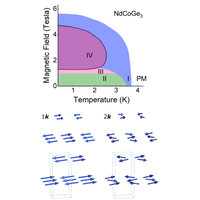
Complex magnetic phases in the polar tetragonal intermetallic NdCoGe3

Binod K. Rai, Ganesh Pokharel, Hasitha Suriya Arachchige, Seung-Hwan Do, Qiang Zhang, Masaaki Matsuda, Matthias Frontzek, Gabriele Sala, V. Ovidiu Garlea, Andrew D. Christianson, and Andrew F. May

Phys. Rev. B 103, 014426 (2021) - Published 19 January, 2021

Polar materials can host topological magnetic phases, which often emerge by applying a field to a modulated magnetic structure. Here, the authors investigate magnetism in the polar tetragonal material NdCoGe3 using physical property measurements and neutron diffraction. Detailed phase mapping reveals unreported magnetic phases, while neutron diffraction experiments demonstrate incommensurate magnetic order. The Nd moments are modulated in all lattice directions and candidate spin structures, include multi-k configurations. NdCoGe3 is thus a potential host of topological spin textures, which also implies that the related members of this material family may be of interest for similar reasons.

Self-consistent ladder dynamical vertex approximation

Josef Kaufmann, Christian Eckhardt, Matthias Pickem, Motoharu Kitatani, Anna Kauch, and Karsten Held

Phys. Rev. B 103, 035120 (2021) - Published 15 January, 2021

The dynamical vertex approximation and related methods represent a great leap forward in the description of nonlocal electronic correlations. It is based on a local two-particle irreducible vertex, from which the momentum-dependent self-energy is constructed via Bethe-Salpeter and Schwinger-Dyson equations. In this paper, the hitherto used one-shot calculations are improved by repeating these equations with feedback from the updated self-energy until self-consistency. The validity of the method is benchmarked by several numerical examples and, prominently, the formation of a pseudogap is demonstrated.

Solving the Bethe-Salpeter equation on a subspace: Approximations and consequences for low-dimensional materials

Diana Y. Qiu, Felipe H. da Jornada, and Steven G. Louie

Phys. Rev. B 103, 045117 (2021) - Published 15 January, 2021

It is known that the ambient environment can dramatically renormalize the electron excitation energies and the binding energy of the prominent excitons in low-dimensional materials, but the effect of the environment on the energy splitting of the spin-singlet and spin-triplet exciton states is less understood. Here, the authors derive a relationship between the extent of electronic states, the ambient screening, and the electron-hole exchange interaction and show that the singlet-triplet splitting in the energy of the excitons is largely unaffected by the external dielectric environment in quasi-two-dimensional materials.

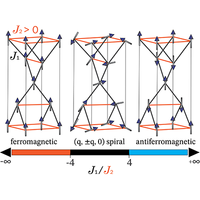
Frustrated Heisenberg J1−J2 model within the stretched diamond lattice of LiYbO2

Mitchell M. Bordelon, Chunxiao Liu, Lorenzo Posthuma, Eric Kenney, M. J. Graf, N. P. Butch, Arnab Banerjee, Stuart Calder, Leon Balents, and Stephen D. Wilson

Phys. Rev. B 103, 014420 (2021) - Published 14 January, 2021

ARO2 (A=alkali, R=rare earth) compounds are well known for forming layered triangular lattices, but they also form other structures. One of these is a three-dimensional tetragonal form chosen by LiYbO2, which is experimentally and theoretically explored in this paper. An unusual spiral magnetic state forms, reflective of frustration inherent to the stretched diamond network of Yb ions. This is modeled by a Heisenberg model, which further predicts a rich phase diagram for other ARO2 variants with the same structure.

Spin Weyl quantum unit: A theoretical proposal

Y. Chen and Y. V. Nazarov

Phys. Rev. B 103, 045410 (2021) - Published 12 January, 2021

Superconducting qubits are important for practical implementation of quantum computers. Here, the authors propose a novel type of the superconducting qubit: the spin Weyl quantum unit, a four-state hybrid quantum system that combines states of a spin and an Andreev superconducting qubit. They demonstrate how the unit can be manipulated to achieve an arbitrary unitary transformation in the space of four states by controlling the superconducting phase only, and a convenient readout.

Quasicrystalline electronic states in twisted bilayers and the effects of interlayer and sublattice symmetries

J. A. Crosse and Pilkyung Moon

Phys. Rev. B 103, 045408 (2021) - Published 11 January, 2021

Twisted bilayer graphene with a twist angle 30° is mapped onto a quasicrystal with a 12-fold rotational symmetry. The authors investigate the quasicrystalline electronic states for every possible two-dimensional twisted bilayer quasicrystal system. The quasicrystalline resonant interaction emerges at specific wave vectors from the combination of the rotational symmetry of the bilayers and the translational symmetries of the constituent layers, as long as all the dominant interlayer interactions occur between the atomic orbitals that have the same magnetic quantum number. In addition, the authors investigate the effects of lifting both interlayer and sublattice symmetry on the respective electronic structures.

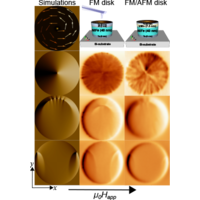
Direct imaging of distorted vortex structures and magnetic vortex annihilation processes in ferromagnetic/antiferromagnetic disk structures

Sri Sai Phani Kanth Arekapudi, Benny Böhm, Lakshmi Ramasubramanian, Fabian Ganss, Peter Heinig, Sven Stienen, Ciarán Fowley, Kilian Lenz, Alina M. Deac, Manfred Albrecht, and Olav Hellwig

Phys. Rev. B 103, 014405 (2021) - Published 6 January, 2021

Topological objects, such as magnetic vortices in soft-magnetic thin films, have attracted continued attention over the past 20 years for their unique magnetic reversal behavior and compelling potential applications. In exchange-coupled ferromagnetic/antiferromagnetic microdisks, high-resolution magnetic force microscopy imaging reveals a distorted ferromagnetic vortex structure due to randomly distributed (nonplanar) uncompensated spins at the antiferromagnetic/ferromagnetic interface. Further, in-field imaging and magneto-optical Kerr effect magnetometry demonstrate an unexpected increase in the stability of an otherwise somewhat volatile, intermediate vortex-antivortex state in exchange-coupled microdisks.

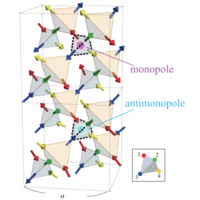
Hedgehog-lattice spin texture in classical Heisenberg antiferromagnets on the breathing pyrochlore lattice

Kazushi Aoyama and Hikaru Kawamura

Phys. Rev. B 103, 014406 (2021) - Published 6 January, 2021

The hedgehog lattice, a three-dimensional periodic array of magnetic monopoles and antimonopoles, is known to be realized in the presence of the Dzyaloshinskii-Moriya interaction (DMI). Here, the authors report a new mechanism other than the conventional DMI. They demonstrate that the hedgehog lattice can be induced by frustration in DMI-free antiferromagnets on the breathing pyrochlore lattice and that an applied magnetic field leads to a nonzero net spin chirality, which, in a metallic system, should yield the so-called topological Hall effect.

Magnetic surface reconstruction in the van der Waals antiferromagnet Fe1+xTe

C. Trainer, M. Songvilay, N. Qureshi, A. Stunault, C. M. Yim, E. E. Rodriguez, C. Heil, V. Tsurkan, M. A. Green, A. Loidl, P. Wahl, and C. Stock

Phys. Rev. B 103, 024406 (2021) - Published 6 January, 2021

Fe1+xTe is a two-dimensional van der Waals antiferromagnet that becomes superconducting on anion substitution on the Te site. Here, the authors present results from spherical neutron polarimetry and scanning tunneling microscopy probing bulk and surface magnetic structures, respectively. While both surface and bulk structures are collinear, the surface magnetism displays a large canting, not found with spherical neutron polarimetry. The authors demonstrate that Fe1+xTe exhibits a surface magnetic reconstruction when the symmetry constraints of the bulk are removed.

Skyrmion zoo in graphene at charge neutrality in a strong magnetic field

Jonathan Atteia, Yunlong Lian, and Mark Oliver Goerbig

Phys. Rev. B 103, 035403 (2021) - Published 6 January, 2021

Quantum Hall ferromagnetic and skyrmion states are commonly encountered in two-dimensional systems in a strong magnetic field. Graphene is special yet again: ferromagnetism does not only involve the spin of the electrons but also their valley “pseudospin.” Since at charge neutrality valley and sublattice are identical, a spin-valley skyrmion has a distinctive spin pattern on the sublattices. The authors characterize a whole skyrmion zoo, where one can obtain, for instance, local antiferromagnetic patterns if the skyrmion is formed solely by spins on a single sublattice.

Distinguishing antiferromagnetic spin sublattices via the spin Seebeck effect

Yongming Luo, Changjiang Liu, Hilal Saglam, Yi Li, Wei Zhang, Steven S.-L. Zhang, John E. Pearson, Brandon Fisher, Tiejun Zhou, Anand Bhattacharya, and Axel Hoffmann

Phys. Rev. B 103, L020401 (2021) - Published 6 January, 2021

Determining the magnetic structure of antiferromagnets is a fundamental challenge for the basic understanding and development of antiferromagnetic spintronic devices. However, apart from techniques that probe individual spins in antiferromagnets directly (such as spin-polarized scanning tunneling microscopy), there are few techniques that can provide independent information for each antiferromagnetic sublattice. Here, the authors demonstrate that spin Seebeck signals from the antiferromagnetic insulator Cr2O3 are controlled by surface spins, and independently detect the orientation of the two different sublattices purely electrically.

Convenient Peierls phase choice for periodic atomistic systems under magnetic field

Alessandro Cresti

Phys. Rev. B 103, 045402 (2021) - Published 5 January, 2021

Peierls phase factors multiplying the hopping elements of tight-binding-like Hamiltonians conveniently describe the effect of slowly varying magnetic fields on electrons. This paper provides practical recipes to determine Peierls phase factors such that they preserve the translation symmetry of periodic two-dimensional systems and of quasi-one-dimensional systems that are periodic or with periodic subcomponents, such as Hall bars, in the presence of a homogeneous magnetic field. This allows the applicability of convenient numerical techniques based on the spatial periodicity of the Hamiltonian as demonstrated here on some examples.

Fractons from polarons

John Sous and Michael Pretko

Phys. Rev. B 102, 214437 (2020) - Published 28 December, 2020

Fractons, as a new exotic quasiparticle, have attracted immense attention due to their unique properties. Here, the authors construct a connection between fractons and polarons. This allows them to derive explicitly microscopic models, in which polarons and their two-body bound states, known as bipolarons, map exactly on to fractons and their two-body counterparts, dipoles. As a specific example, the authors show how fractons and dipoles arise from magnetic polarons and bipolarons in hole-doped antiferromagnets, thus providing a route towards their physical realization.

Static magnetic proximity effects and spin Hall magnetoresistance in Pt/Y3Fe5O12 and inverted Y3Fe5O12/Pt bilayers

Stephan Geprägs, Christoph Klewe, Sibylle Meyer, Dominik Graulich, Felix Schade, Marc Schneider, Sonia Francoual, Stephen P. Collins, Katharina Ollefs, Fabrice Wilhelm, Andrei Rogalev, Yves Joly, Sebastian T. B. Goennenwein, Matthias Opel, Timo Kuschel, and Rudolf Gross

Phys. Rev. B 102, 214438 (2020) - Published 28 December, 2020

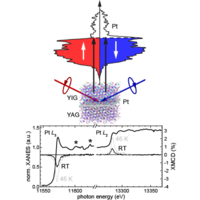
In spintronics and spin caloritronics, the understanding of spin angular momentum transfer across heavy metal/ferromagnetic insulator interfaces is of fundamental importance. There has been much controversy about the presence of magnetic proximity effects at such interfaces. Using element-selective x-ray and angle-resolved magnetotransport measurements, the authors present here a systematic study of Pt/Y3Fe5O12 heterostructures, with different order of the layer stacking resulting in different interface properties. They demonstrate that combined temperature-dependent x-ray and magnetotransport studies are essential to unambiguously confirm or exclude the presence of magnetic proximity effects.

Possible multiorbital ground state in CeCu2Si2

Andrea Amorese, Andrea Marino, Martin Sundermann, Kai Chen, Zhiwei Hu, Thomas Willers, Fadi Choueikani, Philippe Ohresser, Javier Herrero-Martin, Stefano Agrestini, Chien-Te Chen, Hong-Ji Lin, Maurits W. Haverkort, Silvia Seiro, Christoph Geibel, Frank Steglich, Liu Hao Tjeng, Gertrud Zwicknagl, and Andrea Severing

Phys. Rev. B 102, 245146 (2020) - Published 28 December, 2020

The heavy-fermion superconductor CeCu2Si2 is investigated with soft x-ray absorption spectroscopy in the temperature range from 250 mK to 250 K and the Jz admixture of the Γ7 ground-state wave function is determined. The overall temperature dependence of the experimental linear dichroism is reproduced well by the thermal occupation of excited crystal-field states so that the scenario of orbital switching seems unlikely. Spectroscopic evidence for the presence of the Ce 4f0 configuration in the ground state is consistent with the possibility of a multiorbital character of the ground state.

Sign In to Your Journals Account

Filter

Section

Filter

Article Lookup

Enter a citation