Highlights

Probing the topology of the quantum analog of a classical skyrmion

O. M. Sotnikov, V. V. Mazurenko, J. Colbois, F. Mila, M. I. Katsnelson, and E. A. Stepanov

Phys. Rev. B 103, L060404 (2021) - Published 12 February, 2021

The standard theory of magnetic skyrmions essentially relies on the assumption that the local magnetization is a classical vector. In this paper, the authors introduce a novel quantum skyrmion state, and show that this quantum analog of a classical skyrmion can be fully characterized by a local operator defined on three neighboring sites, the quantum scalar chirality. They show that this observable is nearly constant inside the quantum skyrmion phase and can thus be used as an effective topological invariant.

Moiré commensurability and the quantum anomalous Hall effect in twisted bilayer graphene on hexagonal boron nitride

Jingtian Shi, Jihang Zhu, and A. H. MacDonald

Phys. Rev. B 103, 075122 (2021) - Published 11 February, 2021

The quantum anomalous Hall effect sometimes occurs in twisted bilayer graphene when it is nearly aligned with an encapsulating hexagonal boron nitride (hBN) layer. The authors argue that the quantum anomalous Hall effect is likely only when the graphene/graphene and graphene/hBN moiré patterns are nearly commensurate. This picture gives rise to the series of “Hall windows” in the twist-angle space illustrated here.

Exchange interactions and sensitivity of the Ni two-hole spin state to Hund's coupling in doped NdNiO2

Xiangang Wan, Vsevolod Ivanov, Giacomo Resta, Ivan Leonov, and Sergey Y. Savrasov

Phys. Rev. B 103, 075123 (2021) - Published 11 February, 2021

The discovery of superconductivity in Nd1−xSrxNiO2 has resulted in a flurry of experimental and theoretical work to understand the nature of nickelate superconductivity as compared to that of the cuprates and pnictides. Here, the authors use a combination of LDA+U and linear-response methods to study the magnetic exchange interactions in Nd1−xSrxNiO2. The analysis reveals an underlying Mott insulating state comprised of Ni-3dx2−y2/Ni-3dz2−r2 orbitals with either an S=0 or S=1 two-hole ground state depending on the precise value of intra-atomic Hund’s coupling.

Electron thermalization and relaxation in laser-heated nickel by few-femtosecond core-level transient absorption spectroscopy

Hung-Tzu Chang, Alexander Guggenmos, Scott K. Cushing, Yang Cui, Naseem Ud Din, Shree Ram Acharya, Ilana J. P. Molesky, Ulf Kleineberg, Volodymyr Turkowski, Talat S. Rahman, Daniel M. Neumark, and Stephen R. Leone

Phys. Rev. B 103, 064305 (2021) - Published 10 February, 2021

Thermalization and relaxation of photoexcited carriers play an important role in ultrafast demagnetization and photoinduced phase transitions. However, direct observation of carrier thermalization in metals is highly challenging due to its fast timescale. Here, the authors track the thermalization and relaxation of photoexcited electrons in nickel in real time with few-femtosecond core-level transient absorption spectroscopy. In addition, a method to extract carrier temperature from the core-level absorption spectrum is proposed and verified by the experimental results. This enables further applications of core-level spectroscopy to explore element- and, hence, domain-specific carrier dynamics in metallic alloys and multilayers.

Fermi liquid theory sheds light on hot electron-hole liquid in 1L−MoS2

R. L. Wilmington, H. Ardekani, A. Rustagi, A. Bataller, A. F. Kemper, R. A. Younts, and K. Gundogdu

Phys. Rev. B 103, 075416 (2021) - Published 10 February, 2021

Room-temperature electron-hole liquid has recently been experimentally identified in low-dimensional transition metal dichalcogenides. Here, the authors demonstrate that a first-principles Fermi liquid model effectively predicts the photoluminescence response of this phenomenon. Using density functional theory, in conjunction with previous Raman and photoluminescence spectroscopy results, they present a consistent quantitative picture of the electron-hole liquid phase transition in suspended, heat-strained 1L-MoS2 monolayers. They show a 23-fold increase in photoluminescence per unit of direct gap carrier density and 9:1 indirect-direct hole population ratio at high strain.

Cavity optomechanics with a laser-engineered optical trap

P. Sesin, S. Anguiano, A. E. Bruchhausen, A. Lemaître, and A. Fainstein

Phys. Rev. B 103, L081301 (2021) - Published 10 February, 2021

Lasers are used to engineer effective potentials for photons and polaritons in semiconductor microcavities. Here, the authors show that vibrations can be cooled down in three-dimensional optical traps molded, tuned, and pumped with light. A photoelastic optomechanical coupling of g0/2π ~ 1.8 MHz is demonstrated in GaAs quantum well embedded resonators, attaining an optomechanical cooperativity C > 1 for milliwatt excitation. This allows the cooling of mechanical vibrations by more than 160 K from room temperature, with record frequencies as high as ~180 GHz.

Type-III Weyl semimetals: (TaSe4)2I

Xiao-Ping Li, Ke Deng, Botao Fu, YongKai Li, Da-Shuai Ma, JunFeng Han, Jianhui Zhou, Shuyun Zhou, and Yugui Yao

Phys. Rev. B 103, L081402 (2021) - Published 10 February, 2021

The Fermi surface plays a crucial rule in understanding the fundamental physics of crystals, such as superconductivity, the charge/spin density wave, and anomalous transport. Here, the authors discover the type-III Weyl semimetal, whose novel Fermi surface consists of two electron or hole pockets touching at the double Weyl points in Ta2Se8I, supporting the axionic charge density wave phase at low temperature. A unified and transparent picture to classify all of type-I, type-II, and type-III Weyl fermions based on the general tilting mechanism is also found.

Phase transition into an instanton crystal state

Grigory A. Starkov and Konstantin B. Efetov

Phys. Rev. B 103, 075121 (2021) - Published 9 February, 2021

In the context of condensed matter physics, instantons may be important for the description of quantum tunneling. However, they are typically irrelevant for the description of symmetry-broken states. Here, the authors propose a variant of the spin-fermion model, which exhibits a novel thermodynamically stable phase dubbed the “Instanton Crystal.” The intriguing feature of this phase is the configuration of the order parameter consisting precisely of an alternating chain of instantons and anti-instantons. Another interesting feature is a first-order phase transition between the instanton crystal phase and the normal symmetry-broken phase, characterized by a stationary order parameter.

Shortcuts to dynamic polarization

Tamiro Villazon, Pieter W. Claeys, Anatoli Polkovnikov, and Anushya Chandran

Phys. Rev. B 103, 075118 (2021) - Published 8 February, 2021

Dynamic polarization protocols aim to hyperpolarize a spin bath by transferring spin polarization from a well-controlled qubit. Building on techniques from shortcuts to adiabaticity, the authors characterize and design efficient dynamic polarization protocols in central spin models. These protocols maximize the transfer of polarization via bright states through local counterdiabatic driving, efficiently depopulate dark states, and can be experimentally realized through Floquet engineering provided a speed limit is satisfied.

Formation of short-range magnetic order and avoided ferromagnetic quantum criticality in pressurized LaCrGe3

Elena Gati, John M. Wilde, Rustem Khasanov, Li Xiang, Sachith Dissanayake, Ritu Gupta, Masaaki Matsuda, Feng Ye, Bianca Haberl, Udhara Kaluarachchi, Robert J. McQueeney, Andreas Kreyssig, Sergey L. Bud'ko, and Paul C. Canfield

Phys. Rev. B 103, 075111 (2021) - Published 4 February, 2021

Quantum criticality is believed to be avoided in ferromagnetic metals for fundamental reasons, which gives rise to a manifold of realized phase diagrams. Here, the authors revisit the temperature-pressure phase diagram of a prime example system (LaCrGe3), to explore the avoided criticality by thermodynamic and microscopic techniques. The results strongly suggest that a short-range magnetically ordered cluster phase emerges as the ferromagnetic transition is suppressed towards zero temperature. This insight points towards the influence of disorder that is inevitably present even in stoichiometric compounds.

Dynamics of a fractal set of first-order magnetic phase transitions in frustrated Lu2CoMnO6

Adra Carr, John Bowlan, Claudio Mazzoli, Colby Walker, Xiaxin Ding, Andi Barbour, Wen Hu, Stuart Wilkins, Jong Hyuk Kim, Nara Lee, Young Jai Choi, Shi-Zeng Lin, Richard L. Sandberg, and Vivien S. Zapf

Phys. Rev. B 103, L060401 (2021) - Published 4 February, 2021

Magnetic frustration can produce exotic spin configurations and dynamics. Here, the authors explore the seemingly simple competition between ferromagnetic nearest- and antiferromagnetic next-nearest neighbor interactions along Ising spin chains, as realized in the magnetoelectric compound Lu2CoMnO6. Commonly, this situation is described by the axial next-nearest-neighbor Ising model. For the first time, the authors measure and calculate its correlated magnetic dynamics, resulting from a characteristic fractal set of first-order phase boundaries. Experiments and Monte Carlo simulations reveal a dynamics slowdown while approaching the phase transition regime.

Limits to magnetic quantum criticality from nuclear spins

Heike Eisenlohr and Matthias Vojta

Phys. Rev. B 103, 064405 (2021) - Published 3 February, 2021

Quantum critical systems are generically susceptible to small perturbations. Here, the authors study how the hyperfine coupling to nuclear spins modifies magnetic quantum phase transitions. Symmetry arguments allow one to distinguish two generic scenarios: either the disordered phase remains intact, then leading to a shift of the transition point, or the disordered phase is destroyed by nuclear-spin induced order, then replacing the phase transition by a crossover. For both scenarios, relevant observables and crossover scales are obtained within explicit model calculations.

Microscopic diagnosis of universal geometric responses in fractional quantum Hall liquids

Liangdong Hu, Zhao Liu, D. N. Sheng, F. D. M. Haldane, and W. Zhu

Phys. Rev. B 103, 085103 (2021) - Published 2 February, 2021

Topological quantum liquids contain internal degrees of freedom that are coupled to geometric response. Here, the authors present a method, with the help of the Dehn twist on the torus geometry, to microscopically extract fingerprints (guiding center spin, Hall viscosity, etc.) of the underlying topological order from their geometric response.

Out-of-equilibrium phase diagram of the quantum random energy model

Giulio Biroli, Davide Facoetti, Marco Schiró, Marco Tarzia, and Pierpaolo Vivo

Phys. Rev. B 103, 014204 (2021) - Published 29 January, 2021

The quantum version of Derrida’s Random Energy model is the simplest model of a quantum glass. Here, the authors study its dynamical phase diagram, revealing the existence of three distinct dynamical phases: a many-body fully localized phase at low energy, an ergodic phase at high energy, and a multifractal “bad metal” phase at intermediate energy. In the latter, eigenfunctions occupy a diverging volume, yet an exponentially vanishing fraction of the total Hilbert space.

Floquet engineering of topological transitions in a twisted transition metal dichalcogenide homobilayer

Michael Vogl, Martin Rodriguez-Vega, Benedetta Flebus, Allan H. MacDonald, and Gregory A. Fiete

Phys. Rev. B 103, 014310 (2021) - Published 28 January, 2021

Motivated by the recent experimental realization of twisted transition metal dichalcogenide bilayers, the authors study the influence of different forms of monochromatic light on such materials. They consider irradiation with circularly polarized light in free space and longitudinal light, such as the one coming from the waveguide’s TM mode. Unlike irradiated twisted bilayer graphene, they find that the longitudinal light has a more interesting effect on the material and induces topological transitions.

Scanning SQUID characterization of extremely overdoped La2−xSrxCuO4

Chloe Herrera, Jacob Franklin, Ivan Božović, Xi He, and Ilya Sochnikov

Phys. Rev. B 103, 024528 (2021) - Published 27 January, 2021

When a scanning SQUID susceptometer – a mesoscopic quantum version of a mutual inductance sensor – hovers over a superconductor, it sees its own magnetic image reflected with a strength proportional to the density of the Cooper pairs. Here, a scanning SQUID was used to corroborate previous reports that the superfluid density in an extremely overdoped cuprate behaves unusually compared to conventional superconductors. The results obtained show the superfluid density is homogenous in space and linear with temperature, confirming that these characteristics are intrinsic electronic effects.

Probing giant Zeeman shift in vanadium-doped WSe2 via resonant magnetotunneling transport

Jinbao Jiang, Lan-Anh T. Nguyen, Tuan Dung Nguyen, Dinh Hoa Luong, Duk Young Kim, Youngjo Jin, Philip Kim, Dinh Loc Duong, and Young Hee Lee

Phys. Rev. B 103, 014441 (2021) - Published 26 January, 2021

Although room-temperature ferromagnetic semiconducting has been demonstrated in V-doped WSe2 monolayer with gate-tunable magnetic domains, there is no direct evidence for their spin-polarized band structure. Here, the authors report finding a giant Zeeman shift (a g factor up to 135) of the spin-polarized band edges of multilayered vanadium-doped WSe2, seen via magnetotunneling current measurement of a graphite/V-WSe2/graphite heterojunction. The direct observation of the spin-polarized band edges of V-WSe2 provides concrete evidence for the diluted ferromagnetic semiconductor of V-doped WSe2.

Nondiagonal anisotropic quantum Hall states

Pok Man Tam and Charles L. Kane

Phys. Rev. B 103, 035142 (2021) - Published 26 January, 2021

Using the coupled wire construction, the authors investigate a novel Abelian quantum Hall state that possesses a symmetry-enriched topological order given a combination of internal and spatial symmetry. This is termed the “nondiagonal” state due to its relation to nondiagonal conformal field theory, and is characterized by quasiparticles with constrained motion, whose braiding statistics features a marriage of Laughlin state and ℤp toric code. Dislocations in the wire model act as twist defects that implement the e↔m anyonic symmetry.

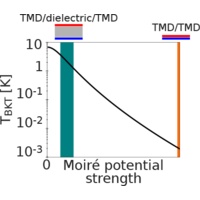
Key role of the moiré potential for the quasicondensation of interlayer excitons in van der Waals heterostructures

Camille Lagoin and François Dubin

Phys. Rev. B 103, L041406 (2021) - Published 26 January, 2021

Transition metal dichalcogenides (TMD) bilayers offer a new platform to study Bose-Einstein condensation of excitons and its related superfluidity. Here, it is shown that such collective quantum phenomena are possibly accessed below around 10 K when a high-k dielectric spacer separates the two TMD monolayers. Without this spacer, interlayer excitons explore a deep moiré potential and their effective mass is increased by orders of magnitude, so that quantum statistics plays no role under experimentally accessible conditions.

Theories for the correlated insulating states and quantum anomalous Hall effect phenomena in twisted bilayer graphene

Jianpeng Liu and Xi Dai

Phys. Rev. B 103, 035427 (2021) - Published 25 January, 2021

Based on an all-band moiré Hartree-Fock variational method, the authors study theoretically the correlated and topological states in magic-angle twisted bilayer graphene. They construct phase diagrams at various integer fillings. In particular, a so far unknown quantum state of matter, the moiré orbital antiferromagnetic state, is identified as the possible ground state at some fillings.

Sign In to Your Journals Account

Filter

Section

Filter

Article Lookup

Enter a citation