Highlights

Enhanced quality factors at resonance in acoustofluidic cavities embedded in matched elastic metamaterials

Valdemar Frederiksen and Henrik Bruus

Phys. Rev. Applied 25, 054026 (2026) - Published 11 May, 2026

Microscale ultrasound acoustofluidics has become an important tool for handling cells and microparticles in lab-on-a-chip technology, but it fails in separation and focusing of submicrometer particles, due to dissipation processes in the viscous boundary layer. Here a theoretical proof-of-concept analysis shows that by embedding the microfluidic channel in a properly designed fused-silica metamaterial, the vibrational motion of the fluid and the metamaterial can be matched, which prevents formation of the viscous boundary layer. This increases the Q factor of the ultrasound resonance modes by several orders of magnitude, reduces acoustic streaming, and enables nanoparticle focusing.

Diamond-based magnetometer aboard the International Space Station

Yarne Beerden, Boo Carmans, Remy Vandebosch, Dries Hendrikx, Sam Bammens, Musa Aydogan, Siemen Achten, Jeffrey Gorissen, Sebastiaan Vanspauwen, Siemen Vandervoort, Teoman Köseoglu, Jens Mannaerts, Stijn Jacobs, Daphne Box, Milos Nesladek, and Jaroslav Hruby

Phys. Rev. Applied 25, 054017 (2026) - Published 7 May, 2026

Precise mapping of the geomagnetic field is essential for geophysics, space weather, and navigation, but current magnetometers are limited by sensitivity, dynamic range, and compactness. The authors present the OSCAR-QUBE quantum magnetometer based on nitrogen-vacancy centers in diamond, achieving vector magnetic-field measurements aboard the International Space Station in a compact device with sensitivity below 300 nT/√Hz. They further validate its performance through direct comparison to geomagnetic field models, showing good agreement with the expected field in low Earth orbit. This establishes diamond-based quantum magnetometry as viable for compact, high-performance space missions.

Synthesis of artificial transmission lines tailored for traveling-wave parametric processes

M. Malnou

Phys. Rev. Applied 25, 054016 (2026) - Published 6 May, 2026

Traveling-wave parametric amplifiers (TWPAs), essential components of superconducting quantum processors, are built from artificial transmission lines for which dispersion relations must be tailored to favor specific parametric processes, while suppressing spurious ones. A unified framework to guide the design of such dispersion relations has been lacking. This study develops such a framework, borrowing concepts from periodic structures and filter synthesis. Innovative architectures are revealed, including an “ambidextrous” right-left-handed TWPA.

Revealing negative thermal expansion and constructing dominant spin-correlation functions in polar antiferromagnetic Fe2Mo3O8 through site-dependent acoustic wave generation

Y.H. Li, C.P. Chang, T. Kurumaji, Y. Tokura, and Y.M. Sheu

Phys. Rev. Applied 25, 054014 (2026) - Published 6 May, 2026

Spin correlations and their coupling to the lattice underpin magnetostrictive functionality, yet conventional probes capture only its collective response. By selectively exciting crystal-field-split d–d transitions, the authors isolate site-specific spin contributions through the generation of acoustic strain pulses. Their distinct temperature dependences expose multiple spin-correlation channels, and uncover negative thermal expansion in Fe2Mo3O8 driven by spontaneous magnetostriction. This approach opens an ultrafast-acoustics route to resolving magnetic contributions to mechanical response.

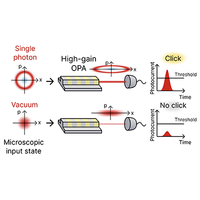
Ultrafast single-photon detector based on a nanophotonic parametric amplifier

Elina Sendonaris, James Williams, Rajveer Nehra, Robert Gray, Ryoto Sekine, Luis Ledezma, and Alireza Marandi

Phys. Rev. Applied 25, 044078 (2026) - Published 27 April, 2026

Single-photon detection is central to optical quantum communication and computation. Its speed and integrability into photonic chips are currently limited by the physical processes by which the photon is absorbed. This work shows that a nanophotonic optical parametric amplifier (OPA) can be used as an ultrafast single-photon detector, bypassing these absorption mechanisms in favor of optical amplification. In addition, a path for OPA-based single-photon detectors to reach state-of-the-art performance is discussed. This approach opens the door to integrated ultrafast single-photon detection, to enable ultrafast optical quantum information processing.

Real-time monitoring of growth of neon film for electron-on-neon qubits

Sidharth Duthaluru, Kaiwen Zheng, Erik A. Henriksen, and Kater W. Murch

Phys. Rev. Applied 25, 044065 (2026) - Published 23 April, 2026

Precise control of noble-gas thin films is essential for emerging quantum platforms such as electron-on-neon qubits, but progress has been limited by the lack of real-time diagnostics and reproducible growth control. Here researchers demonstrate in situ monitoring of neon-film growth by tracking the frequency shift of a high-Tc superconducting microwave resonator during neon deposition. This study reveals stochastic film thinning in the vicinity of neon’s triple point, and identifies routes toward controlled film growth, with broad implications for quantum device fabrication and cryogenic materials engineering.

Enhancing the sensitivity of single-microwave-photon detection with bandwidth tunability

Louis Pallegoix, Jaime Travesedo, Alexandre S. May, Léo Balembois, Denis Vion, Patrice Bertet, and Emmanuel Flurin

Phys. Rev. Applied 25, 044064 (2026) - Published 23 April, 2026

Detecting single microwave photons is important in, for example, primary thermometry in dilution cryostats, dark-matter detection, and detection of a single spin in a crystal lattice. Such detectors are not commercially available and are challenging to design, due to the very low energies of gigahertz photons. The improved device presented in this study uses a qubit coupled to harmonic oscillators and a drive line to encode the detection event using a four-wave mixing process. This single-photon detector could impact engineering solutions to improve cryostat-wiring thermalization, detection of chemical species at ultralow concentrations, and axion detection.

Predicting the future with magnons: Forecasting chaotic time series with reservoir computing

Zeling Xiong (熊则灵), Christopher Heins, Thibaut Devolder, Fabian Kammerbauer, Mathias Kläui, Jürgen Fassbender, Helmut Schultheiss, and Katrin Schultheiss

Phys. Rev. Applied 25, 044047 (2026) - Published 17 April, 2026

Forecasting chaotic signals is important for applications ranging from sensing to communication to climate modeling. Compact hardware for real-time prediction remains challenging, as it must combine high energy efficiency with the nonlinear dynamics and memory needed for computation in a single physical system. Here a magnetic vortex-state microdisk acts as a magnon-scattering reservoir, converting one-dimensional microwave input into high-dimensional spectral output that predicts the chaotic Mackey-Glass benchmark with high accuracy over hundreds of future time steps. Spectral resolution must be carefully tuned, and combining multiple device geometries systematically boosts performance.

Experimental demonstration of an on-axis laser ranging interferometer for future gravity missions

Daikang Wei, Christoph Bode, Kohei Yamamoto, Yongho Lee, Germán Fernández Barranco, Vitali Müller, Miguel Dovale Álvarez, Juan José Esteban Delgado, and Gerhard Heinzel

Phys. Rev. Applied 25, 044039 (2026) - Published 15 April, 2026

High-precision laser interferometry between spacecraft is critical for future gravity missions, yet achieving nanometer-level accuracy remains hindered by challenges in beam alignment and stability, particularly due to spacecraft attitude jitter. To overcome these disturbances, this study presents an interferometric architecture featuring a monoaxial laser ranging interferometer with active beam-steering loops and differential wavefront sensing. Experiments validate pointing stability below 10 µrad/√Hz, while also revealing polarization effects and tilt-to-length coupling noise.

Efficient ammonia synthesis from nitric oxide using the topological nodal-line semimetal CaAgAs

Xinyan Zhang, Ying Liu, Min Zhao, Zihan Li, Xuefang Dai, Xiaoming Zhang, and Guodong Liu

Phys. Rev. Applied 25, 044023 (2026) - Published 9 April, 2026

Electrochemical conversion of NO to NH3 is vital for sustainable ammonia synthesis and environmental remediation, but suffers from sluggish reaction kinetics. The authors identify the topological nodal-line semimetal CaAgAs as a highly efficient and selective catalyst, with a free-energy change ΔG of just 0.22 eV and drumheadlike topological surface states near the Fermi level that provide enhanced surface density of states to facilitate charge transfer. Strain engineering can reduce ΔG to 0.08 eV. Notably, symmetry-breaking transitions that eliminate the topological phase degrade catalytic performance, showing that here topology offers a robust and tunable design principle.

Enhancement of vacuum-ultraviolet dispersive-wave emission using gas-filled tapered hollow-core fibers

Yinuo Zhao, Donghan Liu, Baoqi Shi, Zhiyuan Huang, Tiandao Chen, Jinyu Pan, Zhengzheng Liu, Xinglin Zeng, Wenbin He, Jiapeng Huang, Jinxin Zhan, Xin Jiang, Yuxin Leng, Junqiu Liu, and Meng Pang

Phys. Rev. Applied 25, L041001 (2026) - Published 1 April, 2026

Resonant dispersive wave emission in hollow-core optical fibers offers a promising route to the vacuum-ultraviolet (VUV) sources essential for 229Th nuclear clocks. Unfortunately, standard capillaries force a strict trade-off between the large core diameters needed for efficient input coupling and the high intensities required for efficient nonlinear conversion. The authors use a gas-filled tapered capillary fiber to avoid the trade-off, combining a large input aperture with adiabatic field concentration. This yields a widely tunable source with doubled efficiency specifically at the 148.38-nm isomer energy, in a scalable architecture for much-needed high-flux tabletop VUV tools.

Scalable low-overhead superconducting nonlocal coupler for circuit connectivity enhancement

Haonan Xiong, Jiahui Wang, Juan Song, Jize Yang, Zenghui Bao, Yan Li, Zhen-Yu Mi, Hongyi Zhang, Hai-Feng Yu, Yipu Song, and Luming Duan

Phys. Rev. Applied 25, 034096 (2026) - Published 31 March, 2026

Although nonlocal connectivity is essential for universal logical gates and low-overhead quantum error correction, it is largely absent from today’s superconducting platforms, which are restricted to nearest-neighbor coupling. This work demonstrates an on-chip coupler with centimeter-scale interaction length, to provide high-fidelity, low-crosstalk nonlocal qubit coupling and serve as a building block for binary-tree connectivity graphs, reducing the average entangling distance from O(N) to O(ln N). This capability supports the implementation of innovative quantum algorithms on superconducting processors, and strengthens their competitiveness with other hardware platforms.

Thermally modulated SINIS transconductance amplifier

G. Trupiano, G. De Simoni, and F. Giazotto

Phys. Rev. Applied 25, 034087 (2026) - Published 27 March, 2026

Cryogenic electronics requires amplifiers that can operate at millikelvin temperatures with low noise, while dissipating almost no power—two serious challenges. The authors propose and numerically analyze a fully voltage-controlled three-terminal superconducting transconductance amplifier based on thermally modulating a SINIS structure via quasiparticle injection through an additional NIS tunnel junction. Simulations predict millisiemens-level transconductance and high current gain with nanowatt power dissipation, suggesting a possible route to scalable low-power cryogenic amplification for quantum technologies and low-temperature detectors.

Synergetic enhancement of power factors and suppression of lattice thermal conductivities via biaxial strain in ScAgSe2 and TmAgTe2

Wu Xiong, Zhongjuan Han, Zhonghao Xia, Zhilong Yang, Yali Yang, and Jiangang He

Phys. Rev. Applied 25, 034086 (2026) - Published 27 March, 2026

Thermoelectric technology is promising for energy conversion and solid-state refrigeration. As is well known, though, the strong coupling among the Seebeck coefficient, electrical conductivity, and lattice thermal conductivity substantially limits thermoelectric efficiency. Guided by orbital-mixing theory and first-principles calculations, the authors propose a biaxial-strain strategy to increase the Seebeck coefficient without sacrificing electrical conductivity (enhancing the power factor) and to weaken chemical bonding (suppressing lattice thermal conductivity), in two candidate materials. Consequently, tensile strains of 1–3% yield can double or triple the figure of merit at 300 K.

Three-dimensional niobium coaxial cavity with 0.1-second lifetime

Takaaki Takenaka, Takayuki Kubo, Imran Mahboob, Kosuke Mizuno, Hitoshi Inoue, Takayuki Saeki, and Shiro Saito

Phys. Rev. Applied 25, 034076 (2026) - Published 24 March, 2026

High-coherence superconducting quantum technologies demand as little microwave loss as possible, and niobium-based devices are often limited by dissipation associated with surface oxides. Inspired by processing developed for accelerator cavities, the authors employ a strategy to reduce oxide-related loss in a three-dimensional niobium cavity, achieving ultralow dissipation in the single-photon regime at millikelvin temperatures. This improved performance is largely preserved across multiple cooldown cycles, and after hours of air exposure. These results highlight oxide engineering as a practical route to longer-lived niobium-based qubits and resonators.

Taming nonequilibrium thermal fluctuations in subthreshold CMOS circuits

Nahuel Freitas, Geremia Massarelli, Jeremy Rothschild, Dylan Keane, Ethan Dawe, Sewook Hwang, Akhil Garlapati, and Trevor McCourt

Phys. Rev. Applied 25, 034061 (2026) - Published 18 March, 2026

Probabilistic processors promise significant efficiency gains over GPUs, but scaling is bottlenecked by a reliance on hard-to-manufacture hardware for random number generation. In this study, researchers overcome this hurdle by demonstrating circuits built entirely from standard transistors that harness intrinsic thermal noise to efficiently sample from programmable probability distributions. Because these probabilistic circuits can be seamlessly integrated alongside standard CMOS cells, this approach paves the way for scalable, near-term probabilistic computing.

Harmonic and subharmonic magnon generation in a surface-acoustic-wave resonator

Yunyoung Hwang, Liyang Liao, Jorge Puebla, Marco Brühlmann, Carlos Gonzalez-Ballestero, Kouta Kondou, Naoki Ogawa, Sadamichi Maekawa, and Yoshichika Otani

Phys. Rev. Applied 25, 034056 (2026) - Published 17 March, 2026

Hybrid sound-magnet interactions attract growing interest for advanced signal processing and computing, but generating complex, controllable nonlinear magnetic responses in such systems remains challenging for chip-scale platforms. The authors use a device that concentrates high-frequency sound waves to strongly couple a magnetic film to acoustic motion, revealing nonlinear magnetoelastic waves that generate phase-locked harmonic and subharmonic magnetic signals. Notably, the subharmonic process closely resembles optical parametric down-conversion. These nonlinear magnon-phonon hybrid excitations may represent an important step toward quantum magnonics with propagating excitations.

bifrost: A first-principles model of polarization mode dispersion in optical fiber

Patrick R. Banner, S. L. Rolston, and Joseph W. Britton

Phys. Rev. Applied 25, 034054 (2026) - Published 17 March, 2026

Birefringence in optical fiber causes polarization mode dispersion (PMD), which can broaden telecommunication signals, degrade fiber-sensor measurements, and scramble polarization-encoded quantum states. Though widely studied, PMD is typically modeled using statistical descriptions that obscure its underlying physical origins. The authors present BIFROST, a first-principles model that links PMD to specific physical parameters such as core geometry, temperature, and bend radius. Using this model, they simulate the impact of environmental variations on PMD compensation and demonstrate how knowledge of fiber properties (e.g. fiber spinning) can be applied to emerging quantum networks.

Data-efficient quantum noise modeling via machine learning

Yanjun Ji, Marco Roth, David A. Kreplin, Ilia Polian, and Frank K. Wilhelm

Phys. Rev. Applied 25, 034051 (2026) - Published 16 March, 2026

Noise-aware compilation on near-term quantum processors requires accurate noise models, but standard ones often miss algorithm- and hardware-specific error mechanisms, and full characterization can be costly. In this study a data-efficient framework combines a physically motivated parametrized noise model with Bayesian optimization, to infer algorithm- and hardware-specific error parameters from routine circuit-execution data. Remarkably, models trained only on small-circuit data generalize well to larger validation circuits, yielding 65% better model fidelity. This provides a scalable, low-overhead route to more predictive, application-aware noise models for quantum compilation workflows.

Toward integrated sensors for optimized optical coherence tomography with undetected photons

Franz Roeder, René Pollmann, Viktor Quiring, Christof Eigner, Benjamin Brecht, and Christine Silberhorn

Phys. Rev. Applied 25, 034031 (2026) - Published 10 March, 2026

Optical coherence tomography (OCT) using undetected photons is a promising technique for studying layered materials at wavelengths including the midinfrared, where traditional methods face challenges. However, OCT relies on large optical setups that require high laser power and are difficult to miniaturize. This work explores performance benchmarks for integrated sensors, which offer a path toward smaller, more practical devices, and finds that a less-common system configuration exploiting induced coherence works particularly well in integrated setups. This result not only improves performance but also provides useful guidance for designing future compact quantum sensing systems.

Sign In to Your Journals Account

Filter

Filter

Article Lookup

Enter a citation