Letters

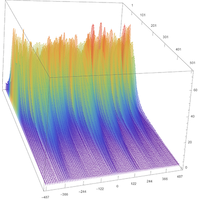
Rapidity and momentum distributions of one-dimensional dipolar quantum gases

Kuan-Yu Li, Yicheng Zhang, Kangning Yang, Kuan-Yu Lin, Sarang Gopalakrishnan, Marcos Rigol, and Benjamin L. Lev

Phys. Rev. A 107, L061302 (2023) - Published 8 June, 2023

The effects of integrability-breaking interactions on equilibrium states are explored using a one-dimensional Bose gas of highly magnetic atoms. A dressed-quasiparticle description is found to be necessary to predict equilibrium rapidity and momentum distributions as the strength of the integrability-breaking perturbation increases.

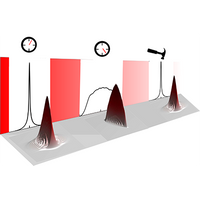
Extremely narrow sharply peaked resonances at the edge of the continuum

Ignas Lukosiunas, Lina Grineviciute, Julianija Nikitina, Darius Gailevicius, and Kestutis Staliunas

Phys. Rev. A 107, L061501 (2023) - Published 8 June, 2023

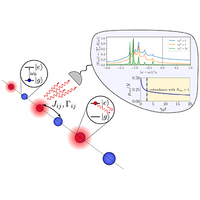
Non-Hermitian zero-mode laser in a nanophotonic trimer

Kaiwen Ji, Bruno Garbin, Melissa Hedir, Juan A. Levenson, and Alejandro Yacomotti

Phys. Rev. A 107, L061502 (2023) - Published 8 June, 2023

The spatial modulation of a pump beam enables direct observation of a lasing zero mode (a symmetry-protected mode pinned at the center of the optical spectrum) in a non-Hermitian three coupled nanocavity array. The realization of zero-mode lasing in large arrays of coupled nanolasers has potential applications in laser-mode engineering and it opens up promising avenues in optical computing.

High-momentum oscillating tails of strongly interacting one-dimensional gases in a box

Gianni Aupetit-Diallo, Silvia Musolino, Mathias Albert, and Patrizia Vignolo

Phys. Rev. A 107, L061301 (2023) - Published 2 June, 2023

The authors show that a hard-wall confinement in quantum one-dimensional mixtures induces a nonlocal spin-coherence signature in the tails ofthe momentum distribution where only local two-body correlation contributions are usually expected.

Reflected entropy: Not a correlation measure

Patrick Hayden, Marius Lemm, and Jonathan Sorce

Phys. Rev. A 107, L050401 (2023) - Published 30 May, 2023

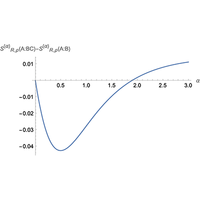
For a quantum state of two coupled physical systems, a correlation measure is a quantity that measures how much each system knows about the other. Here, the authors show that the quantity known as “reflected entropy” is not a correlation measure, by constructing quantum states on three coupled systems for which the reflected entropy increases when one of the systems is discarded.

Distribution of genuine high-dimensional entanglement over 10.2 km of noisy metropolitan atmosphere

Lukas Bulla, Kristian Hjorth, Oskar Kohout, Jan Lang, Sebastian Ecker, Sebastian P. Neumann, Julius Bittermann, Robert Kindler, Marcus Huber, Martin Bohmann, Rupert Ursin, and Matej Pivoluska

Phys. Rev. A 107, L050402 (2023) - Published 30 May, 2023

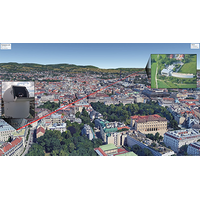
The authors investigate the dimensionality of photonic quantum entanglement distributed through a 10.2-km atmospheric link connecting a building in the center of Vienna to a distant laboratory in Bisamberg. An atypical approach to time-bin encoding was employed to analyze the data. The results show that the distributed data cannot be explained by qubits alone, indicating the presence of high-dimensional entanglement in the system.

Detecting the relative phase between different frequency components of a photon using a three-level Λ atom coupled to a waveguide

Janet Zhong, Rituraj, Fatih Dinc, and Shanhui Fan

Phys. Rev. A 107, L051702 (2023) - Published 30 May, 2023

The authors study the scattering of a two-tone photon with a three-level Λ atom in a superposition of ground states, when the atom is coupled to a waveguide. The system can be used to detect both the relative phase between the photon frequencies and the relative phase of the atomic ground states as the output scattering depends on both quantities.

High-fidelity transport of trapped-ion qubits in a multilayer array

Deviprasath Palani, Florian Hasse, Philip Kiefer, Frederick Boeckling, Jan-Philipp Schroeder, Ulrich Warring, and Tobias Schaetz

Phys. Rev. A 107, L050601 (2023) - Published 26 May, 2023

The authors investigate a trapped-ion architecture with thirteen trapping sites for quantum control of multiple particles. They demonstrate automated qubit loading and shuttling within a three-dimensional trapping landscape, achieving a high success rate while preserving coherence.

Atomtronic multiterminal Aharonov-Bohm interferometer

Jonathan Wei Zhong Lau, Koon Siang Gan, Rainer Dumke, Luigi Amico, Leong-Chuan Kwek, and Tobias Haug

Phys. Rev. A 107, L051303 (2023) - Published 24 May, 2023

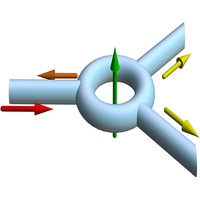
Atomtronics aims to manipulate the flow of cold atoms to create useful devices for quantum technologies. Here, the authors propose a ring-lead system as a device that controls atomic currents using artificial magnetic fields.

Optical telecommunications-band clock based on neutral titanium atoms

Scott Eustice, Dmytro Filin, Jackson Schrott, Sergey Porsev, Charles Cheung, Diego Novoa, Dan M. Stamper-Kurn, and Marianna S. Safronova

Phys. Rev. A 107, L051102 (2023) - Published 19 May, 2023

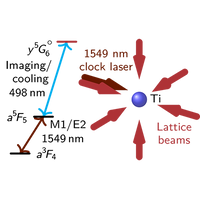
The authors propose an optical frequency standard based on telecom wavelength transitions in neutral titanium atoms. They performed high-precision atomic structure calculations to calculate the key systematic effects that would be present in such a frequency standard.

Measurements of velocity-selective resonances from adiabatic rapid passage

Yifan Fang, Edoardo Buonocore, Michael Wahl, and Harold Metcalf

Phys. Rev. A 107, L051101 (2023) - Published 17 May, 2023

The authors measure the velocity dependence of applied optical forces on a metastable He atom beam. The optical force implemented using adiabatic rapid passage shows unexpected, equally spaced peaks in velocity space. Such resonances may result from coherence established by atomic motion in traveling-wave laser fields.

Tailoring dynamical fermionization: Delta-kick cooling of a Tonks-Girardeau gas

Léonce Dupays, Jing Yang, and Adolfo del Campo

Phys. Rev. A 107, L051302 (2023) - Published 17 May, 2023

An expanding gas of hardcore bosons in the Tonks-Girardeau limit exhibits dynamical fermionization, whereby the momentum distribution approaches that of an ideal spin-polarized Fermi gas. The authors show that this phenomenon can be tailored, enhanced, or reversed, making use of a generalization of Delta Kick Cooling for interacting ultracold gases, that can be readily implemented with current experimental techniques.

Dissipative dynamics of a fermionic superfluid with two-body losses

Giacomo Mazza and Marco Schirò

Phys. Rev. A 107, L051301 (2023) - Published 12 May, 2023

A sudden change of pairing interaction leads to coherent solitonlike oscillations of the superfluid order parameter. Here, the authors study the effect of pair losses on the dynamics of a quenched fermionic superfluid and reveal that even a tiny dissipation leads to a large renormalization of the soliton period. They explain the effect through a dissipative soliton model and a variational approach for the Markovian quantum dynamics.

Dynamic population of multiexcitation subradiant states in incoherently excited atomic arrays

Oriol Rubies-Bigorda, Stefan Ostermann, and Susanne F. Yelin

Phys. Rev. A 107, L051701 (2023) - Published 8 May, 2023

The authors theoretically investigate the creation of subradiant states with multiple excitations in dense arrays of quantum emitters, which is a long-lasting challenge due to the complexity of the system and the experimental limitations in state-of-the-art platforms. The authors analyze the effects of trapping geometry and correlations on the subradiant-state formation and provide insights for controlling and utilizing subradiant states in quantum technologies.

Accelerated quantum control in a three-level system by jumping along the geodesics

Musang Gong, Min Yu, Ralf Betzholz, Yaoming Chu, Pengcheng Yang, Zhenyu Wang, and Jianming Cai

Phys. Rev. A 107, L040602 (2023) - Published 24 April, 2023

By applying a driving field along discrete points of a geodesic path, the authors achieve quantum-state transfer in the electronic ground-state triplet of a nitrogen-vacancy center in diamond, which surpasses the traditional stimulated-Raman-adiabatic-passage protocol. This method can provide a higher transfer fidelity in a shorter time and shows a stronger robustness against control-field perturbations as well as external magnetic-field noise.

Berezinskii-Kosterlitz-Thouless phase transition with Rabi-coupled bosons

Koichiro Furutani, Andrea Perali, and Luca Salasnich

Phys. Rev. A 107, L041302 (2023) - Published 19 April, 2023

The authors perform a renormalization-group analysis of the superfluid–normal-state Berezinskii-Kosterlitz-Thouless transition in a binary Bose mixture with an intercomponent and a Rabi coupling, which involves half-integer vortices and the formation of vortex molecule-antimolecule pairs. It reveals that the Rabi coupling enhances the Berezinskii-Kosterlitz-Thouless transition temperature while it exhibits nonmonotonic dependence on the intercomponent coupling.

Quantifying T-gate-count improvements for ground-state-energy estimation with near-optimal state preparation

S. Pathak, A. E. Russo, S. K. Seritan, and A. D. Baczewski

Phys. Rev. A 107, L040601 (2023) - Published 17 April, 2023

Quantum computers will enable high-accuracy quantum simulations of physical systems, provided that states with reasonable overlap with the ground state can be efficiently prepared. In this Letter, the authors articulate conditions in which quadratic runtime speedups are plausible for ground-state energy estimation by translating a near-optimal ground-state preparation scheme into explicit circuits and estimating the cost in a model relevant to their fault-tolerant implementation.

Singularity in the electron-core potential as a gateway to accurate multielectron ionization spectra in strongly driven atoms

A. Emmanouilidou, M. B. Peters, and G. P. Katsoulis

Phys. Rev. A 107, L041101 (2023) - Published 17 April, 2023

A general three-dimensional classical model is developed that accurately describes multi-electron ionization in atoms driven by intense fields. While addressing artificial autoionization, this model also accounts for the Coulomb singularity in the electron-core Coulomb potential resulting in ionization spectra that agree with experiment.

Frustration in a dipolar Bose-Einstein condensate introduced by an optical lattice

Eli J. Halperin, Shai Ronen, and J. L. Bohn

Phys. Rev. A 107, L041301 (2023) - Published 17 April, 2023

The authors theoretically examine the application of a weak optical lattice on the droplet crystal ground state of a dipolar Bose-Einstein condensate. By choosing a lattice with incommensurate symmetry to that of the ground state, they find spontaneous pattern formation and evidence for superfluid frustration.

Large-area quantum-spin-Hall waveguide states in a three-layer topological photonic crystal heterostructure

Zhihao Lan, Menglin L. N. Chen, Jian Wei You, and Wei E. I. Sha

Phys. Rev. A 107, L041501 (2023) - Published 12 April, 2023

Topological photonic edge states usually are formed at the interface between two domains of topologically trivial and nontrivial photonic crystals. The authors propose topological waveguide states with tunable widths in a three-layer topological photonic crystal heterostructure, which exhibit a helical pseudospin-momentum locking feature of the quantum spin Hall effect.

Sign In to Your Journals Account

Filter

Category
Section

Filter

Article Lookup

Enter a citation