Letters

Microscopic origin of polarization-entangled Stokes–anti-Stokes photons in diamond

Tiago A. Freitas, Paula Machado, Lucas Valente, Diego Sier, Raul Corrêa, Riichiro Saito, Christophe Galland, Marcelo F. Santos, Carlos H. Monken, and Ado Jorio

Phys. Rev. A 108, L051501 (2023) - Published 20 November, 2023

This work shows that Stokes and anti-Stokes photons generated in a degenerate four-wave-mixing process in diamond are entangled in polarization. The degree of entanglement generated by process indeterminacy (electronic or phononic) depends on the detuning of the photon pairs from the excitation laser and on the orientation of the polarization of the incident light with respect to the sample.

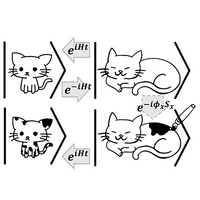
Detailed fluctuation theorem from the one-time measurement scheme

Kenji Maeda, Tharon Holdsworth, Sebastian Deffner, and Akira Sone

Phys. Rev. A 108, L050203 (2023) - Published 17 November, 2023

The authors develop a quantum fluctuation theorem from quantum nondemolition measurements, considering the influence of quantum coherence and correlations. They demonstrate that the derived fluctuation theorem captures detailed information about the irreversibility of the quantum process, which can be useful for quantum thermometry.

Experimental storage of photonic polarization entanglement in a broadband loop-based quantum memory

C. J. Evans, C. M. Nunn, S. W. L. Cheng, J. D. Franson, and T. B. Pittman

Phys. Rev. A 108, L050601 (2023) - Published 16 November, 2023

The authors experimentally demonstrate the storage of entangled photons using a loop-based quantum memory device. Their results highlight the compatibility of this quantum memory platform with the broadband nature of many conventional entangled photon sources.

Effective mass and interaction energy of heavy Bose polarons at unitarity

Nikolay Yegovtsev and Victor Gurarie

Phys. Rev. A 108, L051301 (2023) - Published 14 November, 2023

The authors study the effective mass of a heavy impurity moving through a Bose-Einstein condensate, and the condensate-induced attraction between two such impurities in the regime of strong boson-impurity interactions. This problem turns out to be analytically solvable in the regime of small gas densities.

Nonperturbative effects of deep strong light-matter interaction in a mesoscopic cavity-QED system

A. Kudlis, D. Novokreschenov, I. Iorsh, and I. V. Tokatly

Phys. Rev. A 108, L051701 (2023) - Published 13 November, 2023

The authors quantitatively describe the nonperturbative correlations in finite- size cavity quantum electrodynamics (cavity QED) systems. They track the onset of these correlations as the system departs from the thermodynamic limit. They propose an experimental setup, where these correlations can be directly probed.

Contribution of negative-energy states to the E2−M1 polarizability of optical clocks

Fang-Fei Wu, Ting-Yun Shi, Wei-Tou Ni, and Li-Yan Tang

Phys. Rev. A 108, L051101 (2023) - Published 9 November, 2023

The authors theoretically investigate the impact of Dirac negative-energy states on the E2 and M1 polarizabilities in optical clocks. They demonstrate the importance of negative-energy states for the M1 polarizability and resolve the sign inconsistency between the theoretical calculations and experimental measurements in the E2-M1 polarizability difference of the Sr clock.

Contribution of negative-energy states to multipolar polarizabilities of the Sr optical lattice clock

S. G. Porsev, M. G. Kozlov, and M. S. Safronova

Phys. Rev. A 108, L051102 (2023) - Published 9 November, 2023

An accurate formula for the magnetic-dipole polarizability that takes into account both the positive- and negative-energy-state contributions is presented. The major discrepancy between the theory and experiment is explained.

Experimental investigation of conditional majorization uncertainty relations in the presence of quantum memory

Gaoyan Zhu, Aoxiang Liu, Lei Xiao, Kunkun Wang, Dengke Qu, Junli Li, Congfeng Qiao, and Peng Xue

Phys. Rev. A 108, L050202 (2023) - Published 7 November, 2023

The authors report experimental studies of conditional uncertainty relations in terms of majorization in the presence of quantum memory. They also demonstrate an application of the conditional majorization uncertainty relation in witnessing quantum steerability.

Rydberg-ion flywheel for quantum work storage

Wilson S. Martins, Federico Carollo, Weibin Li, Kay Brandner, and Igor Lesanovsky

Phys. Rev. A 108, L050201 (2023) - Published 6 November, 2023

The authors propose a protocol for work generation and storage in a periodically laser-driven system of two trapped Rydberg ions. The study advances our understanding of how work that is produced in strongly interacting quantum spin systems can be extracted and stored in mechanical degrees of freedom.

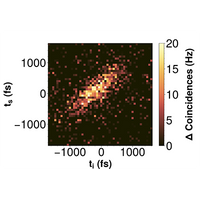
Ultrafast measurement of energy-time entanglement with an optical Kerr shutter

Andrew R. Cameron, Kate L. Fenwick, Sandra W. L. Cheng, Sacha Schwarz, Benjamin MacLellan, Philip J. Bustard, Duncan England, Benjamin Sussman, and Kevin J. Resch

Phys. Rev. A 108, L041503 (2023) - Published 25 October, 2023

Correlations between the temporal and frequency properties of two photons may be exploited for optical quantum technologies, but they can be difficult to measure on ultrafast time scales. In this work, we measure the time-of-arrival correlations of two energy-time entangled photons using an optical Kerr shutter.

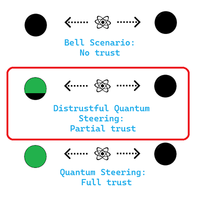
Distrustful quantum steering

Shubhayan Sarkar

Phys. Rev. A 108, L040401 (2023) - Published 24 October, 2023

The author explores the importance of trust in quantum steering. With imperfect detectors in practical quantum steering experiments, one can never perfectly trust their device. The author shows that even devices that are 95% reliable may not be enough to observe quantum steering in higher dimensions.

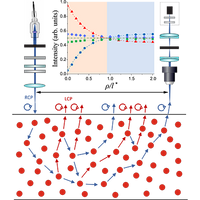
Depolarization composition of backscattered circularly polarized light

Ivan Lopushenko, Alexander Bykov, and Igor Meglinski

Phys. Rev. A 108, L041502 (2023) - Published 24 October, 2023

The authors explore the origin of unpolarized light generated through the backscattering of circularly polarized light by a random, turbid, tissuelike dispersive medium. They reveal the dynamics of the backscattered portion of unpolarized light, disclosing its decomposition into two polarized components characterized by opposing helicities.

Verifying a quasiclassical spin model of perturbed quantum rewinding in a Fermi gas

J. Huang, Camen A. Royse, I. Arakelyan, and J. E. Thomas

Phys. Rev. A 108, L041304 (2023) - Published 20 October, 2023

By implementing perturbed quantum rewinding experiments in a weakly interacting Fermi gas, the authors illustrate the validity of a quasiclassical model of a large synthetic spin lattice with a collective Heisenberg Hamiltonian.

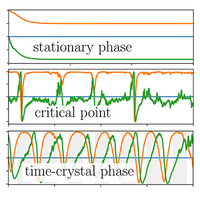
Quantum trajectories of dissipative time crystals

Albert Cabot, Leah Sophie Muhle, Federico Carollo, and Igor Lesanovsky

Phys. Rev. A 108, L041303 (2023) - Published 17 October, 2023

The authors address the boundary time-crystal transition at the level of individual quantum trajectories that result from continuous monitoring. Signatures of critical behavior and of the time-crystal phase are identified for the photon count signal and homodyne current, while each monitoring scheme is shown to imprint its own characteristic features.

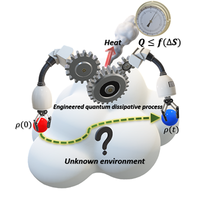
Universal Landauer-like inequality from the first law of thermodynamics

Junjie Liu and Hanlin Nie

Phys. Rev. A 108, L040203 (2023) - Published 13 October, 2023

The authors establish universal Landauer-like inequalities derived from the first law of thermodynamics, offering a robust framework for constraining the energetic costs of quantum processes in diverse environments. The study applies these general inequalities to two illustrative scenarios: a dissipative quantum state preparation setup and a quantum information erasure model.

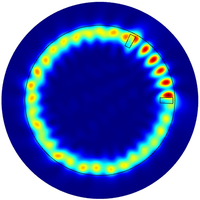
Local chirality at exceptional points in optical whispering-gallery microcavities

Junda Zhu, Changqing Wang, Can Tao, Zhoutian Fu, Haitao Liu, Fang Bo, Lan Yang, Guoquan Zhang, and Jingjun Xu

Phys. Rev. A 108, L041501 (2023) - Published 12 October, 2023

The field chirality at the exceptional points (EPs) in an optical whispering gallery mode (WGM) microcavity is commonly believed to be globally perfect. The authors discover a locally imperfect or locally perfect chirality of eigenmodes at the EPs in a WGM microcavity perturbed by two strong nanoscatterers, and explain these counterintuitive phenomena with a first-principle-based model.

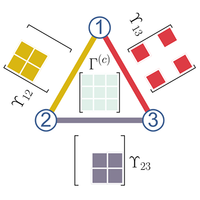
Characterizing arbitrary quantum networks in the noisy intermediate-scale quantum era

Zhen-Peng Xu

Phys. Rev. A 108, L040201 (2023) - Published 5 October, 2023

Quantum networks, as a playground for various quantum technologies, describe the distribution of quantum sources represented by edges to different parties represented by nodes in the network. Here, the author introduces a systematic approach to characterize arbitrary quantum networks in the noisy intermediate-scale quantum era, which can be noisy, intermediate-scale, random, and sparse.

Simple proof that anomalous weak values require coherence

Rafael Wagner and Ernesto F. Galvão

Phys. Rev. A 108, L040202 (2023) - Published 5 October, 2023

The significance of anomalous weak values has been a matter of great debate in quantum foundations and quantum information. Here, a simple proof shows that the weak-value anomaly requires both negativity of a certain quasiprobability representation and coherence of pre- and postselected states in the observable’s basis.

Clock-line photoassociation of strongly bound dimers in a magic-wavelength lattice

O. Bettermann, N. Darkwah Oppong, G. Pasqualetti, L. Riegger, I. Bloch, and S. Fölling

Phys. Rev. A 108, L041302 (2023) - Published 3 October, 2023

The authors demonstrate single-photon photoassociation on an ultranarrow clock line directly from an unbound pair to a tightly bound molecular state. This is combined with a modified magic-wavelength implementation to enable narrow line measurements.

Velocity-mapped imaging of electron dynamics in an ultracold laser-induced plasma

Eric James Smoll, Jr., Irina Jana, Jonathan H. Frank, and David W. Chandler

Phys. Rev. A 108, L041301 (2023) - Published 2 October, 2023

The authors experimentally demonstrate the time-resolved velocity-mapped imaging for simultaneously probing the electron energy distribution and total electron count of an ultracold plasma produced by resonance-enhanced multiphoton ionization of Kr.

Sign In to Your Journals Account

Filter

Category
Section

Filter

Article Lookup

Enter a citation