Letters

Precision measurement of Mg+25-ion D1 and D2 transition frequencies

P. Hao, K. Deng, F. F. Wu, Z. Y. Ma, W. Z. Wei, W. H. Yuan, Y. B. Du, H. L. Liu, H. X. Zhang, L. R. Pang, B. Wang, J. Zhang, and Z. H. Lu

Phys. Rev. A 107, L020803 (2023) - Published 27 February, 2023

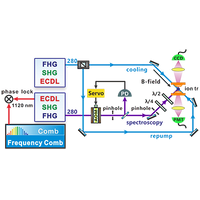
The authors report the precision measurement of 25Mg+ ion-doublet transition frequencies using a decoherence-assisted spectroscopy method with the full use of spontaneous emission signals to improve the detection sensitivity. The results indicate that consideration of additional physical effects in theoretical calculations, such as the possible capture of electron correlations, is required.

Shape resonances in photoionization cross sections and time delay

Anatoli S. Kheifets and Stephen Catsamas

Phys. Rev. A 107, L021102 (2023) - Published 27 February, 2023

Traditionally, photoionization experiments measured cross sections while more recently photoemission became resolved in time. Here, the authors show that for shape resonances in atomic and molecular photoionization the cross sections and the time delay become directly related, providing a rigorous test for novel time-resolved measurements.

Measurements of electron bremsstrahlung double-differential cross sections for solid targets down to low photon energies: No polarization contribution

Ling Li, Zhu An, Jingjun Zhu, Weiping Lin, Scott Williams, Fan Bai, Peng Wang, Yixiang Fan, and Gen Liu

Phys. Rev. A 107, L020802 (2023) - Published 24 February, 2023

The authors measured the bremsstrahlung double-differential cross sections for some solid thin-film elemental targets by kilovolt electron impact down to low photon energies. The results definitely show that there is no polarization bremsstrahlung contribution in solid-target experiments.

π-mode solitons in photonic Floquet lattices

Hua Zhong (钟华), Yaroslav V. Kartashov, Yongdong Li (李永东), and Yiqi Zhang (张贻齐)

Phys. Rev. A 107, L021502 (2023) - Published 24 February, 2023

Using driven SSH waveguide arrays that periodically switch between trivial and topological phases on one longitudinal driving period, the authors illustrate that, in this system, stable one- and two-dimensional anomalous 𝜋-mode solitons may form that bifurcate under the action of nonlinearity from linear 𝜋-mode edge or corner states. These results can be promising for the observation of various nonlinear phenomena in nonequilibrium Floquet systems, including the development of 𝜋-mode lasers.

Capturing transient core-to-core resonances in Kr in intense extreme-ultraviolet laser fields by electron-ion coincidence spectroscopy

Mizuho Fushitani, Makoto Yamada, Hikaru Fujise, Shigeki Owada, Tadashi Togashi, Kyo Nakajima, Makina Yabashi, Akitaka Matsuda, Yasumasa Hikosaka, and Akiyoshi Hishikawa

Phys. Rev. A 107, L021101 (2023) - Published 23 February, 2023

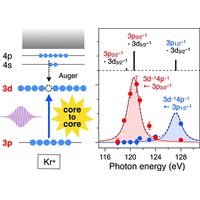
Resonances between core-hole states have been long hypothesized to understand dynamics of atoms and molecules exposed to intense XFEL pulses, but evaded clear identification due to their transient nature. The authors report clear evidence of core-to-core resonances by electron-ion coincidence spectroscopy on Kr atoms and elucidate the importance in nonlinear electronic responses of matter to high-frequency laser fields.

Floquet-heating-induced Bose condensation in a scarlike mode of an open driven optical-lattice system

Alexander Schnell, Ling-Na Wu, Artur Widera, and André Eckardt

Phys. Rev. A 107, L021301 (2023) - Published 22 February, 2023

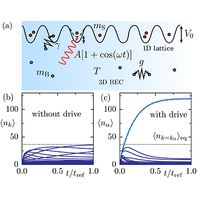
The authors consider an open system of ultracold bosonic atoms coupled to a heat bath given by a Bose-Einstein condensate of a second species of cold atoms. The authors show that, counterintuitively, the interplay of bath-induced dissipation and controlled Floquet heating can give rise to nonequilibrium Bose condensation in a quantum-scar-like mode protected from the drive.

Chiral discrimination in helicity-preserving Fabry-Pérot cavities

L. Mauro, J. Fregoni, J. Feist, and R. Avriller

Phys. Rev. A 107, L021501 (2023) - Published 21 February, 2023

The authors show that putting chiral molecules into a helicity-preserving Fabry-Pérot cavity can increase the circular dichroism signal by 2 orders of magnitude. They furthermore show a clear signature of chiral cavity polaritons upon entering the regime of strong light-matter coupling.

Unexpected dipole instabilities in small molecules after ultrafast XUV irradiation

P.-G. Reinhard, D. Dundas, P. M. Dinh, M. Vincendon, and E. Suraud

Phys. Rev. A 107, L020801 (2023) - Published 17 February, 2023

The authors show how ultrashort laser pulses can be used to almost immediately remove deep-lying electrons from small molecules. By suitably tuning the laser, the authors show that dipole instabilities can be driven whereby the dipole signal spontaneously reappears long after the original signal dies out. An experimental approach for observing these instabilities is proposed.

Non-Hermitian squeezed polarons

Fang Qin (覃昉), Ruizhe Shen, and Ching Hua Lee

Phys. Rev. A 107, L010202 (2023) - Published 26 January, 2023

Polarons are dressed states caused by interacting impurities. In this work, the authors discovered that non-Hermiticity can fundamentally “squeeze” the polaron into an asymmetric spatial profile. Yet, despite their locality, such squeezed polarons drastically modify the energy spectrum of the entire system.

Theoretical hyperfine splittings of Be2+7,9 ions for future studies of nuclear properties

Xiao-Qiu Qi, Pei-Pei Zhang, Zong-Chao Yan, Ting-Yun Shi, G. W. F. Drake, Ai-Xi Chen, and Zhen-Xiang Zhong

Phys. Rev. A 107, L010802 (2023) - Published 23 January, 2023

The authors demonstrate that higher-order quantum-electrodynamic calculations improve the accuracy of theoretical hyperfine splittings for heliumlike beryllium by two orders of magnitude. The consequent sensitivity to the nuclear Zemach radius and electric quadrupole moment opens the way to measurements of these nuclear properties to an accuracy of 5% or better; thus providing a critical test of nuclear structure models, especially for the isotope 7Be.

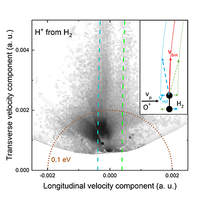
Molecular-rotation-induced splitting of the binary ridge in the velocity map of sub-eV H+ ions ejected from H2 molecules by ion impact

Z. Juhász, S. T. S. Kovács, V. Vizcaïno, P. Herczku, S. Demes, R. Rácz, B. Sulik, S. Biri, N. Sens, D. V. Mifsud, and J.-Y. Chesnel

Phys. Rev. A 107, L010801 (2023) - Published 19 January, 2023

The authors developed a field-free time-of-flight technique to study the binary ridge in the velocity map of sub-eV H+ fragments knocked out from molecular H2 by O+-ion impact. The ridge is found to be split into two parts arising from the rotational motion of the molecule, indicating that rotations significantly influence fragmentation processes.

Dissipative time crystals originating from parity-time symmetry

Yuma Nakanishi and Tomohiro Sasamoto

Phys. Rev. A 107, L010201 (2023) - Published 13 January, 2023

The authors provide evidence for the emergence of a class of dissipative time crystals when parity-time (PT) symmetry is restored in collective spin systems with Lindblad dynamics. They show that a standard model of boundary time crystals satisfies Liouvillian PT symmetry, and prove that boundary time crystals exist only when the stationary state is PT symmetric in the large-spin limit.

Spatial separation of collinearly emitted broadband frequency-correlated photon pairs

Yuki Kamei, Cao Bo, Ryo Okamoto, and Shigeki Takeuchi

Phys. Rev. A 107, L010601 (2023) - Published 10 January, 2023

The authors demonstrate the efficient separation of broadband frequency-entangled photon pairs generated in the same spatial and polarization mode. Entangled photons with a broad bandwidth of 90 nm are successfully separated using time-reversed Hong-Ou-Mandel interference.

Spin-noise spectroscopy of optical light shifts

J. Delpy, S. Liu, P. Neveu, E Wu, F. Bretenaker, and F. Goldfarb

Phys. Rev. A 107, L011701 (2023) - Published 5 January, 2023

A light-induced nonequilibrium regime is introduced in the standard spin noise spectroscopy, in which the laser light plays the role of both the probe beam and a driving field. The effect of the induced coherences is experimentally and theoretically demonstrated to be a splitting in the spin noise spectrum, which originates from and allows for the measurement of light shifts experienced by the atomic levels.

Genuine quadripartite steering in three-photon spontaneous parametric down-conversion

T. H. Chen, Y. B. Yu, and A. X. Chen

Phys. Rev. A 106, L060601 (2022) - Published 28 December, 2022

The authors show that genuine quadripartite quantum steering can be produced in the case of three-photon spontaneous parametric down-conversion when the quantum property of the pump is considered. They also find that the injected signal can improve the stability of quadripartite quantum steering.

Automated generation of arbitrarily many Kochen-Specker and other contextual sets in odd-dimensional Hilbert spaces

Mladen Pavičić and Norman D. Megill

Phys. Rev. A 106, L060203 (2022) - Published 27 December, 2022

In contrast to classical computations with predetermined outputs, quantum computations are characterized by measured outputs that are described by contextual sets. Here, the authors present algorithms for automated generation of contextual sets from simple vector components in odd-dimensional Hilbert spaces.

Creation and robustness of quantized vortices in a dipolar supersolid when crossing the superfluid-to-supersolid transition

Marija Šindik, Alessio Recati, Santo Maria Roccuzzo, Luis Santos, and Sandro Stringari

Phys. Rev. A 106, L061303 (2022) - Published 21 December, 2022

In this numerical study, the authors propose a realistic protocol for proving quantized vortices in dipolar supersolids, in which they are nucleated in the supersolid and observed after crossing the phase transition to the superfluid phase. This approach is of interest to ongoing experiments, allowing for probing of the superfluid character of dipolar supersolids.

Theoretical prediction of a non-Hermitian skin effect in ultracold-atom systems

Sibo Guo, Chenxiao Dong, Fuchun Zhang, Jiangping Hu, and Zhesen Yang

Phys. Rev. A 106, L061302 (2022) - Published 20 December, 2022

The authors demonstrate a robust non-Hermitian skin effect in spin-orbit-coupled fermions with dissipation, which has been implemented in a recent experiment. They also reveal an anomalous dynamic phenomenon named the dynamic sticky effect, which shares the same physical origin as the non-Hermitian skin effect.

Space-time-resolved quantum field approach to Klein-tunneling dynamics across a finite barrier

M. Alkhateeb and A. Matzkin

Phys. Rev. A 106, L060202 (2022) - Published 19 December, 2022

Klein tunneling takes place when a particle scatters on a supercritical barrier that is creating particle antiparticle pairs. The authors, using a space-time resolved relativistic quantum field theory approach, show that the transmitted particle does not tunnel through the barrier but is instead produced by modulations in the pair creation rate.

Avoiding barren plateaus via transferability of smooth solutions in a Hamiltonian variational ansatz

Antonio A. Mele, Glen B. Mbeng, Giuseppe E. Santoro, Mario Collura, and Pietro Torta

Phys. Rev. A 106, L060401 (2022) - Published 19 December, 2022

Parametrized quantum circuits inspired by adiabatic quantum computation often suffer from vanishing gradients, hindering the trainability of hybrid quantum-classical algorithms. Here, the authors put forward a strategy to overcome this by reusing parameters and iterating from small to large systems.

Sign In to Your Journals Account

Filter

Category
Section

Filter

Article Lookup

Enter a citation