Letters

Certifying beyond quantumness of locally quantum no-signaling theories through a quantum-input Bell test

Edwin Peter Lobo, Sahil Gopalkrishna Naik, Samrat Sen, Ram Krishna Patra, Manik Banik, and Mir Alimuddin

Phys. Rev. A 106, L040201 (2022) - Published 12 October, 2022

The authors study the correlations observed in quantum input Bell tests obtained from locally quantum no-signaling theories, which can reveal post-quantumness of bipartite “beyond-quantum” (i.e., more general than quantum) states that is undetectable with the standard classical input Bell tests. The study suggests the requirement of additional information principles to isolate the set of physical correlations.

Number-resolved detection of dark ions in Coulomb crystals

Fabian Schmid, Johannes Weitenberg, Jorge Moreno, Theodor W. Hänsch, Thomas Udem, and Akira Ozawa

Phys. Rev. A 106, L041101 (2022) - Published 4 October, 2022

Trapped ions without a suitable transition for laser cooling can be sympathetically cooled by embedding them in a Coulomb crystal of laser-cooled ions of another species. The authors demonstrate a method for identifying and counting such embedded ions in real time, which can be used for precision spectroscopy and for the study of ion-neutral chemical reactions.

Driven anti-Bragg subradiant correlations in waveguide quantum electrodynamics

Alexander N. Poddubny

Phys. Rev. A 106, L031702 (2022) - Published 29 September, 2022

It is theoretically predicted that strong electromagnetic driving of an array of two-level atoms, coupled to a waveguide, can make quantum excitations of the array decay faster.

Quantum heat engine based on a spin-orbit- and Zeeman-coupled Bose-Einstein condensate

Jing Li, E. Ya Sherman, and Andreas Ruschhaupt

Phys. Rev. A 106, L030201 (2022) - Published 27 September, 2022

The authors propose and explore a quantum heat engine based on a Bose-Einstein condensate with spin-orbit and Zeeman couplings as a working medium where the cooling and heating are simulated by the condensate contact with an external magnetized and demagnetized media. This study of the quantum thermal machine could help understand the basic principles of quantum thermodynamics.

Synchronization and amplification enabled by diversity in nonlinear optical systems and the analogy with converse symmetry breaking for coupled oscillators

Auro M. Perego

Phys. Rev. A 106, L031505 (2022) - Published 26 September, 2022

Converse symmetry breaking is a phenomenon occurring in populations of coupled oscillators, where stable and phase-locked symmetric states are possible only if the system itself is not symmetric. In this Letter, the analogy of converse symmetry breaking with amplification processes caused by phase and loss asymmetry for signal and idler waves in nonlinear optical systems is presented.

Measuring space-time curvature using maximally path-entangled quantum states

Thomas B. Mieling, Christopher Hilweg, and Philip Walther

Phys. Rev. A 106, L031701 (2022) - Published 26 September, 2022

The authors describe an experimental scheme capable of simultaneously demonstrating signatures of quantum theory and general relativity by using entangled multiphoton states to measure space-time curvature. The setup allows for curvature measurements at altitudes smaller than those required for classical or single-photon measurements.

Single quantum emitters with spin ground states based on Cl bound excitons in ZnSe

Aziz Karasahin, Robert M. Pettit, Nils von den Driesch, Marvin Marco Jansen, Alexander Pawlis, and Edo Waks

Phys. Rev. A 106, L030402 (2022) - Published 19 September, 2022

The authors experimentally investigate the optical properties of single chlorine donor atoms within a zinc-selenide quantum well. They show that donor-bound excitons are a stable source of single photons with a fast radiative lifetime on the order of 200 ps.

Excitation of absorbing exceptional points in the time domain

Asaf Farhi, Ahmed Mekawy, Andrea Alù, and Douglas Stone

Phys. Rev. A 106, L031503 (2022) - Published 15 September, 2022

The authors find that tuning a cavity to an absorbing exceptional point, in which eigenvalues and eigenmodes coalesce, results in an expansion of the class of waveforms that can be perfectly captured by the system. As a result, such cavities can impedance match to an optimal transient input signal at least an order of magnitude better.

Entropic measure of directional emissions in microcavity lasers

Kyu-Won Park, Chang-Hyun Ju, and Kabgyun Jeong

Phys. Rev. A 106, L031504 (2022) - Published 15 September, 2022

The authors introduce new measures of directional emission in microcavity lasers by exploiting the notion of Shannon entropy, and suggest that an entropic measure of the unidirectional emission is more accurate and efficient than former measures.

Spatially tunable noncritical phase matching of second-harmonic generation in a doped LiNbO3 crystal

Georgiy Shoulga, Gilad Robert Barir, and Alon Bahabad

Phys. Rev. A 106, L031502 (2022) - Published 8 September, 2022

The authors demonstrate tunable all-optical phase matching of second-harmonic generation (SHG) by controlling the spatial modes of a pump beam propagating inside a nonlinear crystal. This can be used for SHG which is essentially immune to temperature instability.

Universal entanglement entropy in the ground state of biased bipartite systems

Ohad Shpielberg

Phys. Rev. A 106, L030401 (2022) - Published 2 September, 2022

In the presence of conserved charges, the ground-state entanglement entropy of highly biased systems exhibits a universal power-law behavior. This relation allows a direct link between local measurements and the value of the entanglement entropy.

Topological molecules and topological localization of a Rydberg electron on a classical orbit

Ali Emami Kopaei, Xuedong Tian, Krzysztof Giergiel, and Krzysztof Sacha

Phys. Rev. A 106, L031301 (2022) - Published 1 September, 2022

The authors show that topological localization is capable of protecting the bound states of atoms and, consequently, molecules. A similar mechanism allows for the realization of topologically protected localization of an electron on a classical orbit if a Rydberg atom is perturbed by a properly modulated microwave field.

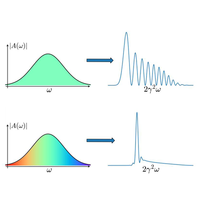
Towards high photon density for Compton scattering by spectral chirp

M. A. Valialshchikov, D. Seipt, V. Yu. Kharin, and S. G. Rykovanov

Phys. Rev. A 106, L031501 (2022) - Published 1 September, 2022

The authors study nonlinear Compton scattering of laser pulses linearly chirped in the spectral domain and show that using optimal chirp parameter leads to a higher photon peak in the scattering spectrum. Applying catastrophe theory, it is possible to find the optimal chirp value analytically.

Two-point measurement of entropy production from the outcomes of a single experiment with correlated photon pairs

Gabriel H. Aguilar, Thaís L. Silva, Thiago E. Guimarães, Rodrigo S. Piera, Lucas C. Céleri, and Gabriel T. Landi

Phys. Rev. A 106, L020201 (2022) - Published 17 August, 2022

Ponderomotive forces, Stokes drift, and momentum in acoustic and electromagnetic waves

Konstantin Y. Bliokh, Yury P. Bliokh, and Franco Nori

Phys. Rev. A 106, L021503 (2022) - Published 17 August, 2022

This work illuminates fundamental connections between three wave-induced phenomena: (i) the ponderomotive force acting on the medium particles, (ii) the Stokes drift of free medium particles, and (iii) the canonical wave momentum. The results are applicable to sound waves in fluids or gases and to electromagnetic waves in media with free electrons.

Photonic topological pump between chiral disclination states

Bi-Ye Xie, Oubo You, and Shuang Zhang

Phys. Rev. A 106, L021502 (2022) - Published 12 August, 2022

Topological pump describes the quantized transport of charges (or particles) in the absence of a net external electric or magnetic field. Here the authors show that topological pumps can happen between disclination states with different chiralities in a distorted lattice. By constructing structures with one and two disclination cores, they achieve topological pumping both within a single disclination core and between different disclination cores.

Dynamical emergence of a Kosterlitz-Thouless transition in a disordered Bose gas following a quench

Thibault Scoquart, Dominique Delande, and Nicolas Cherroret

Phys. Rev. A 106, L021301 (2022) - Published 11 August, 2022

Following a quantum quench, two-dimensional Bose gases dynamically evolve toward a thermal state exhibiting a Kosterlitz-Thouless transition. Here the authors theoretically characterize this nonequilibrium phenomenon in the presence of spatial disorder, a scenario that could be realized either in ultracold atomic gases or in nonlinear paraxial optics.

Correlation-driven charge migration as an initial step of the dynamics in correlation bands

Victor Despré and Alexander I. Kuleff

Phys. Rev. A 106, L021501 (2022) - Published 11 August, 2022

When an inner valence electron of a molecule is ionized, ultrafast pure electronic charge migration is initiated that tries to stabilize the system by redistributing the hole charge such that the molecular fragmentation is minimized. The authors argue that this is a general mechanism which can explain recent time-resolved measurements in adenine molecule.

Quantum Hall states for Rydberg arrays with laser-assisted dipole-dipole interactions

Tian-Hua Yang, Bao-Zong Wang, Xin-Chi Zhou, and Xiong-Jun Liu

Phys. Rev. A 106, L021101 (2022) - Published 8 August, 2022

The authors propose to manipulate complex dipole-dipole interactions via laser assistance, a mechanism dubbed laser-assisted dipole-dipole interaction. This mechanism provides a quantum simulation toolbox that may expand the capability of exploring strongly correlated topological quantum matter with Rydberg atoms.

Vibronic branching ratios for nearly closed rapid photon cycling of SrOH

Zack Lasner, Annika Lunstad, Chaoqun Zhang, Lan Cheng, and John M. Doyle

Phys. Rev. A 106, L020801 (2022) - Published 3 August, 2022

Sign In to Your Journals Account

Filter

Category
Section

Filter

Article Lookup

Enter a citation