Samuel H. Pickering and Bruno Bertini
PRX Quantum 7, 043001 (2026) - Published 1 October, 2026
A new family of quantum circuits gives rise to correlations that are chaotic at short scales yet exactly solvable at long scales.
Bankim Chandra Das, Dmytro Kiselov, Lee Drori, Ariel Nakav, Alexander Poddubny, and Ofer Firstenberg
PRX Quantum 7, 043002 (2026) - Published 2 October, 2026
A new study develops an analytical framework to understand and control nonlinear multiphoton processes in strongly interacting Rydberg media.
Felix Fritzsch, Gabriel O. Alves, Michael A. Rampp, and Pieter W. Claeys
PRX Quantum 7, 043003 (2026) - Published 5 October, 2026
The introduction of boundary scrambling as a solvable many-body quantum model yields an analytically tractable study of higher-order out-of-time-order correlation function dynamics and new insights into free probability and the emergence of random-matrix behavior.
Lucas H. English, Sam Roberts, Stephen D. Bartlett, Andrew C. Doherty, and Dominic J. Williamson
PRX Quantum 7, 043004 (2026) - Published 6 October, 2026
An exact mapping to the 2D Ising model produces closed-form logical failure rates for the toric code, offering an analytic tool kit for benchmarking topological codes beyond current computational limits.
V. Champain, G. Boschetto, H. Niebojewski, B. Bertrand, L. Mauro, C. Haab, M. Bassi, V. Schmitt, X. Jehl, S. Zihlmann, R. Maurand, Y.-M. Niquet, C. B. Winkelmann, S. De Franceschi, B. Martinez, and B. Brun
PRX Quantum 7, 043005 (2026) - Published 7 October, 2026
A silicon hole spin unveils an electric origin of thermal frequency shifts and exhibits a magnetic-field sweet-spot immune to those, guiding the design of thermally robust semiconductor qubits.
Yu-Jie Liu, Wen-Tao Xu, Frank Pollmann, and Michael Knap
PRX Quantum 7, 043006 (2026) - Published 9 October, 2026
Viewing emergent 1-form symmetries through the lens of quantum error correction(QEC) makes them detectable with QEC decoders, providing efficient protocols for revealing emergent symmetry structure and probing phase transitions in quantum many-body systems.
Elisa Vallini, Laura Foini, and Silvia Pappalardi
PRX Quantum 7, 043007 (2026) - Published 13 October, 2026
Using the mathematical language of free probability theory, researchers reveal how local rotational invariance structures matrix-element correlations, including their first subleading corrections.
C. A. Siegele, A. A. Sokolova, L. N. Kapoor, F. Hassani, and J. M. Fink
PRX Quantum 7, 043008 (2026) - Published 14 October, 2026
An architecture design for real-time tunable bit-flip protection yields a hardware-efficient, noise-biased platform amenable to error correction and scalability.
J. M. Varela, L. L. Keller, A. de Oliveira Junior, D. A. Moreira, R. Chaves, and R. A. Macêdo
PRX Quantum 7, 043009 (2026) - Published 14 October, 2026
A near-optimal method quantifies nonstabilizerness—the resource that enables universal quantum computation—from a small number of Pauli measurements, extending its estimation to system sizes beyond the reach of standard techniques.
Lucas Pache, Antoine Glicenstein, Philipp Schneeweiss, Jürgen Volz, Arno Rauschenbeutel, and Riccardo Pennetta
PRX Quantum 7, 043010 (2026) - Published 15 October, 2026
Λ-enhanced gray molasses and electromagnetically induced transparency cooling enable efficient loading and longer storage times, improving the practicality of nanophotonic interfaces for neutral atoms.
Myeongjin Shin, Junseo Lee, and Changhun Oh
PRX Quantum 7, 043011 (2026) - Published 16 October, 2026
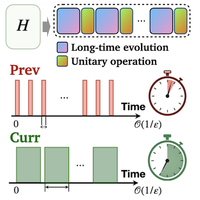
A new approach for learning Hamiltonians achieves the Heisenberg limit even when experiments cannot access short evolution times, easing a demanding control requirement.
G. H. dos Santos, K. B. Sawada, N. Villalba, C. Jara, N. Guerrero, C. Melo, M. H. Magiotto, D. Martinez, G. B. Xavier, J. Cariñe, G. Saavedra, E. S. Gómez, S. P. Walborn, and G. Lima
PRX Quantum 7, 043012 (2026) - Published 19 October, 2026
A four-dimensional quantum key distribution protocol utilizing full core-mode encoding over deployed multicore fibers is demonstrated, establishing a viable architecture for high-rate quantum-secure communications.
Oliver Diekmann, Enrico Di Benedetto, Nicolas Jungwirth, Daniele De Bernardis, Zeyu Kuang, Francesco Ciccarello, Stefan Rotter, Peter Rabl, Alejandro González-Tudela, and Carlos Gonzalez-Ballestero
PRX Quantum 7, 043013 (2026) - Published 20 October, 2026
Tailored coupling between giant atoms and a waveguide enables deterministic quantum state transfer at above 99% fidelity, without any time-dependent control.
Ignacio González, Sagnik Chakraborty, and Ángel Rivas
PRX Quantum 7, 043014 (2026) - Published 21 October, 2026
A unified theoretical framework allows one to measure thermodynamic quantities in strongly coupled quantum systems using only local information, offering a practical foundation for designing next-generation quantum thermal devices.
Zidu Liu and Dominik S. Wild
PRX Quantum 7, 043015 (2026) - Published 22 October, 2026
Exponential decay of correlations enables scalable reconstruction of many-qubit processes and their global properties from local measurements.
Athena Caesura, Cristian L. Cortes, William Pol, Sukin Sim, Mark Steudtner, Gian-Luca R. Anselmetti, Matthias Degroote, Nikolaj Moll, Raffaele Santagati, Michael Streif, and Christofer S. Tautermann
PRX Quantum 7, 049901 (2026) - Published 8 October, 2026