

- Open Access
Meson Spectroscopy of Exotic Symmetries of Ising Criticality in Rydberg Atom Arrays
PRX Quantum 7, 043018 – Published 27 October, 2026
DOI: https://doi.org/10.1103/w3zn-7xht
Abstract
The Ising model serves as a canonical platform for exploring emergent symmetry in quantum critical systems. The critical point of the 1D Ising chain is described by a conformal Ising field theory, which remains integrable in the presence of a magnetic perturbation, leading to massive particles associated with the exceptional Lie algebra . Weakly coupling two Ising chains into a ladder breaks this integrability and is predicted to bind the elementary kink excitations of the decoupled chains, giving rise to a richer spectrum of excitations described by the theory. Experimental signatures of excitations have arguably been observed in scattering studies of the spin chain material , but direct observation of the bound-state spectrum emerging from interchain coupling has remained elusive. Here, we probe these emergent symmetries in a Rydberg atom quantum processing unit, leveraging its tunable geometry to realize both chain and ladder configurations. We identify mass spectra consistent with at the single-chain critical point and, in the weakly coupled ladder, report the first signatures of the reorganization of Ising excitations into the bound-state spectrum predicted by symmetry. Our results demonstrate the power of Rydberg platforms for investigating symmetry emergence in quantum many-body systems and provide a direct window into the interplay of quasiparticle interactions, geometry, and criticality.
Physics Subject Headings (PhySH)
Popular Summary
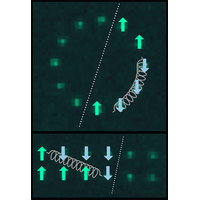
At a quantum critical point, the behavior of a many-body system can become largely independent of its microscopic details and instead be determined by an underlying symmetry. The one-dimensional Ising chain is a canonical example. When the system is perturbed at criticality by a magnetic field along the ordering direction, theory predicts eight particle-like excitations with mass ratios fixed by the exceptional Lie algebra , a symmetry that has its roots in quantum field theory and high-energy physics, where bound states of particles are commonly referred to as mesons. Evidence for this spectrum has been reported in the insulator . The chains in that material are not isolated, however: coupling between them is expected to bind their excitations into meson-like states, replacing the spectrum with a different set of states associated with the affine algebra . This reorganization has not previously been observed directly. Here, we realize both cases in a single device using individual rubidium atoms held in focused laser beams and excited to strongly interacting states. The traps can be positioned arbitrarily, allowing us to create a closed ring of atoms, an isolated chain, or two parallel rows forming a weakly coupled ladder. We prepare each system in a simple state and let it evolve, then use spectroscopy of the resulting magnetization dynamics to extract the system’s excitation spectrum. For the ring, the measured frequencies agree with the predicted mass ratios. For the ladder, we observe the emergence of bound, meson-like states and signatures of the spectrum, providing a direct view of the binding induced by interchain coupling. These results show how reconfigurable atom arrays can be used to study how emergent symmetries and their associated excitation spectra change with the geometry of a quantum system.
Article Text
Supplemental Material
References (58)
- G. Mussardo, Statistical field theory: An introduction to exactly solved models in statistical physics, in Oxford Graduate Texts, 2nd ed. (Oxford University Press, Oxford, 2020).
- A. B. Zamolodchikov, Integrals of motion and S-matrix of the (scaled) Ising model with magnetic field, Int. J. Mod. Phys. A 4, 4235 (1989).
- P. Fonseca and A. Zamolodchikov, Ising field theory in a magnetic field: Analytic properties of the free energy, J. Stat. Phys. 110, 527 (2003).
- P. Fonseca and A. Zamolodchikov, Ising spectroscopy I: Mesons at , arXiv:hep-th/0612304.
- R. Coldea, D. A. Tennant, E. M. Wheeler, E. Wawrzynska, D. Prabhakaran, M. Telling, K. Habicht, P. Smeibidl, and K. Kiefer, Quantum criticality in an Ising chain: Experimental evidence for emergent symmetry, Science 327, 177 (2010).
- A. LeClair, A. W. W. Ludwig, and G. Mussardo, Integrability of coupled conformal field theories, Nucl. Phys. B512, 523 (1998).
- Y. Gao, X. Wang, N. Xi, Y. Jiang, R. Yu, and J. Wu, Spin dynamics and dark particle in a weak-coupled quantum Ising ladder with spectrum, Phys. Rev. B 111, L201117 (2025).
- N. Xi, X. Wang, Y. Gao, Y. Jiang, R. Yu, and J. Wu, Emergent spectrum and topological soliton excitation in , Phys. Rev. B 112, L241104 (2025).
- S. B. Rutkevich, Energy spectrum of bound-spinons in the quantum Ising spin-chain ferromagnet, J. Stat. Phys. 131, 917 (2008).
- J. Greensite, An introduction to the confinement problem, in Lecture Notes in Physics, 2nd ed. (Springer, Cham, 2020), Vol. 972.
- J. A. Kjäll, F. Pollmann, and J. E. Moore, Bound states and symmetry effects in perturbed quantum Ising chains, Phys. Rev. B 83, 020407(R) (2011).
- M. Kormos, M. Collura, G. Takács, and P. Calabrese, Real-time confinement following a quantum quench to a non-integrable model, Nat. Phys. 13, 246 (2017).
- B. M. McCoy and T. T. Wu, Two-dimensional Ising field theory in a magnetic field: Breakup of the cut in the two-point function, Phys. Rev. D 18, 1259 (1978).
- J. Vovrosh and J. Knolle, Confinement and entanglement dynamics on a digital quantum computer, Sci. Rep. 11, 11577 (2021).
- F. Liu, R. Lundgren, P. Titum, G. Pagano, J. Zhang, C. Monroe, and A. V. Gorshkov, Confined quasiparticle dynamics in long-range interacting quantum spin chains, Phys. Rev. Lett. 122, 150601 (2019).
- W. L. Tan, P. Becker, F. Liu, G. Pagano, K. S. Collins, A. De, L. Feng, H. B. Kaplan, A. Kyprianidis, R. Lundgren, W. Morong, S. Whitsitt, A. V. Gorshkov, and C. Monroe, Domain-wall confinement and dynamics in a quantum simulator, Nat. Phys. 17, 742 (2021).
- F. B. Ramos, M. Lencsés, J. C. Xavier, and R. G. Pereira, Confinement and bound states of bound states in a transverse-field two-leg Ising ladder, Phys. Rev. B 102, 014426 (2020).
- G. Lagnese, F. M. Surace, M. Kormos, and P. Calabrese, Confinement in the spectrum of a Heisenberg–Ising spin ladder, J. Stat. Mech.:Theory Exp. 2020, 093106 (2020).
- C. Lamb, Y. Tang, R. Davis, and A. Roy, Ising meson spectroscopy on a noisy digital quantum simulator, Nat. Commun. 15, 5901 (2024).
- A. Browaeys and T. Lahaye, Many-body physics with individually controlled Rydberg atoms, Nat. Phys. 16, 132 (2020).
- P. Schauss, Quantum simulation of transverse Ising models with Rydberg atoms, Quantum Sci. Technol. 3, 023001 (2018).
- H. Labuhn, D. Barredo, S. Ravets, S. de Léséleuc, T. Macrì, T. Lahaye, and A. Browaeys, Tunable two-dimensional arrays of single Rydberg atoms for realizing quantum Ising models, Nature (London) 534, 667 (2016).
- J. Vovrosh, R. Mukherjee, A. Bastianello, and J. Knolle, Dynamical hadron formation in long-range interacting quantum spin chains, PRX Quantum 3, 040309 (2022).
- S. Birnkammer, A. Bastianello, and M. Knap, Prethermalization in one-dimensional quantum many-body systems with confinement, Nat. Commun. 13, 7663 (2022).
- R. Verdel, F. Liu, S. Whitsitt, A. V. Gorshkov, and M. Heyl, Real-time dynamics of string breaking in quantum spin chains, Phys. Rev. B 102, 014308 (2020).
- P. I. Karpov, G.-Y. Zhu, M. P. Heller, and M. Heyl, Spatiotemporal dynamics of particle collisions in quantum spin chains, Phys. Rev. Res. 4, L032001 (2022).
- A. Milsted, J. Liu, J. Preskill, and G. Vidal, Collisions of false-vacuum bubble walls in a quantum spin chain, PRX Quantum 3, 020316 (2022).
- R. G. Jha, A. Milsted, D. Neuenfeld, J. Preskill, and P. Vieira, Real-time scattering in Ising field theory using matrix product states, Phys. Rev. Res. 7, 023266 (2025).
- J. Schuhmacher, G.-X. Su, J. J. Osborne, A. Gandon, J. C. Halimeh, and I. Tavernelli, Observation of hadron scattering in a lattice gauge theory on a quantum computer, arXiv:2505.20387.
- F. M. Surace and A. Lerose, Scattering of mesons in quantum simulators, New. J. Phys. 23, 062001 (2021).
- E. R. Bennewitz, B. Ware, A. Schuckert, A. Lerose, F. M. Surace, R. Belyansky, W. Morong, D. Luo, A. De, K. S. Collins, O. Katz, C. Monroe, Z. Davoudi, and A. V. Gorshkov, Simulating meson scattering on spin quantum simulators, Quantum 9, 1773 (2025).
- G. Delfino and J. Viti, On the theory of quantum quenches in near-critical systems, J. Phys. A 50, 084004 (2017).
- M. Sorba, N. Defenu, and G. Delfino, Quantum quenches with long range interactions, Nucl. Phys. B1019, 117105 (2025).
- J. Knaute and P. Hauke, Relativistic meson spectra on ion-trap quantum simulators, Phys. Rev. A 105, 022616 (2022).
- L. Henriet, L. Beguin, A. Signoles, T. Lahaye, A. Browaeys, G.-O. Reymond, and C. Jurczak, Quantum computing with neutral atoms, Quantum 4, 327 (2020).
- R. Menu, Gaussian-State Approaches to Quantum Spin Systems Away From Equilibrium, Ph.D. thesis, Université de Lyon, 2020.
- P. Calabrese and J. Cardy, Time dependence of correlation functions following a quantum quench, Phys. Rev. Lett. 96, 136801 (2006).
- E. H. Lieb and D. W. Robinson, The finite group velocity of quantum spin systems, Commun. Math. Phys. 28, 251 (1972).
- M. Kebrič, J. C. Halimeh, U. Schollwöck, and F. Grusdt, Confinement in lattice gauge theories at finite temperature, Phys. Rev. B 109, 245110 (2024).
- G. Delfino, Correlation spreading and properties of the quantum state in quench dynamics, Phys. Rev. E 97, 062138 (2018).
- J. Mildenberger, W. Mruczkiewicz, J. C. Halimeh, Z. Jiang, and P. Hauke, Confinement in a lattice gauge theory on a quantum computer, Nat. Phys. 21, 312 (2025).
- T. A. Cochran, B. Jobst, E. Rosenberg, Y. D. Lensky, G. Gyawali, N. Eassa, M. Will, D. Abanin, R. Acharya, L. A. Beni et al., Visualizing dynamics of charges and strings in lattice gauge theories, Nature (London) 642, 315 (2025).
- K. Bidzhiev, S. Grava, P. le Henaff, M. Mendizabal, E. Merhej, and A. Quelle, Efficient emulation of neutral atom quantum hardware, arXiv:2510.09813.
- D. P. Kingma and J. Ba, Adam: A method for stochastic optimization, arXiv:1412.6980.
- J. Vovrosh, K. E. Khosla, S. Greenaway, C. Self, M. S. Kim, and J. Knolle, Simple mitigation of global depolarizing errors in quantum simulations, Phys. Rev. E 104, 035309 (2021).
- C. Dalyac et al., Noise-aware emulation and cross-device validation of neutral atom analog quantum processing units, arXiv:2607.28364.
- D. González-Cuadra, M. Hamdan, T. V. Zache, B. Braverman, M. Kornjača, A. Lukin, S. H. Cantú, F. Liu, S.-T. Wang, A. Keesling, M. D. Lukin, P. Zoller, and A. Bylinskii, Observation of string breaking on a Rydberg quantum simulator, Nature (London) 642, 321 (2025).
- A. Yoshinaga, H. Hakoshima, T. Imoto, Y. Matsuzaki, and R. Hamazaki, Emergence of Hilbert space fragmentation in Ising models with a weak transverse field, Phys. Rev. Lett. 129, 090602 (2022).
- L. Zhao, P. R. Datla, W. Tian, M. M. Aliyu, and H. Loh, Observation of quantum thermalization restricted to Hilbert space fragments and scars, Phys. Rev. X 15, 011035 (2025).
- S. Karch, S. Bandyopadhyay, Z.-H. Sun, A. Impertro, S. Huh, I. P. Rodríguez, J. F. Wienand, W. Ketterle, M. Heyl, A. Polkovnikov, I. Bloch, and M. Aidelsburger, Probing quantum many-body dynamics using subsystem loschmidt echos, arXiv:2501.16995.
- T. J. Osborne, Hamiltonian complexity, Rep. Prog. Phys. 75, 022001 (2012).
- P. Coleman, Introduction to Many-Body Physics (Cambridge University Press, Cambridge, 2015).
- A. Paszke et al., Pytorch: An imperative style, high-performance deep learning library, arXiv:1912.01703.
- S. de Léséleuc, D. Barredo, V. Lienhard, A. Browaeys, and T. Lahaye, Analysis of imperfections in the coherent optical excitation of single atoms to Rydberg states, Phys. Rev. A 97, 053803 (2018).
- H. Silvério, S. Grijalva, C. Dalyac, L. Leclerc, P. J. Karalekas, N. Shammah, M. Beji, L.-P. Henry, and L. Henriet, Pulser: An open-source package for the design of pulse sequences in programmable neutral-atom arrays, Quantum 6, 629 (2022).
- P. Scholl, M. Schuler, H. J. Williams, A. A. Eberharter, D. Barredo, K.-N. Schymik, V. Lienhard, L.-P. Henry, T. C. Lang, T. Lahaye, A. M. Läuchli, and A. Browaeys, Quantum simulation of 2d antiferromagnets with hundreds of Rydberg atoms, Nature (London) 595, 233 (2021).
- A. L. Shaw, Z. Chen, J. Choi, D. K. Mark, P. Scholl, R. Finkelstein, A. Elben, S. Choi, and M. Endres, Benchmarking highly entangled states on a 60-atom analogue quantum simulator, Nature (London) 628, 71 (2024).
- See Supplemental Material at, which also contains Refs. [53–58], for further details on the experimental implementation, together with the data and noise analysis. http://link.aps.org/supplemental/10.1103/w3zn-7xht for brief description.

