

- Open Access
Free Mutual Information and Higher-Point Out-of-Time-Ordered Correlators
PRX Quantum 7, 043017 – Published 26 October, 2026
DOI: https://doi.org/10.1103/wt7l-6385
Abstract
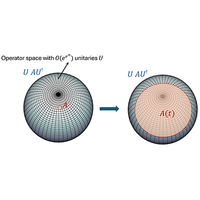
We introduce a quantity called the free mutual information (FMI), adapted from concepts in free probability theory, as a new physical measure of quantum chaos. This quantity captures the spreading of a time-evolved operator in the space of all possible operators on the Hilbert space, which is doubly exponential in the number of degrees of freedom. It thus provides a finer notion of operator spreading than the well-understood phenomenon of operator growth in physical space. We derive two central results which apply in any physical system: first, an explicit “Coulomb gas” formula for the FMI of two observables and in terms of the eigenvalues of the product operator ; and second, a general relation expressing the FMI as a weighted sum of all higher-point out-of-time-ordered correlators (OTOCs). This second result provides a precise information-theoretic interpretation for the higher-point OTOCs as collectively quantifying operator ergodicity and the approach to freeness. This physical interpretation is particularly useful in light of recent progress in experimentally measuring higher-point OTOCs. We identify universal behaviors of the FMI and higher-point OTOCs across a variety of chaotic systems, including random unitary circuits and chaotic spin chains, which indicate that spreading in the doubly exponential operator space is a generic feature of quantum many-body chaos. At the same time, the non-generic behavior of the FMI in various non-chaotic systems, including certain unitary designs, shows that there are cases where an operator spreads in physical space but remains localized in operator space. The FMI is thus a sharper diagnostic of chaos than the standard four-point OTOC.
Physics Subject Headings (PhySH)
Popular Summary
In classical chaos, it is well known that the trajectory of a chaotic particle fills the entire space available to it at late times. It is natural to ask whether a similar notion exists in the much more complex world of quantum chaotic dynamics. In this paper, we address this question, using a new measure of the volume of a quantum operator in the enormous space of all available operators, which is doubly exponential in the number of physical constituents of the system. We show that in quantum chaotic systems, the volume universally grows to fill this entire space. This volume growth indicates that chaotic dynamics typically set the final operator “free” from the initial operator in a precise mathematical sense. We find a general relation that allows us to deduce the value of the abstract volume measure from concrete experimental observables, which have recently been measured on cutting-edge quantum platforms.
Article Text
References (112)
- B. V. Chirikov, A universal instability of many-dimensional oscillator systems, Phys. Rep. 52, 263 (1979).
- A. J. Lichtenberg and M. A. Lieberman, Regular and Chaotic Dynamics, Applied Mathematical Sciences, Vol. 38, 2nd ed. (New York, Springer-Verlag, 1992).
- A. I. Larkin and Y. N. Ovchinnikov, Quasiclassical method in the theory of superconductivity, Sov. J. Exp. Theor. Phys. 28, 1200 (1969), https://jetp.ras.ru/cgi-bin/e/index/e/28/6/p1200?a=list.
- D. A. Roberts, D. Stanford, and A. Streicher, Operator growth in the SYK model, J. High Energy Phys. 06 (2018), 122 (2018).
- D. A. Roberts, D. Stanford, and L. Susskind, Localized shocks, J. High Energy Phys. 03 (2015), 051 (2015).
- S. Xu and B. Swingle, Scrambling dynamics and out-of-time-ordered correlators in quantum many-body systems, PRX Quantum 5, 010201 (2024).
- S. H. Shenker and D. Stanford, Black holes and the butterfly effect, J. High Energy Phys. 03 (2014) 067.
- S. H. Shenker and D. Stanford, Multiple shocks, J. High Energy Phys. 12 (2014) 046.
- A. Almheiri, D. Marolf, J. Polchinski, D. Stanford, and J. Sully, An apologia for firewalls, J. High Energy Phys. 09 (2013) 018.
- A. Kitaev, Hidden correlations in the Hawking radiation and thermal noise, in talk at the 2015 Breakthrough Prize Symposium, held at Stanford University, Stanford, CA, USA, November 10, 2014, https://www.youtube.com/watch?v=OQ9qN8j7EZI.
- J. Maldacena, S. H. Shenker, and D. Stanford, A bound on chaos, J. High Energy Phys. 08 (2016) 106.
- J. Maldacena and D. Stanford, Remarks on the Sachdev-Ye-Kitaev model, Phys. Rev. D 94, 106002 (2016).
- S. H. Shenker and D. Stanford, Stringy effects in scrambling, J. High Energy Phys. 05 (2015) 132, (2015).
- V. Khemani, D. A. Huse, and A. Nahum, Velocity-dependent Lyapunov exponents in many-body quantum, semiclassical, and classical chaos, Phys. Rev. B 98, 144304 (2018).
- D. Voiculescu, The analogues of entropy and of Fisher’s information measure in free probability theory I, Commun. Math. Phys. 155, 71 (1993).
- D. Voiculescu, The analogues of entropy and of Fisher’s information measure in free probability theory II, Inventiones Math. 118, 411 (1994).
- D. Voiculescu, The analogues of entropy and of Fisher’s information measure in free probability theory III: The absence of cartan subalgebras, Geometric Funct. Anal. 6, 172 (1996).
- D. Voiculescu, The analogues of entropy and of Fisher’s information measure in free probability theory IV: Maximum entropy, Free Probab. Theory 12, 293 (1997).
- D. Voiculescu, The analogues of entropy and of Fisher’s information measure in free probability theory V: Noncommutative hilbert transforms, Inventiones Math. 132, 189 (1998).
- D. Voiculescu, The analogues of entropy and of Fisher’s information measure in free probability theory VI: Liberation and mutual free information, Adv. Math. 146, 101 (1999).
- D. Voiculescu, Free entropy, Bull. London Math. Soc. 34, 257 (2016).
- F. Hiai and D. Petz, Large deviations for functions of two random projection matrices, arXiv:math/0504435.
- F. Hiai, T. Miyamoto, and Y. Ueda, Orbital approach to microstate free entropy, Int. J. Math. 20, 227 (2009).
- B. Collins and T. Kemp, Liberation of projections, J. Funct. Anal. 266, 1988 (2014).
- A. Nica and R. Speicher, in Lectures on the Combinatorics of Free Probability, London Mathematical Society Lecture Note Series, 335 (Cambridge University Press, Cambridge, UK, 2006).
- M. Fava, J. Kurchan, and S. Pappalardi, Designs via free probability, Phys. Rev. X 15, 011031 (2025).
- E. Vallini and S. Pappalardi, Long-time freeness in the kicked top, arXiv:2411.12050.
- N. Dowling, J. De Nardis, M. Heinrich, X. Turkeshi, and S. Pappalardi, Free independence and unitary design from random matrix product unitaries, arXiv:2508.00051.
- H. J. Chen and J. Kudler-Flam, Free independence and the noncrossing partition lattice in dual-unitary quantum circuits, Phys. Rev. B 111, 014311 (2025).
- G. Cipolloni, László Erdős, and D. Schröder, Thermalisation for wigner matrices, J. Funct. Anal. 282, 109394 (2022).
- V. Chandrasekaran, G. Penington, and E. Witten, Large N algebras and generalized entropy, J. High Energy Phys. 04 (2023), 009 (2023).
- G. Penington and E. Tabor, The algebraic structure of gravitational scrambling, arXiv:2508.21062.
- H. A. Camargo, Y. Fu, V. Jahnke, K. Pal, and K.-Y. Kim, Quantum signatures of chaos from free probability, J. High Energy Phys. 10 (2025), 138 (2025).
- V. Jahnke, P. Nandy, K. Pal, H. A. Camargo, and K.-Y. Kim, Free probability approach to spectral and operator statistics in Rosenzweig-Porter random matrix ensembles, J. High Energy Phys. 12 (2025), 002 (2025).
- F. Fritzsch and P. W. Claeys, Free probability in a minimal quantum circuit model, Phys. Rev. X 16, 031027 (2026).
- F. Fritzsch, G. O. Alves, M. A. Rampp, and P. W. Claeys, Free cumulants and full eigenstate thermalization from boundary scrambling, arXiv:2509.08060.
- J. Cotler, N. Hunter-Jones, J. Liu, and B. Yoshida, Chaos, complexity, and random matrices, J. High Energy Phys. 11 (2017), 048 (2017).
- L. Leone, S. F. E. Oliviero, Y. Zhou, and A. Hamma, Quantum chaos is quantum, Quantum 5, 453 (2021).
- P. Basu, S. Das, and P. Nandy, Complexity of quadratic quantum chaos, J. High Energy Phys. 04 (2026) 081 (2026).
- F. M. Haehl and M. Rozali, Fine grained chaos in gravity, Phys. Rev. Lett. 120, 121601 (2018).
- F. M. Haehl and M. Rozali, Effective field theory for chaotic CFTs, J. High Energy Phys. 10, (2018) 118.
- P. Saad, Late time correlation functions, baby universes, and ETH in JT gravity, arXiv:1910.10311.
- N. Yunger Halpern, B. Swingle, and J. Dressel, Quasiprobability behind the out-of-time-ordered correlator, Phys. Rev. A 97, 042105 (2018).
- N. Yunger Halpern, A. Bartolotta, and J. Pollack, Entropic uncertainty relations for quantum information scrambling, Commun. Phys. 2, 92 (2019).
- Google Quantum AI and Collaborators, Observation of constructive interference at the edge of quantum ergodicity, Nature (London) 646, 825 (2025).
- N. Y. Yao, F. Grusdt, B. Swingle, M. D. Lukin, D. M. Stamper-Kurn, J. E. Moore, and E. A. Demler, Interferometric approach to probing fast scrambling, arXiv:1607.01801.
- B. Swingle, G. Bentsen, M. Schleier-Smith, and P. Hayden, Measuring the scrambling of quantum information, Phys. Rev. A 94, 040302(R) (2016).
- M. Gärttner, J. G. Bohnet, A. Safavi-Naini, M. L. Wall, J. J. Bollinger, and A. M. Rey, Measuring out-of-time-order correlations and multiple quantum spectra in a trapped-ion quantum magnet, Nat. Phys. 13, 781 (2017).
- B. Vermersch, A. Elben, L. M. Sieberer, N. Y. Yao, and P. Zoller, Probing scrambling using statistical correlations between randomized measurements, Phys. Rev. X 9, 021061 (2019).
- J. Li, R. Fan, H. Wang, B. Ye, B. Zeng, H. Zhai, X. Peng, and J. Du, Measuring out-of-time-order correlators on a nuclear magnetic resonance quantum simulator, Phys. Rev. X 7, 031011 (2017).
- Y.-C. Li, T.-G. Zhou, S. Zhang, Z. Wu, L. Zhao, H. Yin, X. An, H. Zhai, P. Zhang, X. Peng, and J. Du, Error-resilient reversal of quantum chaotic dynamics enabled by scramblons, Phys. Rev. Lett. 136, 060403 (2026).
- T. Metger, A. Poremba, M. Sinha, and H. Yuen, Simple constructions of linear-depth t-designs and pseudorandom unitaries, in 2024 IEEE 65th Annual Symposium on Foundations of Computer Science (FOCS) (IEEE Computer Society Press, Los Alamitos, CA, USA, 2024), pp. 485–492.
- D. A. Roberts and B. Yoshida, Chaos and complexity by design, J. High Energy Phys. 04 (2017), 121 (2017).
- T. Schuster, J. Haferkamp, and H.-Y. Huang, Random unitaries in extremely low depth, Science 389, 92 (2025).
- E. T. Jaynes, Information theory and statistical mechanics, Phys. Rev. 106, 620 (1957).
- E. T. Jaynes, Information theory and statistical mechanics. II, Phys. Rev. 108, 171 (1957).
- N. Engelhardt and A. C. Wall, Decoding the apparent horizon: Coarse-grained holographic entropy, Phys. Rev. Lett. 121, 211301 (2018).
- D. Šafránek, J. M. Deutsch, and A. Aguirre, Quantum coarse-grained entropy and thermodynamics, Phys. Rev. A 99, 010101 (2019).
- D. Šafránek, A. Aguirre, J. Schindler, and J. M. Deutsch, A brief introduction to observational entropy, Found. Phys. 51, 101 (2021).
- P. Hosur, X.-L. Qi, D. A. Roberts, and B. Yoshida, Chaos in quantum channels, J. High Energy Phys. 02 (2016), 004 (2016).
- P. Glorioso, X.-L. Qi, and Z. Yang, Space-time generalization of mutual information, J. High Energy Phys. 05 (2024), 338 (2024).
- Z. Wu, A. J. Parzygnat, V. Vedral, and J. Fullwood, Quantum mutual information in time, New J. Phys. 27, 064504 (2025).
- A. Milekhin, Z. Adamska, and J. Preskill, Observable and computable entanglement in time, arXiv:2502.12240.
- K. Doi, J. Harper, A. Mollabashi, T. Takayanagi, and Y. Taki, Timelike entanglement entropy, J. High Energy Phys. 05, (2023) 052.
- Y. Nakata, T. Takayanagi, Y. Taki, K. Tamaoka, and Z. Wei, New holographic generalization of entanglement entropy, Phys. Rev. D 103, 026005 (2021).
- J. F. Fitzsimons, J. A. Jones, and V. Vedral, Quantum correlations which imply causation, Sci. Rep. 5, 18281 (2016).
- D. Horsman, C. Heunen, M. F. Pusey, J. Barrett, and R. W. Spekkens, Can a quantum state over time resemble a quantum state at a single time?, Proc. R. Soc. A 473, 20170395 (2017).
- J. Fullwood and A. J. Parzygnat, On quantum states over time, Proc. R. Soc. A 478, 20220104 (2022).
- Aé Berthiaume, W. van Dam, and S. Laplante, Quantum Kolmogorov complexity, J. Comput. Syst. Sci. 63, 201 (2001).
- P. Gács, Quantum algorithmic entropy, J. Phys. A 34, 6859 (2001).
- Y. Yang, R. Renner, and G. Chiribella, Optimal universal programming of unitary gates, Phys. Rev. Lett. 125, 210501 (2020).
- J. Wang, Towards an information theory of scrambling, PIRSA: 25060025, https://pirsa.org/25060025.
- S. Vardhan and J. Wang (To be published).
- M. M. Wolf, F. Verstraete, M. B. Hastings, and J. I. Cirac, Area laws in quantum systems: Mutual information and correlations, Phys. Rev. Lett. 100, 070502 (2008).
- A. Nahum, S. Vijay, and J. Haah, Operator spreading in random unitary circuits, Phys. Rev. X 8, 021014 (2018).
- C. W. von Keyserlingk, T. Rakovszky, F. Pollmann, and S. L. Sondhi, Operator hydrodynamics, OTOCs, and entanglement growth in systems without conservation laws, Phys. Rev. X 8, 021013 (2018).
- R. Speicher, Lecture notes on” free probability theory, arXiv:1908.08125.
- T. Zhou and A. Nahum, Emergent statistical mechanics of entanglement in random unitary circuits, Phys. Rev. B 99, 174205 (2019).
- M. Mezei and D. Stanford, On entanglement spreading in chaotic systems, J. High Energy Phys. 05 (2017), 065 (2017).
- C. Jonay, D. A. Huse, and A. Nahum, Coarse-grained dynamics of operator and state entanglement, arXiv:1803.00089.
- Z. Webb, The Clifford group forms a unitary 3-design, Quantum Inf. Comput. 16, 1379 (2016).
- F. Dupuis, The decoupling approach to quantum information theory, arXiv:1004.1641.
- P. Hayden and J. Preskill, Black holes as mirrors: Quantum information in random subsystems, J. High Energy Phys. 09 (2007), 120 (2007).
- P. Hayden, M. Horodecki, A. Winter, and J. Yard, A decoupling approach to the quantum capacity, Open Syst. Inf. Dyn. 15, 7 (2008).
- N. Lashkari, D. Stanford, M. Hastings, T. Osborne, and P. Hayden, Towards the fast scrambling conjecture, J. High Energy Phys. 04 (2013), 022 (2013).
- W. Brown and O. Fawzi, Decoupling with random quantum circuits, Commun. Math. Phys. 340, 867 (2015).
- E. Onorati, O. Buerschaper, M. Kliesch, W. Brown, A. H. Werner, and J. Eisert, Mixing properties of stochastic quantum hamiltonians, Commun. Math. Phys. 355, 905 (2017).
- H. Zhu, R. Kueng, M. Grassl, and D. Gross, The Clifford group fails gracefully to be a unitary 4-design, arXiv:1609.08172.
- T. Prosen and I. Pižorn, Operator space entanglement entropy in a transverse Ising chain, Phys. Rev. A 76, 032316 (2007).
- L. Leone, S. F. E. Oliviero, and A. Hamma, Stabilizer Rényi entropy, Phys. Rev. Lett. 128, 050402 (2022).
- F. Ma and H.-Y. Huang, How to construct random unitaries, arXiv:2410.10116.
- C.-F. Chen, J. Haah, J. Haferkamp, Y. Liu, T. Metger, and X. Tan, Incompressibility and spectral gaps of random circuits, arXiv:2406.07478.
- S. Sachdev, Quantum phase transitions, Phys. World 12, 33 (1999).
- D. Rattacaso, L. Leone, S. F. E. Oliviero, and A. Hamma, Stabilizer entropy dynamics after a quantum quench, Phys. Rev. A 108, 042407 (2023).
- S. Xu and B. Swingle, Accessing scrambling using matrix product operators, Nat. Phys. 16, 199 (2020).
- S. Gopalakrishnan, D. A. Huse, V. Khemani, and R. Vasseur, Hydrodynamics of operator spreading and quasiparticle diffusion in interacting integrable systems, Phys. Rev. B 98, 220303 (2018).
- D. A. Trunin, Quantum chaos without false positives, Phys. Rev. D 108, L101703 (2023).
- D. A. Trunin, Refined quantum Lyapunov exponents from replica out-of-time-order correlators, Phys. Rev. D 108, 105023 (2023).
- A. Connes, H. Narnhofer, and W. Thirring, Dynamical entropy of, algebras and von neumann algebras, Commun. Math. Phys. 112, 691 (1987).
- R. Alicki and M. Fannes, Defining quantum dynamical entropy, Lett. Math. Phys. 32, 75 (1994).
- D. Voiculescu, Alternative entropies in operator algebras, in First European Congress of Mathematics Paris, July 6-10, 1992: Vol. II: Invited Lectures (Birkhäuser Verlag, Basel, Switzerland, 1994), Vol. 2, pp. 475–483.
- D. Voiculescu, Dynamical approximation entropies and topological entropy in operator algebras, Commun. Math. Phys. 170, 249 (1995).
- F. G. S. L. Brandão, A. W. Harrow, and M. Horodecki, Local random quantum circuits are approximate polynomial-designs, Commun. Math. Phys. 346, 397 (2016).
- F. G. S. L. Brandão, W. Chemissany, N. Hunter-Jones, R. Kueng, and J. Preskill, Models of quantum complexity growth, PRX Quantum 2, 030316 (2021).
- C.-F. Chen, J. Haah, J. Haferkamp, Y. Liu, T. Metger, and X. Tan, Incompressibility and spectral gaps of random circuits, arXiv:2406.07478.
- P. Biane, Free Brownian motion, free stochastic calculus and random matrices, in Free Probability Theory, Fields Institute Communications, 12 (American Mathematical Society, Providence, RI, USA, 1997), pp. 1–19.
- P. Biane, M. Capitaine, and A. Guionnet, Large deviation bounds for matrix Brownian motion, Inventiones Math. 152, 433 (2003).
- B. Collins, Product of random projections, Jacobi ensembles and universality problems arising from free probability, Prob. Theory Relat. fields 133, 315 (2005).
- V. Braverman, A. Krishnan, and C. Musco, Sublinear time spectral density estimation, in Proceedings of the 54th Annual ACM SIGACT Symposium on Theory of Computing (Association for Computing Machinery (ACM), New York, NY, USA, 2022), pp. 1144–1157.
- B. S. Mityagin, The zero set of a real analytic function, Math. Notes 107, 529 (2020).
- S. G. Krantz and H. R. Parks, A Primer of Real Analytic Functions (Birkhäuser, Boston, MA, USA, 2002).
- B. Collins, Moments and cumulants of polynomial random variables on unitarygroups, the Itzykson-Zuber integral, and free probability, Int. Math. Res. Not. 2003, 953 (2003).

