

- Open Access
Heisenberg-Limited Hamiltonian Learning Without Short-Time Control
PRX Quantum 7, 043011 – Published 16 October, 2026
DOI: https://doi.org/10.1103/kjvf-jgqj
Abstract
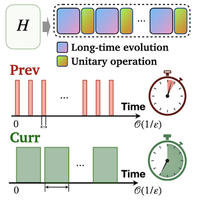
Characterizing quantum systems by learning their underlying Hamiltonians is a central task in quantum information science. While recent algorithmic advances have achieved near-optimal efficiency in this task, they critically rely on accessing arbitrarily short-time dynamics. This reliance poses severe experimental challenges due to finite control bandwidth and transient pulse errors. In this work, we demonstrate that Heisenberg-limited Hamiltonian learning can be achieved without short-time control. We introduce a framework in which every query to the unknown dynamics has duration at least a prescribed minimum time , and show that this restriction does not preclude Heisenberg-limited scaling. The key ingredient is a method for emulating the continuous quantum control required by iterative learning algorithms using only such lower-bounded evolution times. This reduces the learning task to sparse pure-state tomography. Notably, for logarithmically sparse Hamiltonians, our algorithm achieves the information-theoretically optimal scaling in total evolution time for any arbitrary constant minimum evolution time . For many-body (polynomially sparse) systems, we uncover a rigorous quantitative tradeoff, showing that the minimum required evolution time can be significantly relaxed from the standard limit at a polynomial cost in total evolution time. Our results affirmatively resolve a prominent open problem in the field and reveal that high-bandwidth, ultra-short pulses are not fundamentally necessary for optimal quantum learning.
Physics Subject Headings (PhySH)
Popular Summary
Accurate knowledge of a quantum system’s interactions is essential for predicting, controlling its dynamics and benchmarking quantum devices. Existing methods for learning these interactions with optimal precision often rely on very short evolutions, which can be difficult to implement when experimental controls require finite switching times. We develop a Hamiltonian learning algorithm that replaces short evolutions with longer ones. For systems with sufficiently few interaction terms, the algorithm retains Heisenberg-limited scaling, in which the estimation error decreases essentially inversely with the total evolution time, despite a fixed lower bound on the duration of every evolution. For systems with more interaction terms, we quantify the trade-off between this minimum duration and the resources required for learning. Our results show that ultrashort evolution is not a prerequisite for Heisenberg-limited Hamiltonian learning and identify the control resources needed to achieve this precision under experimentally motivated timing constraints.
Article Text
References (54)
- J. Wang, S. Paesani, R. Santagati, S. Knauer, A. A. Gentile, N. Wiebe, F. Petruccione, J. L. O’Brien, J. G. Rarity, and A. Laing, Experimental quantum Hamiltonian learning, Nat. Phys. 13, 551 (2017).
- S. Pang and T. A. Brun, Quantum metrology for a general Hamiltonian parameter, Phys. Rev. A 90, 022117 (2014).
- R. Shaffer, E. Megidish, J. Broz, W.-T. Chen, and H. Häffner, Practical verification protocols for analog quantum simulators, npj Quantum Inf. 7, 46 (2021).
- A. Gu, L. Cincio, and P. J. Coles, Practical Hamiltonian learning with unitary dynamics and Gibbs states, Nat. Commun. 15, 312 (2024).
- H.-Y. Huang, Y. Tong, D. Fang, and Y. Su, Learning many-body Hamiltonians with Heisenberg-limited scaling, Phys. Rev. Lett. 130, 200403 (2023).
- W. Yu, J. Sun, Z. Han, and X. Yuan, Robust and efficient Hamiltonian learning, Quantum 7, 1045 (2023).
- M. Ma, S. T. Flammia, J. Preskill, and Y. Tong, Learning k-body Hamiltonians via compressed sensing, IEEE Trans. Info. Theor. 72, 7553 (2026).10.1109/TIT.2026.3720996
- H.-Y. Hu, M. Ma, W. Gong, Q. Ye, Y. Tong, S. T. Flammia, and S. F. Yelin, Hamiltonian learning with Heisenberg-limited scaling, PRX Quantum 6, 040315 (2025).
- A. Abbas, N. Cerrato, F. E. Gutiérrez, D. Grinko, F. A. Mele, and P. Sinha, Nearly optimal algorithms to learn sparse quantum Hamiltonians in physically motivated distances, (2026), arXiv:2509.09813v2.
- H. Li, Y. Tong, T. Gefen, H. Ni, and L. Ying, Heisenberg-limited Hamiltonian learning for interacting bosons, npj Quantum Inf. 10, 83 (2024).
- A. Zhao, Learning the structure of any Hamiltonian from minimal assumptions, in Proceedings of the 57th Annual ACM Symposium on Theory of Computing (Association for Computing Machinery, New York, NY, USA, 2025), pp. 1201–1211, 10.1145/3717823.3718115.
- M. P. da Silva, O. Landon-Cardinal, and D. Poulin, Practical characterization of quantum devices without tomography, Phys. Rev. Lett. 107, 210404 (2011).
- N. Wiebe, C. Granade, C. Ferrie, and D. G. Cory, Hamiltonian learning and certification using quantum resources, Phys. Rev. Lett. 112, 190501 (2014).
- A. Dutkiewicz, T. E. O’Brien, and T. Schuster, The advantage of quantum control in many-body Hamiltonian learning, Quantum 8, 1537 (2024).
- A. Zubida, E. Yitzhaki, N. H. Lindner, and E. Bairey, Optimal short-time measurements for Hamiltonian learning (2021), arXiv:2108.08824.
- J. Haah, R. Kothari, and E. Tang, Optimal learning of quantum Hamiltonians from high-temperature Gibbs states, in 2022 IEEE 63rd Annual Symposium on Foundations of Computer Science (FOCS) (IEEE Computer Society, Los Alamitos, CA, USA, 2022), pp. 135–146, 10.1109/FOCS54457.2022.00020.
- A. Bakshi, A. Liu, A. Moitra, and E. Tang, Structure learning of Hamiltonians from real-time evolution, in 2024 IEEE 65th Annual Symposium on Foundations of Computer Science (FOCS) (IEEE Computer Society, Los Alamitos, CA, 2024), pp. 1037–1050, 10.1109/FOCS61266.2024.00069.
- A. M. Childs, Y. Su, M. C. Tran, N. Wiebe, and S. Zhu, Theory of trotter error with commutator scaling, Phys. Rev. X 11, 011020 (2021).
- S. Blanes and F. Casas, A Concise Introduction to Geometric Numerical Integration (CRC Press, Boca Raton, FL, USA, 2026).
- D. W. Berry, G. Ahokas, R. Cleve, and B. C. Sanders, Efficient quantum algorithms for simulating sparse Hamiltonians, Commun. Math. Phys. 270, 359 (2007).
- S. Gustavsson, O. Zwier, J. Bylander, F. Yan, F. Yoshihara, Y. Nakamura, T. P. Orlando, and W. D. Oliver, Improving quantum gate fidelities by using a qubit to measure microwave pulse distortions, Phys. Rev. Lett. 110, 040502 (2013).
- M. Jerger, A. Kulikov, Zénon Vasselin, and A. Fedorov, In situ characterization of qubit control lines: A qubit as a vector network analyzer, Phys. Rev. Lett. 123, 150501 (2019).
- M. A. Rol, L. Ciorciaro, F. K. Malinowski, B. M. Tarasinski, R. E. Sagastizabal, C. C. Bultink, Y. Salathe, N. Haandbaek, J. Sedivy, and L. DiCarlo, Time-domain characterization and correction of on-chip distortion of control pulses in a quantum processor, Appl. Phys. Lett. 116, 054001 (2020).
- C. Hellings, N. Lacroix, A. Remm, R. Boell, J. Herrmann, S. Lazăr, S. Krinner, F. Swiadek, C. K. Andersen, C. Eichler et al., Calibrating magnetic flux control in superconducting circuits by compensating distortions on timescales from nanoseconds up to tens of microseconds, Phys. Rev. Res. 7, 043142 (2025).
- D. Hangleiter, I. Roth, Jáš Fuksa, J. Eisert, and P. Roushan, Robustly learning the Hamiltonian dynamics of a superconducting quantum processor, Nat. Commun. 15, 9595 (2024).
- T. I. Andersen, N. Astrakhantsev, A. H. Karamlou, J. Berndtsson, J. Motruk, A. Szasz, J. A. Gross, A. Schuckert, T. Westerhout, Y. Zhang et al., Thermalization and criticality on an analogue–digital quantum simulator, Nature (London) 638, 79 (2025).
- G. H. Low and I. L. Chuang, Optimal Hamiltonian simulation by quantum signal processing, Phys. Rev. Lett. 118, 010501 (2017).
- G. H. Low and I. L. Chuang, Hamiltonian simulation by qubitization, Quantum 3, 163 (2019).
- A. Gilyén, Y. Su, G. H. Low, and N. Wiebe, Quantum singular value transformation and beyond: Exponential improvements for quantum matrix arithmetics, in Proceedings of the 51st Annual ACM SIGACT Symposium on Theory of Computing (Association for Computing Machinery, New York, NY, USA, 2019), pp. 193–204, 10.1145/3313276.3316366.
- A. M. Childs and N. Wiebe, Hamiltonian simulation using linear combinations of unitary operations, Quantum Inf. Comput. 12, 901 (2012).
- D. W. Berry, A. M. Childs, R. Cleve, R. Kothari, and R. D. Somma, Simulating Hamiltonian dynamics with a truncated Taylor series,, Phys. Rev. Lett. 114, 090502 (2015).
- X.-M. Zhang and X. Yuan, Circuit complexity of quantum access models for encoding classical data, npj Quantum Inf. 10, 42 (2024).
- J. Haah, R. Kothari, R. O’Donnell, and E. Tang, Query-optimal estimation of unitary channels in diamond distance, in 2023 IEEE 64th Annual Symposium on Foundations of Computer Science (FOCS) (IEEE Computer Society, Los Alamitos, CA, 2023), pp. 363–390, 10.1109/FOCS57990.2023.00028.
- J. Haah, M. B. Hastings, R. Kothari, and G. H. Low, Quantum algorithm for simulating real time evolution of lattice Hamiltonians, SIAM J. Comput. 52, FOCS18-250 (2021), 10.1137/18M1231511.
- A. M. Childs and Y. Su, Nearly optimal lattice simulation by product formulas, Phys. Rev. Lett. 123, 050503 (2019).
- A. Bakshi, A. Liu, A. Moitra, and E. Tang, Learning quantum Hamiltonians at any temperature in polynomial time, in Proceedings of the 56th Annual ACM Symposium on Theory of Computing (Association for Computing Machinery, New York, NY, USA, 2024), pp. 1470–1477, 10.1145/3618260.3649619.
- S. Brahmachari, S. Zhu, I. Marvian, and Y. Tong, Learning Hamiltonians in the Heisenberg limit with static single-qubit fields (2026), arXiv:2601.10380.
- S. Chen, J. Cotler, and H.-Y. Huang, Quantum probe tomography (2025) arXiv:2510.08499.
- D. Aharonov, J. Cotler, and X.-L. Qi, Quantum algorithmic measurement, Nat. Commun. 13, 887 (2022).
- M. L. LaBorde and M. M. Wilde, Quantum algorithms for testing Hamiltonian symmetry, Phys. Rev. Lett. 129, 160503 (2022).
- A. She and H. Yuen, Unitary property testing lower bounds by polynomials, in 14th Innovations in Theoretical Computer Science Conference (ITCS 2023), Leibniz International Proceedings in Informatics, Vol. 251, edited by Y. Tauman Kalai (Schloss Dagstuhl – Leibniz-Zentrum für Informatik, Dagstuhl, Germany, 2023), pp. 96:1–96:17.
- A. Bluhm, M. C. Caro, and A. Oufkir, Hamiltonian property testing, Quantum 10, 1979 (2026).
- S. Arunachalam, A. Dutt, and F. Escudero Gutiérrez, Testing and learning structured quantum Hamiltonians, in Proceedings of the 57th Annual ACM Symposium on Theory of Computing (Association for Computing Machinery, New York, NY, USA, 2025), pp. 1263–1270, 10.1145/3717823.3718289.
- J. Kallaugher and D. Liang, Hamiltonian Locality Testing via Trotterized Postselection, in 20th Conference on the Theory of Quantum Computation, Communication and Cryptography (TQC 2025), Leibniz International Proceedings in Informatics 350, edited by B. Fefferman (2025), 10:1, 10.4230/LIPIcs.TQC.2025.10
- M. Gao, Z. Ji, Q. Wang, W. Yu, and Q. Zhao, Quantum Hamiltonian certification, in Proceedings of the 2026 Annual ACM-SIAM Symposium on Discrete Algorithms (SODA) (Society for Industrial and Applied Mathematics, Philadelphia, PA, USA, 2026), pp. 1424–1467, 10.1137/1.9781611978971.53.
- A. Bluhm, M. C. Caro, F. E. Gutiérrez, A. Oufkir, and C. Rouzé, Certifying and learning quantum Ising Hamiltonians (2025) arXiv:2509.10239.
- J. Lee and M. Shin, Optimal certification of constant-local Hamiltonians (2025), arXiv:2512.09778.
- A. Bluhm, M. C. Caro, F. E. Gutiérrez, J. Lee, A. Oufkir, C. Rouzé, and M. Shin, Certifying and learning local quantum Hamiltonians (2026), arXiv:2603.29809.
- Z. Chen, J. Li, and J. Slote Lower bounds for learning Hamiltonians from time evolution (2026), arXiv:2509.20665v4.
- C. Cedillo Vayson de Pradenne, J. Cotler, and H.-Y. Huang, Learning Hamiltonians at long times (2026), arXiv:2606.05690.
- A. Montanaro, Learning stabilizer states by Bell sampling (2017), arXiv:1707.04012.
- D. Hangleiter and M. J. Gullans, Bell sampling from quantum circuits, Phys. Rev. Lett. 133, 020601 (2024).
- R. Mathias, Evaluating the Frechet derivative of the matrix exponential, Numer. Math. 63, 213 (1992).
- F. Casas and A. Murua, An efficient algorithm for computing the Baker-Campbell-Hausdorff series and some of its applications, J. Math. Phys. 50, 033513 (2009).

