

- Open Access
Pauli Propagation Enables Fast Classical Simulation of Strongly Correlated Quantum Systems
PRX Quantum 7, 043022 – Published 2 November, 2026
DOI: https://doi.org/10.1103/kq3v-whcq
Abstract
Ground-state energy estimation for strongly correlated quantum systems remains a central challenge in computational physics and chemistry. While tensor network methods like Density Matrix Renormalization Group (DMRG) provide efficient solutions for one-dimensional systems, higher-dimensional problems remain difficult. Here we present a variational double bracket flow (vDBF) algorithm that leverages Pauli Propagation, a technique originally developed for classical simulation of quantum circuits, to efficiently approximate ground-state energies. By combining greedy operator selection with coefficient-based fluctuation truncation and energy-variance extrapolation, we obtain sub-1% relative errors for Heisenberg and Hubbard lattices of up to 128 qubits. For a Heisenberg lattice (100 qubits), vDBF obtains accurate results in approximately 2 min on a single CPU thread, compared to over 50 h on 64 threads for DMRG. Accurate results are also obtained for systems that are difficult for quantum Monte Carlo: on the maximally frustrated lattice and the hole-doped Hubbard model, the tightest thresholds extrapolate to within a few tenths of a percent of the best published variational estimates. We further test vDBF on the 84-qubit -valence active space of hexabenzocoronene, where the most reliable extrapolated correlation energies agree with DMRG to within 1%. These results demonstrate that classical simulation techniques developed in the context of quantum advantage benchmarking can provide practical tools for many-body physics.
Physics Subject Headings (PhySH)
Popular Summary
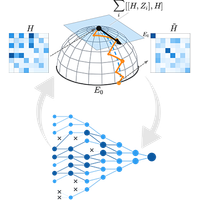
Many of the most important problems in physics and chemistry, including high-temperature superconductivity, magnetism, and the electronic structure of large molecules, involve electrons that interact strongly with one another. The equations describing these “strongly correlated” systems become exponentially harder to solve as the number of electrons grows. Quantum computers were expected to handle such problems naturally, but classical algorithms have kept pace surprisingly well. In 2023, IBM reported that its 127-qubit quantum processor had simulated a system thought to lie beyond the reach of any classical computer. Within weeks, several research groups responded with classical methods, built on an idea called Pauli propagation, that matched or exceeded the quantum result. These algorithms were designed for a single purpose: stress testing quantum advantage claims. We show that the same machinery can be redirected toward a much older problem: finding the lowest energy configuration of a strongly correlated system. Our algorithm, the variational double bracket flow, recovers ground-state energies for 100-particle lattices in about 1 min on a single processor core, where the standard classical method requires dozens of hours on dozens of cores. It also works for a large organic molecule encoded onto 84 qubits, a regime where conventional approaches struggle. The work shows that algorithms developed to probe the boundary between classical and quantum computation can become practical tools for long-standing problems in chemistry and physics, and it sharpens the bar that quantum hardware must clear to demonstrate genuine advantage.
Article Text
References (125)
- C. K. Møller and M. S. Plesset, Note on an approximation treatment for many-electron systems, Phys. Rev. 46, 618 (1934).
- R. J. Bartlett and G. D. Purvis, Many-body perturbation theory, coupled-pair many-electron theory, and the importance of quadruple excitations for the correlation problem, Int. J. Quantum Chem. 14, 561 (1978).
- I. Shavitt and R. J. Bartlett, Many-Body Methods in Chemistry and Physics: MBPT and Coupled-Cluster Theory, 1st ed. (Cambridge University Press, Cambridge, England, 2009).
- R. J. Bartlett and M. Musiał, Coupled-cluster theory in quantum chemistry, Rev. Mod. Phys. 79, 291 (2007).
- R. J. Bartlett, Many-body perturbation theory and coupled cluster theory for electron correlation in molecules, Ann. Rev. Phys. Chem. 32, 359 (1981).
- L. Hedin, New method for calculating the one-particle Green’s function with application to the electron-gas problem, Phys. Rev. 139, A796 (1965).
- A. Marie, A. Ammar, and P.-F. Loos, Advances in Quantum Chemistry (Elsevier, New York, 2024), Vol. 90, pp. 157–184.
- F. Aryasetiawan and O. Gunnarsson, The GW method, Rep. Prog. Phys. 61, 237 (1998).
- W. M. C. Foulkes, L. Mitas, R. J. Needs, and G. Rajagopal, Quantum Monte Carlo simulations of solids, Rev. Mod. Phys. 73, 33 (2001).
- G. H. Booth, A. J. W. Thom, and A. Alavi, Monte Carlo without fixed nodes: A game of life, death, and annihilation in Slater determinant space, J. Chem. Phys. 131, 054106 (2009).
- D. Cleland, G. H. Booth, and A. Alavi, Communications: Survival of the fittest: Accelerating convergence in full configuration-interaction quantum Monte Carlo, J. Chem. Phys. 132, 041103 (2010).
- M. Motta and S. Zhang, Ab Initio computations of molecular systems by the auxiliary-field quantum Monte Carlo method, Comput. Mol. Sci. 8, e1364 (2018).
- S. Zhang and H. Krakauer, Quantum Monte Carlo method using phase-free random walks with slater determinants, Phys. Rev. Lett. 90, 136401 (2003).
- S. Zhang, J. Carlson, and J. E. Gubernatis, Constrained path Monte Carlo method for fermion ground states, Phys. Rev. B 55, 7464 (1997).
- G. K.-L. Chan and S. Sharma, The density matrix renormalization group in quantum chemistry, Ann. Rev. Phys. Chem. 62, 465 (2011).
- K. H. Marti and M. Reiher, New electron correlation theories for transition metal chemistry, Phys. Chem. Chem. Phys. 13, 6750 (2011).
- S. Wouters and D. Van Neck, The density matrix renormalization group for ab initio quantum chemistry, Eur. Phys. J. D 68, 272 (2014).
- S. R. White, Density matrix formulation for quantum renormalization groups, Phys. Rev. Lett. 69, 2863 (1992).
- S. R. White and R. L. Martin, Ab initio quantum chemistry using the density matrix renormalization group, J. Chem. Phys. 110, 4127 (1999).
- S. R. White, Density matrix renormalization group algorithms with a single center site, Phys. Rev. B 72, 180403 (2005).
- Y. Ma, J. Wen, and H. Ma, Density-matrix renormalization group algorithm with multi-level active space, J. Chem. Phys. 143, 034105 (2015).
- K. Hyatt and E. M. Stoudenmire, DMRG approach to optimizing two-dimensional tensor networks, arXiv:1908.08833.
- M. T. Fishman, L. Vanderstraeten, V. Zauner-Stauber, J. Haegeman, and F. Verstraete, Faster methods for contracting infinite 2D tensor networks, arXiv:1711.05881.
- L. Ma, M. Fishman, E. M. Stoudenmire, and E. Solomonik, Approximate contraction of arbitrary tensor networks with a flexible and efficient density matrix algorithm, Quantum 8, 1580 (2024).
- V. Zauner-Stauber, L. Vanderstraeten, M. T. Fishman, F. Verstraete, and J. Haegeman, Variational optimization algorithms for uniform matrix product states, Phys. Rev. B 97, 045145 (2018).
- G. Vidal, Classical simulation of infinite-size quantum lattice systems in one spatial dimension, Phys. Rev. Lett. 98, 070201 (2007).
- F. Verstraete and J. I. Cirac, Renormalization algorithms for quantum-many body systems in two and higher dimensions, arXiv:cond-mat/0407066.
- E. M. Stoudenmire, Learning relevant features of data with multi-scale tensor networks, Quantum Sci. Technol. 3, 034003 (2018).
- G. Vidal, Entanglement renormalization, Phys. Rev. Lett. 99, 220405 (2007).
- M. Troyer and U.-J. Wiese, Computational complexity and fundamental limitations to fermionic quantum Monte Carlo simulations, Phys. Rev. Lett. 94, 170201 (2005).
- Google Quantum AI and Collaborators, Quantum error correction below the surface code threshold, Nature (London) 638, 920 (2025).
- Y. Kim, A. Eddins, S. Anand, K. X. Wei, E. van den Berg, S. Rosenblatt, H. Nayfeh, Y. Wu, M. Zaletel, K. Temme, and A. Kandala, Evidence for the utility of quantum computing before fault tolerance, Nature (London) 618, 500 (2023).
- D. Bluvstein, S. J. Evered, A. A. Geim, S. H. Li, H. Zhou, T. Manovitz, S. Ebadi, M. Cain, M. Kalinowski, D. Hangleiter, J. P. Bonilla Ataides, N. Maskara, I. Cong, X. Gao, P. Sales Rodriguez, T. Karolyshyn, G. Semeghini, M. J. Gullans, M. Greiner, V. Vuletić, and M. D. Lukin, Logical quantum processor based on reconfigurable atom arrays, Nature (London) 626, 58 (2024).
- S. Lee et al., Evaluating the evidence for exponential quantum advantage in ground-state quantum chemistry, Nat. Commun. 14, 1952 (2023).
- Y. Kim, A. Eddins, S. Anand, K. X. Wei, E. van den Berg, S. Rosenblatt, H. Nayfeh, Y. Wu, M. Zaletel, K. Temme, and A. Kandala, Evidence for the utility of quantum computing before fault tolerance, Nature (London) 618, 500 (2023).
- T. Begušić, J. Gray, and G. K. Chan, Fast and converged classical simulations of evidence for the utility of quantum computing before fault tolerance, Sci. Adv. 10, eadk4321 (2024).
- J. Tindall, M. Fishman, E. M. Stoudenmire, and D. Sels, Efficient tensor network simulation of IBM’s eagle kicked Ising experiment, PRX quantum 5, 010308 (2024).
- P. Rall, D. Liang, J. Cook, and W. Kretschmer, Simulation of qubit quantum circuits via Pauli propagation, Phys. Rev. A 99, 062337 (2019).
- L. Broers, R.-Y. Sun, and S. Yunoki, Scalable simulation of quantum many-body dynamics with OR-represented quantum algebra, arXiv:2506.13241.
- M. S. Rudolph, E. Fontana, Z. Holmes, and L. Cincio, Classical surrogate simulation of quantum systems with LOWESA (2023).
- N. Loizeau, J. C. Peacock, and D. Sels, Quantum many-body simulations with PauliStrings.jl, SciPost Phys. Codebases 054 (2025).
- L. Müller, A. Bärligea, A. Knapp, and J. S. Kottmann, PauliEngine: High-performant symbolic arithmetic for quantum operations, arXiv:2601.02233.
- T. Schuster, C. Yin, X. Gao, and N. Y. Yao, A polynomial-time classical algorithm for noisy quantum circuits (2024).
- C. Cirstoiu, A Fourier analysis framework for approximate classical simulations of quantum circuits (2024).
- E. Fontana, M. S. Rudolph, R. Duncan, I. Rungger, and C. Cîrstoiu, Classical simulations of noisy variational quantum circuits, npj Quantum Inf. 11, 84 (2025).
- T. Begušić, K. Hejazi, and G. K. Chan, Simulating quantum circuit expectation values by Clifford perturbation theory, J. Chem. Phys. 162, 154110 (2025).
- T. Schuster, C. Yin, X. Gao, and N. Y. Yao, A polynomial-time classical algorithm for noisy quantum circuits, Phys. Rev. X 15, 041018 (2025).
- A. Angrisani, A. Schmidhuber, M. S. Rudolph, M. Cerezo, Z. Holmes, and H. Y. Huang, Classically estimating observables of noiseless quantum circuits, Phys. Rev. Lett. 135, 170602 (2025).
- A. Angrisani, A. A. Mele, M. S. Rudolph, M. Cerezo, and Z. Holmes, Simulating quantum circuits with arbitrary local noise using pauli propagation, PRX Quantum 7, 020313 (2026).
- A. Miller, Z. Holmes, Ö. Salehi, R. Chakraborty, A. Nykänen, Z. Zimborás, A. Glos, and G. García-Pérez, Simulation of fermionic circuits using majorana propagation, arXiv:2503.18939.
- M. Robbiati, E. Pedicillo, A. Pasquale, X. Li, O. Kiss, A. Wright, R. M. Farias, K. U. Giang, J. Son, J. Knörzer, and S. T. Goh, Double-bracket quantum algorithms for high-fidelity ground-state preparation, Phys. Rev. Res. 8, 033078 (2026).
- M. S. Rudolph, T. Jones, Y. Teng, A. Angrisani, and Z. Holmes, Pauli propagation: A computational framework for simulating quantum systems, PRX Quantum 7, 032001 (2026).
- G. González-García, J. I. Cirac, and R. Trivedi, Pauli path simulations of noisy quantum circuits beyond average case, Quantum 9, 1730 (2025).
- M. Gluza, Double-bracket quantum algorithms for diagonalization, Quantum 8, 1316 (2024).
- M. Gluza, J. Son, B. H. Tiang, R. Zander, R. Seidel, Y. Suzuki, Z. Holmes, and N. H. Y. Ng, Double-bracket quantum algorithms for quantum imaginary-time evolution, Phys. Rev. Lett. 136, 020601 (2026).
- Y. Suzuki, B. H. Tiang, J. Son, N. H. Y. Ng, Z. Holmes, and M. Gluza, Double-bracket algorithm for quantum signal processing without post-selection, Quantum 9, 1954 (2025).
- Y. Suzuki, M. Gluza, J. Son, B. H. Tiang, N. H. Ng, and Z. Holmes, Grover’s algorithm is an approximation of imaginary-time evolution, arXiv:2507.15065.
- M. Alghadeer, K. U. Giang, S. Cao, S. D. Fasciati, M. Piscitelli, N. Ng, P. J. Leek, M. Gluza, and M. Bakr, Double-bracket algorithmic cooling, arXiv:2510.00302.
While one can always find a change of basis that makes the ground-state sparse (e.g., the eigenbasis), this is computationally intractable, whereas Hamiltonians are generally sparse in computationally tractable bases (e.g., Pauli, or fermionic operator bases).
- G. Aguilar, S. Cichy, J. Eisert, and L. Bittel, Full classification of Pauli lie algebras, arXiv:2408.00081v1.
- E. Kökcü, T. Steckmann, Y. Wang, J. K. Freericks, E. F. Dumitrescu, and A. F. Kemper, Fixed depth Hamiltonian simulation via cartan decomposition, Phys. Rev. Lett. 129, 070501 (2022).
- R. Wiersema, E. Kökcü, A. F. Kemper, and B. N. Bakalov, Classification of dynamical lie algebras of 2-local spin systems on linear, circular and fully connected topologies, npj Quantum Inf. 10, 110 (2024).
- I. Magoulas and F. A. Evangelista, Clifford transformations for fermionic quantum systems: From Paulis to Majoranas to Fermions, arXiv:2510.23923.
- P. Jayakumar, T. Zeng, and A. F. Izmaylov, On the feasibility of exact unitary transformations for many-body Hamiltonians, J. Chem. Theory Comput. 22, 3916 (2026).
- F. A. Evangelista and I. Magoulas, Exact closed-form unitary transformations of fermionic operators, Phys. Rev. A 111, 042825 (2025).
- I. Magoulas and F. A. Evangelista, Spin-adapted fermionic unitaries: From lie algebras to compact quantum circuits, arXiv:2511.13485.
- V. Martinez, A. Angrisani, E. Pankovets, O. Fawzi, and D. S. França, Efficient simulation of parametrized quantum circuits under non-unital noise through Pauli backpropagation, Phys. Rev. Lett. 134, 250602 (2025).
- S. D. Glazek and K. G. Wilson, Perturbative renormalization group for Hamiltonians, Phys. Rev. D 49, 4214 (1994).
- S. D. Głazek and K. G. Wilson, Renormalization of Hamiltonians, Phys. Rev. D 48, 5863 (1993).
- F. Wegner, Flow-equations for Hamiltonians, Ann. Phys. 506, 77 (1994).
- H. Hergert, S. K. Bogner, J. G. Lietz, T. D. Morris, S. J. Novario, N. M. Parzuchowski, and F. Yuan, in An Advanced Course in Computational Nuclear Physics: Bridging the Scales from Quarks to Neutron Stars, edited by M. Hjorth-Jensen, M. P. Lombardo, and Kolck van (Springer International Publishing, Cham, 2017), p. 570.
- F. A. Evangelista, Driven similarity renormalization group approach to quantum many-body problems, J. Chem. Phys. 141, 054109 (2014).
- A. Marie and P.-F. Loos, A Similarity renormalization group approach to Green’s function methods, J. Chem. Theory Comput. 19, 3943 (2023).
- S. Wang, C. Li, and F. A. Evangelista, Analytic energy gradients for the driven similarity renormalization group multireference second-order perturbation theory, J. Chem. Theory Comput. 17, 7666 (2021).
Any computational basis state can be rotated into , folding the resulting unitary into .
- L. Xiaoyue, M. Robbiati, A. Pasquale, E. Pedicillo, A. Wright, S. Carrazza, and M. Gluza, Strategies for optimizing double-bracket quantum algorithms, arXiv:2408.07431.
- M. Pervez, A. Haqq, N. A. McMahon, and C. Arenz, Riemannian gradient descent-based quantum algorithms for ground state preparation with guarantees, arXiv:2512.13401.
- E. Malvetti, C. Arenz, G. Dirr, and T. Schulte-Herbrüggen, Randomized gradient descents on riemannian manifolds: Almost sure convergence to global minima in and beyond quantum optimization, arXiv:2405.12039.
- R. Zander, R. Seidel, L. Xiaoyue, and M. Gluza, Role of Riemannian geometry in double-bracket quantum imaginary-time evolution, in Proceedings of the International Conference on Geometric Science of Information. (2025), pp. 105–114.
- R. Wiersema and N. Killoran, Optimizing quantum circuits with Riemannian gradient flow, Phys. Rev. A 107, 062421 (2023).
- N. A. McMahon, M. Pervez, and C. Arenz, Equating quantum imaginary time evolution, Riemannian gradient flows, and stochastic implementations, arXiv:2504.06123.
While this approach is valid for any computational basis reference state, the choice of Eq. (8) means that we must work with as reference state by first transforming by a sequence of gates that transform to , which is essentially a particle-hole transformation.
- H. R. Grimsley, S. E. Economou, E. Barnes, and N. J. Mayhall, An adaptive variational algorithm for exact molecular simulations on a quantum computer, Nat. Commun. 10, 3007 (2019).
- H. L. Tang, V. Shkolnikov, G. S. Barron, H. R. Grimsley, N. J. Mayhall, E. Barnes, and S. E. Economou, Qubit-ADAPT-VQE: An adaptive algorithm for constructing hardware-efficient Ansätze on a quantum processor, PRX Quantum 2, 020310 (2021).
We note that additional applications of the clip function are applied at various points to improve efficiency but are not included in Algorithm for clarity. For example, after forming the flow generator, , this operator is clipped. However, this is clipped with a tight threshold (default ) so as to not affect the accuracy.
- A. B. Magann, K. M. Rudinger, M. D. Grace, and M. Sarovar, Feedback-based quantum optimization, Phys. Rev. Lett. 129, 250502 (2022).
- R. Chakraborty, A. Miller, A. Nykänen, S. Özlem, F. Tarocco, F. Pavošević, P. A. B. Haase, M. Stella, and A. Glos, Scalable quantum circuit generation for iterative ground state approximation using Majorana Propagation, arXiv:2603.23444.
- I. G. Ryabinkin, R. A. Lang, S. N. Genin, and A. F. Izmaylov, Iterative qubit coupled cluster approach with efficient screening of generators, J. Chem. Theory Comput. 16, 1055 (2020).
- I. G. Ryabinkin, T.-C. Yen, S. N. Genin, and A. F. Izmaylov, Qubit coupled-cluster method: A systematic approach to quantum chemistry on a quantum computer, J. Chem. Theory Comput. 14, 6317 (2018).
- R. A. Lang, A. Ganeshram, and A. F. Izmaylov, Growth reduction of similarity-transformed electronic Hamiltonians in qubit space, J. Chem. Theory Comput. 19, 6656 (2023).
- R. A. Lang, S. G. Mehendale, I. G. Ryabinkin, and A. F. Izmaylov, Multistate iterative qubit coupled cluster (MS-iQCC): A quantum-inspired, state-averaged approach to ground- and excited-state energies (2025).
- T. Mizusaki and M. Imada, Precise estimation of shell model energy by second-order extrapolation method, Phys. Rev. C 67, 041301 (2003).
- N. Shimizu, Y. Utsuno, T. Mizusaki, T. Otsuka, T. Abe, and M. Honma, Novel extrapolation method in the Monte Carlo shell model, Phys. Rev. C 82, 061305 (2010).
- N. Shimizu, Y. Utsuno, T. Mizusaki, T. Otsuka, T. Abe, and M. Honma, Extrapolation method in the Monte Carlo shell model and its applications, AIP Conf. Proc. 1355, 138 (2011).
- T. Mizusaki and N. Shimizu, New variational Monte Carlo method with energy variance extrapolation for large-scale shell-model calculations, Phys. Rev. C 85, 021301 (2012).
- https://github.com/nmayhall/DBF.jl (2025).
- https://github.com/nmayhall/PauliOperators.jl (2025).
- M. Fishman, S. R. White, and E. M. Stoudenmire, The ITensor software library for tensor network calculations, arXiv:2007.14822.
- H. Zhai, H. R. Larsson, S. Lee, Z.-H. Cui, T. Zhu, C. Sun, L. Peng, R. Peng, K. Liao, J. Tölle, J. Yang, S. Li, and G. K..-L. Chan, Block2: A comprehensive open source framework to develop and apply state-of-the-art DMRG algorithms in electronic structure and beyond, J. Chem. Phys. 234801, 159 (2023).
- C. Peng, C. A. Lewis, X. Wang, M. C. Clement, K. Pierce, V. Rishi, F. Pavošević, S. Slattery, J. Zhang, N. Teke, A. Kumar, C. Masteran, A. Asadchev, J. A. Calvin, and E. F. Valeev, Massively parallel quantum chemistry: A high-performance research platform for electronic structure, J. Chem. Phys. 153, 044120 (2020).
- R. Alkabetz and I. Arad, Tensor networks contraction and the belief propagation algorithm, Phys. Rev. Res. 3, 023073 (2021).
- G. Evenbly, N. Pancotti, A. Milsted, J. Gray, and G. K.-L. Chan, Loop series expansions for tensor networks, arXiv:2409.03108.
- J. Tindall and M. T. Fishman, Gauging tensor networks with belief propagation, arXiv:2306.17837.
- Y. Nomura and M. Imada, Dirac-type nodal spin liquid revealed by refined quantum many-body solver using neural-network wave function, correlation ratio, and level spectroscopy, Phys. Rev. X 11, 031034 (2021).
- D. Wu et al., Variational benchmarks for quantum many-bodyproblems, Science 386, 296 (2024).
- A. W. Sandvik, Finite-size scaling of the ground-state parameters of the two-dimensional Heisenberg model, Phys. Rev. B 56, 11678 (1997).
- A. W. Sandvik, High-precision ground state parameters of the two-dimensional spin-1/2 Heisenberg model on the square lattice, J. Stat. Mech. 2026, 043101 (2026).
- C. A. Jiménez-Hoyos and G. E. Scuseria, Cluster-based mean-field and perturbative description of strongly correlated fermion systems: Application to the one- and two-dimensional Hubbard model, Phys. Rev. B 92, 085101 (2015).
- V. Abraham and N. J. Mayhall, Selected configuration interaction in a basis of cluster state tensor products, J. Chem. Theory Comput. 16, 6098 (2020).
- N. J. Mayhall, Using higher-order singular value decomposition to define weakly coupled and strongly correlated clusters: The n-body tucker approximation, J. Chem. Theory Comput. 13, 4818 (2017).
- V. Abraham and N. J. Mayhall, Cluster many-body expansion: A many-body expansion of the electron correlation energy about a cluster mean field reference, J. Chem. Phys. 155, 054101 (2021).
- A. Bachhar and N. J. Mayhall, Restricted open-shell cluster mean-field theory for strongly correlated systems, J. Phys. Chem. A 128, 9015 (2024).
- While this improved reference state made our calculations more efficient, we were still able to obtain sufficiently accurate results when starting from the original Néel state.
- J. P. F. LeBlanc, A. E. Antipov, F. Becca, I. W. Bulik, G. K.-L. Chan, C.-M. Chung, Y. Deng, M. Ferrero, T. M. Henderson, C. A. Jiménez-Hoyos, E. Kozik, X.-W. Liu, A. J. Millis, N. V. Prokof’ev, M. Qin, G. E. Scuseria, H. Shi, B V. Svistunov, L. F. Tocchio, I. S. Tupitsyn, S. R. White, S. Zhang, B.-X. Zheng, Z. Zhu, E. Gull,, Solutions of the two-dimensional Hubbard model: Benchmarks and results from a wide range of numerical algorithms, Phys. Rev. 5, 041041 (2015).
- E. Pavarini, E. Koch, J. van den Brink, and G. Sawatzky (eds.), Quantum Materials: Experiments and Theory, Modeling and Simulation 6, 1 (Verlag des Forschungszentrum Jülich, Jülich, 2016).
- R. Levy, M. A. Morales, and S. Zhang, Automatic order detection and restoration through systematically improvable variational wave functions, Phys. Rev. Res. 6, 013237 (2024).
- H. Shi and S. Zhang, Symmetry in auxiliary-field quantum Monte Carlo calculations, Phys. Rev. B 88, 125132 (2013).
- V. Abraham and N. J. Mayhall, Selected configuration interaction in a basis of cluster state tensor products, J. Chem. Theory Comput. 16, 6098 (2020).
- N. M. Braunscheidel, A. Bachhar, and N. J. Mayhall, Accurate and interpretable representation of correlated electronic structure via Tensor Product Selected CI, Faraday Discuss. 254, 130 (2024).
- N. M. Braunscheidel, V. Abraham, and N. J. Mayhall, Generalization of the tensor product selected CI method for molecular excited states, J. Phys. Chem. A 127, 8179 (2023).
- A. Bachhar and N. J. Mayhall, Computing exchange coupling constants in transition metal complexes with tensor product selected configuration Interaction, J. Chem. Theory Comput. 22, 1699 (2026).
- R. Haghshenas, E. Chertkov, M. Mills, W. Kadow, S. H. Lin, Y. H. Chen, C. Cade, I. Niesen, T. Begušić, M. S. Rudolph, and C. Cirstoiu, Digital quantum magnetism on a trapped-ion quantum computer, Nature (London) 653, 56 (2026).
- Y. Teng, S. Y. Chang, M. S. Rudolph, and Z. Holmes, Leveraging symmetry merging in Pauli propagation, arXiv:2512.12094.

