Browse by Subject

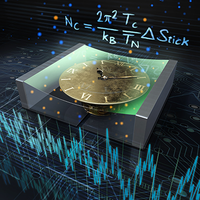
Measuring the Thermodynamic Cost of Timekeeping

A. N. Pearson, Y. Guryanova, P. Erker, E. A. Laird, G. A. D. Briggs, M. Huber, and N. Ares

Phys. Rev. X 11, 021029 (2021) - Published 6 May, 2021

An experiment with a nanoscale clock verifies that a clock’s entropy per tick increases as the clock is made more precise.

Local Number Fluctuations in Hyperuniform and Nonhyperuniform Systems: Higher-Order Moments and Distribution Functions

Salvatore Torquato, Jaeuk Kim, and Michael A. Klatt

Phys. Rev. X 11, 021028 (2021) - Published 5 May, 2021

A theoretical and numerical study stresses the importance of higher-order moments of density fluctuations in characterizing models of many-body systems.

Optical Signatures of Periodic Charge Distribution in a Mott-like Correlated Insulator State

Yuya Shimazaki, Clemens Kuhlenkamp, Ido Schwartz, Tomasz Smoleński, Kenji Watanabe, Takashi Taniguchi, Martin Kroner, Richard Schmidt, Michael Knap, and Ataç Imamoğlu

Phys. Rev. X 11, 021027 (2021) - Published 4 May, 2021

Optical spectroscopy provides direct evidence of electrons organizing themselves into a periodic distribution in the correlated insulating state of a twisted bilayer 2D semiconductor.

Moiré Surface States and Enhanced Superconductivity in Topological Insulators

Taige Wang, Noah F. Q. Yuan, and Liang Fu

Phys. Rev. X 11, 021024 (2021) - Published 29 April, 2021

The moiré pattern formed on the surface of a topological insulator could lead to enhanced topological superconductivity.

Origin of Terahertz Soft-Mode Nonlinearities in Ferroelectric Perovskites

Shovon Pal, Nives Strkalj, Chia-Jung Yang, Mads C. Weber, Morgan Trassin, Michael Woerner, and Manfred Fiebig

Phys. Rev. X 11, 021023 (2021) - Published 28 April, 2021

Terahertz spectroscopy reveals the microscopic dynamics underlying soft vibrational modes in a ferroelectric material, providing inroads to all-optical control of nonlinear functional materials.

Emergent Ferromagnetism with Fermi-Liquid Behavior in Proton Intercalated CaRuO3

Shengchun Shen, Zhuolu Li, Zijun Tian, Weidong Luo, Satoshi Okamoto, and Pu Yu

Phys. Rev. X 11, 021018 (2021) - Published 21 April, 2021

A voltage-controlled transition from a non-Fermi-liquid state in a metal to a typical Fermi-liquid state precedes the onset of ferromagnetism, new experiments show.

Time-Reversal Symmetry Breaking Driven Topological Phase Transition in EuB6

Shun-Ye Gao, Sheng Xu, Hang Li, Chang-Jiang Yi, Si-Min Nie, Zhi-Cheng Rao, Huan Wang, Quan-Xin Hu, Xue-Zhi Chen, Wen-Hui Fan, Jie-Rui Huang, Yao-Bo Huang, Nini Pryds, Ming Shi, Zhi-Jun Wang, You-Guo Shi, Tian-Long Xia, Tian Qian, and Hong Ding

Phys. Rev. X 11, 021016 (2021) - Published 19 April, 2021

Observations of an ideal magnetic topological state in the ferromagnet EuB6 offer the promise of realizing novel electronic and magnetic states in 2D materials.

Observation of Hydrogen-Induced Dzyaloshinskii-Moriya Interaction and Reversible Switching of Magnetic Chirality

Gong Chen, MacCallum Robertson, Markus Hoffmann, Colin Ophus, André L. Fernandes Cauduro, Roberto Lo Conte, Haifeng Ding, Roland Wiesendanger, Stefan Blügel, Andreas K. Schmid, and Kai Liu

Phys. Rev. X 11, 021015 (2021) - Published 16 April, 2021

Adsorption of hydrogen onto a ferromagnetic surface induces and controls a winding arrangement of magnetic moments potentially useful in future energy-efficient information applications.

Thermodynamic bounds on coherent transport in periodically driven conductors

Elina Potanina, Christian Flindt, Michael Moskalets, and Kay Brandner

Phys. Rev. X 11, 021013 (2021) - Published 14 April, 2021

Universal bounds on dissipation offer a powerful new tool to measure and optimize the performance of thermal quantum devices.

Gapless Spin Wave Transport through a Quantum Canted Antiferromagnet

Hailong Fu, Ke Huang, Kenji Watanabe, Takashi Taniguchi, and Jun Zhu

Phys. Rev. X 11, 021012 (2021) - Published 13 April, 2021

An all-electrical technique resolves the dispersion relation of spin waves in bilayer graphene, shedding light on the magnetic order of a quantum Hall canted antiferromagnet.

Dynamical Freezing and Scar Points in Strongly Driven Floquet Matter: Resonance vs Emergent Conservation Laws

Asmi Haldar, Diptiman Sen, Roderich Moessner, and Arnab Das

Phys. Rev. X 11, 021008 (2021) - Published 7 April, 2021

The commonly expected infinite-temperature-like state in a periodically driven homogeneous system of interacting particles can be avoided if the system is quantum mechanical and the drive is strong enough.

Ab Initio Full Cell GW+DMFT for Correlated Materials

Tianyu Zhu and Garnet Kin-Lic Chan

Phys. Rev. X 11, 021006 (2021) - Published 6 April, 2021

A new framework for “quantum embedding methods,” which enable tractable predictions of correlated electron materials, improves accuracy by avoiding approximations used by previous approaches.

Non-Fermi Liquids as Ersatz Fermi Liquids: General Constraints on Compressible Metals

Dominic V. Else, Ryan Thorngren, and T. Senthil

Phys. Rev. X 11, 021005 (2021) - Published 6 April, 2021

By identifying how fractional electron filling manifests in effective field theory, a new analysis offers a more general way to understand certain collective behaviors of electrons in a solid.

Revealing the Absolute Direction of the Dzyaloshinskii-Moriya Interaction in Prototypical Weak Ferromagnets by Polarized Neutrons

H. Thoma, V. Hutanu, H. Deng, V. E. Dmitrienko, P. J. Brown, A. Gukasov, G. Roth, and M. Angst

Phys. Rev. X 11, 011060 (2021) - Published 25 March, 2021

Experiments show that polarized neutron diffraction is an effective tool for determining the direction of a basic magnetic interaction that impacts spintronics devices and topological materials.

Doublonlike Excitations and Their Phononic Coupling in a Mott Charge-Density-Wave System

C. J. Butler, M. Yoshida, T. Hanaguri, and Y. Iwasa

Phys. Rev. X 11, 011059 (2021) - Published 24 March, 2021

By injecting electrons into the Mott state of tantalum disulfide, experiments reveal new, unexpected electronic behaviors that could shed light on the underlying interactions that create this exotic state.

Tracking the Footprints of Spin Fluctuations: A MultiMethod, MultiMessenger Study of the Two-Dimensional Hubbard Model

Thomas Schäfer et al.

Phys. Rev. X 11, 011058 (2021) - Published 23 March, 2021

An extensive assessment of the ability of many computational methods to tackle the fundamental model of interacting particles, the Hubbard model, reveals the nature and role of magnetic fluctuations.

Suppressing Dissipation in a Floquet-Hubbard System

Konrad Viebahn, Joaquín Minguzzi, Kilian Sandholzer, Anne-Sophie Walter, Manish Sajnani, Frederik Görg, and Tilman Esslinger

Phys. Rev. X 11, 011057 (2021) - Published 19 March, 2021

Floquet engineering uses periodic driving to design novel quantum matter but is limited by dissipation. Experiments show how to use interference between related drives to combat these losses.

Higgs-Mediated Optical Amplification in a Nonequilibrium Superconductor

Michele Buzzi, Gregor Jotzu, Andrea Cavalleri, J. Ignacio Cirac, Eugene A. Demler, Bertrand I. Halperin, Mikhail D. Lukin, Tao Shi, Yao Wang, and Daniel Podolsky

Phys. Rev. X 11, 011055 (2021) - Published 17 March, 2021

A novel technique for probing photoinduced superconductivity supports the existence of such a state in the compound K3C60 by demonstrating large Higgs mode oscillations.

Electronic Structure Trends Across the Rare-Earth Series in Superconducting Infinite-Layer Nickelates

Emily Been, Wei-Sheng Lee, Harold Y. Hwang, Yi Cui, Jan Zaanen, Thomas Devereaux, Brian Moritz, and Chunjing Jia

Phys. Rev. X 11, 011050 (2021) - Published 11 March, 2021

A complex interplay of electric and magnetic behaviors resides in the parent compound of a nickel oxide material known to host high-temperature superconductivity, a finding that may guide studies into this phenomenon.

Laplacian-Level Quantum Hydrodynamic Theory for Plasmonics

Henrikh M. Baghramyan, Fabio Della Sala, and Cristian Ciracì

Phys. Rev. X 11, 011049 (2021) - Published 11 March, 2021

A generalization of quantum hydrodynamic theory provides a new, accurate approach to calculating the optical response of a plasmonic system beyond classical electromagnetism.

Sign In to Your Journals Account

Filter

Subject

Filter

Article Lookup

Enter a citation