Browse by Subject

Nonclassical Nucleation Pathways in Stacking-Disordered Crystals

Fabio Leoni and John Russo

Phys. Rev. X 11, 031006 (2021) - Published 9 July, 2021

Layered and onionlike structures emerge solely from structural differences among competing crystalline growths in a liquid melt, according to a new deep neural network analysis.

Prediction of Toric Code Topological Order from Rydberg Blockade

Ruben Verresen, Mikhail D. Lukin, and Ashvin Vishwanath

Phys. Rev. X 11, 031005 (2021) - Published 8 July, 2021

A lattice of highly excited atoms can exhibit a topological phase, a new theoretical study shows.

Length Scales in Brownian yet Non-Gaussian Dynamics

José M. Miotto, Simone Pigolotti, Aleksei V. Chechkin, and Sándalo Roldán-Vargas

Phys. Rev. X 11, 031002 (2021) - Published 2 July, 2021

The distribution of particle displacements in certain diffusive systems takes on an unusual non-Gaussian behavior. New simulations explore how the evolution of such dynamics depends on the system’s details.

Ultrafast Control of Material Optical Properties via the Infrared Resonant Raman Effect

Guru Khalsa, Nicole A. Benedek, and Jeffrey Moses

Phys. Rev. X 11, 021067 (2021) - Published 30 June, 2021

A theoretical and computational analysis shows that it is possible to precisely control the optical properties of a material by optically exciting crystalline lattice vibrations, or phonons.

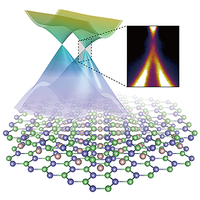
Coexistence of Surface Superconducting and Three-Dimensional Topological Dirac States in Semimetal KZnBi

Junseong Song, Sunghun Kim, Youngkuk Kim, Huixia Fu, Jahyun Koo, Zhen Wang, Gyubin Lee, Jouhahn Lee, Sang Ho Oh, Joonho Bang, Taku Matsushita, Nobuo Wada, Hiroki Ikegami, Jonathan D. Denlinger, Young Hee Lee, Binghai Yan, Yeongkwan Kim, and Sung Wng Kim

Phys. Rev. X 11, 021065 (2021) - Published 28 June, 2021

A newly discovered 3D topological Dirac semimetal exhibits surface superconductivity at ambient pressure, a key step in the development of systems sought after for quantum computation.

Spintronics Meets Density Matrix Renormalization Group: Quantum Spin-Torque-Driven Nonclassical Magnetization Reversal and Dynamical Buildup of Long-Range Entanglement

Marko D. Petrović, Priyanka Mondal, Adrian E. Feiguin, Petr Plecháč, and Branislav K. Nikolić

Phys. Rev. X 11, 021062 (2021) - Published 23 June, 2021

A synergy between strongly electron-correlated physics, quantum transport theory, and quantum information science provides a long-sought quantum-mechanical description of spin torque, an effect at the heart of spintronic research.

Interaction-Stabilized Topological Magnon Insulator in Ferromagnets

Alexander Mook, Kirill Plekhanov, Jelena Klinovaja, and Daniel Loss

Phys. Rev. X 11, 021061 (2021) - Published 22 June, 2021

Particle number nonconservation in interactions among magnons in ferromagnet models reveal a topological phase transition, which opens possibilities for energy-efficient magnetic information processing.

Particle-Level Visualization of Hydrodynamic and Frictional Couplings in Dense Suspensions of Spherical Colloids

Taiki Yanagishima, Yanyan Liu, Hajime Tanaka, and Roel P. A. Dullens

Phys. Rev. X 11, 021056 (2021) - Published 14 June, 2021

A method for visualizing rotation of micrometer-sized spheres reveals for the first time how hydrodynamic and frictional effects affect rotational motion in particulate suspensions.

Incoherent Cooper Pairing and Pseudogap Behavior in Single-Layer FeSe/SrTiO3

B. D. Faeth, S.-L. Yang, J. K. Kawasaki, J. N. Nelson, P. Mishra, C. T. Parzyck, C. Li, D. G. Schlom, and K. M. Shen

Phys. Rev. X 11, 021054 (2021) - Published 10 June, 2021

A monolayer of FeSe atop SrTiO3 displays enhanced high-temperature superconductivity. New measurements reveal a sharp distinction between the appearance of a superconducting energy gap and true zero resistivity.

Local Pairing of Feynman Histories in Many-Body Floquet Models

S. J. Garratt and J. T. Chalker

Phys. Rev. X 11, 021051 (2021) - Published 7 June, 2021

A new framework for analyzing chaotic quantum systems with local interactions identifies generic many-body interference effects, with strong implications for quantum spectra.

Spinon Fermi Surface Spin Liquid in a Triangular Lattice Antiferromagnet NaYbSe2

Peng-Ling Dai, Gaoning Zhang, Yaofeng Xie, Chunruo Duan, Yonghao Gao, Zihao Zhu, Erxi Feng, Zhen Tao, Chien-Lung Huang, Huibo Cao, Andrey Podlesnyak, Garrett E. Granroth, Michelle S. Everett, Joerg C. Neuefeind, David Voneshen, Shun Wang, Guotai Tan, Emilia Morosan, Xia Wang, Hai-Qing Lin, Lei Shu, Gang Chen, Yanfeng Guo, Xingye Lu, and Pengcheng Dai

Phys. Rev. X 11, 021044 (2021) - Published 27 May, 2021

Neutron-scattering experiments provide solid evidence for the elusive quantum spin liquid state in a 2D triangular crystalline material.

Luminescence Anomaly of Dipolar Valley Excitons in Homobilayer Semiconductor Moiré Superlattices

Hongyi Yu and Wang Yao

Phys. Rev. X 11, 021042 (2021) - Published 25 May, 2021

A mathematical analysis shows how changes in the brightness and polarization of light emitted by excitons in a transition-metal dichalcogenide bilayer is a powerful probe of exciton behavior.

Influence Matrix Approach to Many-Body Floquet Dynamics

Alessio Lerose, Michael Sonner, and Dmitry A. Abanin

Phys. Rev. X 11, 021040 (2021) - Published 21 May, 2021

A new theoretical framework provides a way to predict nonequilibrium dynamics in quantum-many body systems.

Entropy Scaling Law and the Quantum Marginal Problem

Isaac H. Kim

Phys. Rev. X 11, 021039 (2021) - Published 20 May, 2021

A new method to compute physical properties of interacting many-body quantum systems can do so exponentially faster than other techniques.

Relationship between Transport Anisotropy and Nematicity in FeSe

Jack M. Bartlett, Alexander Steppke, Suguru Hosoi, Hilary Noad, Joonbum Park, Carsten Timm, Takasada Shibauchi, Andrew P. Mackenzie, and Clifford W. Hicks

Phys. Rev. X 11, 021038 (2021) - Published 19 May, 2021

Resistive anisotropy grows then shrinks following the onset of electronic nematicity in FeSe, a key observation of how the electronic structure of FeSe changes as nematicity develops.

Symmetry Classes of Open Fermionic Quantum Matter

Alexander Altland, Michael Fleischhauer, and Sebastian Diehl

Phys. Rev. X 11, 021037 (2021) - Published 18 May, 2021

A generalization of fundamental symmetry classes of fermionic quantum matter to out-of-equilibrium systems provides a framework for engineering novel quantum phases.

Quench Dynamics of a Fermi Gas with Strong Nonlocal Interactions

Elmer Guardado-Sanchez, Benjamin M. Spar, Peter Schauss, Ron Belyansky, Jeremy T. Young, Przemyslaw Bienias, Alexey V. Gorshkov, Thomas Iadecola, and Waseem S. Bakr

Phys. Rev. X 11, 021036 (2021) - Published 17 May, 2021

A method that enables long-range interactions between fermions on a lattice allows atomic quantum simulations of exotic quantum many-body phenomena.

Stable iPEPO Tensor-Network Algorithm for Dynamics of Two-Dimensional Open Quantum Lattice Models

C. Mc Keever and M. H. Szymańska

Phys. Rev. X 11, 021035 (2021) - Published 14 May, 2021

A new algorithm for solving a large 2D grid of interacting particles provides much more accurate predictions of how such systems interact with their environment than previous techniques.

Site Mixing for Engineering Magnetic Topological Insulators

Yaohua Liu, Lin-Lin Wang, Qiang Zheng, Zengle Huang, Xiaoping Wang, Miaofang Chi, Yan Wu, Bryan C. Chakoumakos, Michael A. McGuire, Brian C. Sales, Weida Wu, and Jiaqiang Yan

Phys. Rev. X 11, 021033 (2021) - Published 12 May, 2021

Randomly distributed atomic-level defects in the magnetic topological insulator MnSb2Te4 help stabilize ferromagnetic interactions but are detrimental to topological electronic properties.

Broadband Terahertz Probes of Anisotropic Magnetoresistance Disentangle Extrinsic and Intrinsic Contributions

Lukáš Nádvorník, Martin Borchert, Liane Brandt, Richard Schlitz, Koen A. de Mare, Karel Výborný, Ingrid Mertig, Gerhard Jakob, Matthias Kläui, Sebastian T. B. Goennenwein, Martin Wolf, Georg Woltersdorf, and Tobias Kampfrath

Phys. Rev. X 11, 021030 (2021) - Published 7 May, 2021

In magnetic metals, electrical resistance depends on the direction of magnetization relative to the current. New experiments show that this effect does not depend solely on electron collisions, as is typically assumed.

Sign In to Your Journals Account

Filter

Subject

Filter

Article Lookup

Enter a citation