Browse by Subject

Anomalous Crystalline-Electromagnetic Responses in Semimetals

Mark R. Hirsbrunner, Oleg Dubinkin, F. J. Burnell, and Taylor L. Hughes

Phys. Rev. X 14, 041060 (2024) - Published 9 December, 2024

An analysis of the quasitopological responses of topological semimetals to distortions of their crystal lattice sheds light on the relationship between material properties and crystalline symmetries.

Semi-Dirac Fermions in a Topological Metal

Yinming Shao, Seongphill Moon, A. N. Rudenko, Jie Wang, Jonah Herzog-Arbeitman, Mykhaylo Ozerov, David Graf, Zhiyuan Sun, Raquel Queiroz, Seng Huat Lee, Yanglin Zhu, Zhiqiang Mao, M. I. Katsnelson, B. Andrei Bernevig, Dmitry Smirnov, Andrew J. Millis, and D. N. Basov

Phys. Rev. X 14, 041057 (2024) - Published 5 December, 2024

Semi-Dirac fermions, which are massless in one 2D direction but possess mass in the other, have so far eluded detection in solids. New experiments reveal their defining feature in the nodal-line metal ZrSiS.

First-Principles Prediction of Structural Distortions in the Cuprates and Their Impact on the Electronic Structure

Zheting Jin and Sohrab Ismail-Beigi

Phys. Rev. X 14, 041053 (2024) - Published 2 December, 2024

A study of how structural symmetry breaking impacts key structural, electronic, and magnetic properties in the cuprate BSCCO resolves several long-standing puzzles in this intriguing superconducting material.

Assessing the Ubiquity of Bloch Domain Walls in Ferroelectric Lead Titanate Superlattices

Edoardo Zatterin, Petr Ondrejkovic, Louis Bastogne, Céline Lichtensteiger, Ludovica Tovaglieri, Daniel A. Chaney, Alireza Sasani, Tobias Schülli, Alexei Bosak, Steven Leake, Pavlo Zubko, Philippe Ghosez, Jirka Hlinka, Jean-Marc Triscone, and Marios Hadjimichael

Phys. Rev. X 14, 041052 (2024) - Published 26 November, 2024

An investigation of domain walls in ferroelectric materials unveils the complexity of their structure and sets the stage for similar studies in other materials, with the aim of leveraging domain walls in future nanoelectronics.

Observation of Robust One-Dimensional Edge Channels in a Three-Dimensional Quantum Spin Hall Insulator

Shuikang Yu, Junze Deng, Wenhao Liu, Yunmei Zhang, Yiming Sun, Nikhil Dhale, Sheng Li, Wanru Ma, Zhuying Wang, Ping Wu, Zuowei Liang, Xuechen Zhang, Bing Lv, Zhijun Wang, Zhenyu Wang, and Xianhui Chen

Phys. Rev. X 14, 041048 (2024) - Published 19 November, 2024

Evidence of helical edge states in the layered crystal α-Bi4I4 suggests that this material is not a trivial insulator, as predicted, but a new phase of matter dubbed a 3D quantum spin Hall insulator.

Local Density Approximation for Excited States

Tim Gould and Stefano Pittalis

Phys. Rev. X 14, 041045 (2024) - Published 15 November, 2024

The ground states of homogeneous electron gases have been used to predict material properties for nearly a century. A new formulation extends this to excited states.

Spectral Signatures of Nontrivial Topology in a Superconducting Circuit

L. Peyruchat, R. H. Rodriguez, J.-L. Smirr, R. Leone, and Ç. Ö. Girit

Phys. Rev. X 14, 041041 (2024) - Published 12 November, 2024

Spectroscopy reveals remarkable topological properties of a superconducting circuit that could inspire the design of more robust qubits.

Parent Berry Curvature and the Ideal Anomalous Hall Crystal

Tixuan Tan and Trithep Devakul

Phys. Rev. X 14, 041040 (2024) - Published 12 November, 2024

Certain geometric features in the electronic structure of a material hosting a 2D system of strongly interacting electrons can lead to a crystal-like pattern—an anomalous Hall crystal—that insulates in its bulk but conducts along its edges.

Revealing the Microscopic Mechanism of Elementary Vortex Pinning in Superconductors

C. Chen, Y. Liu, Y. Chen, Y. N. Hu, T. Z. Zhang, D. Li, X. Wang, C. X. Wang, Z. Y. W. Lu, Y. H. Zhang, Q. L. Zhang, X. L. Dong, R. Wang, D. L. Feng, and T. Zhang

Phys. Rev. X 14, 041039 (2024) - Published 8 November, 2024

Atomic-scale investigations of how vortices get pinned to defects in superconductors offers new insights into enabling new superconductor-based applications.

Evidence of Zero-Field Wigner Solids in Ultrathin Films of Cadmium Arsenide

Simon Munyan, Sina Ahadi, Binghao Guo, Arman Rashidi, and Susanne Stemmer

Phys. Rev. X 14, 041037 (2024) - Published 7 November, 2024

Wigner crystals, frozen 2D arrangements of electrons, generally require strong magnetic fields. The formation of such phases in Cd3As2 without a magnetic field point to an unconventional means for their formation.

Emergent Properties of the Periodic Anderson Model: A High-Resolution, Real-Frequency Study of Heavy-Fermion Quantum Criticality

Andreas Gleis, Seung-Sup B. Lee, Gabriel Kotliar, and Jan von Delft

Phys. Rev. X 14, 041036 (2024) - Published 7 November, 2024

A theoretical study of the Kondo breakdown transition—a sudden localization of f electrons in heavy-fermion metals—provides new insights into what drives both the localization and the concurrent emergence of strange-metal behavior.

CFTD from TQFTD+1 via Holographic Tensor Network, and Precision Discretization of CFT2

Lin Chen, Kaixin Ji, Haochen Zhang, Ce Shen, Ruoshui Wang, Xiangdong Zeng, and Ling-Yan Hung

Phys. Rev. X 14, 041033 (2024) - Published 5 November, 2024

A framework for simulating a continuous theory of spacetime as a discrete network provides a way to make such simulations more tractable and deepens insights into how symmetries interact with continuous and discrete spacetime.

Imaging Quantum Interference in a Monolayer Kitaev Quantum Spin Liquid Candidate

Y. Kohsaka, S. Akutagawa, S. Omachi, Y. Iwamichi, T. Ono, I. Tanaka, S. Tateishi, H. Murayama, S. Suetsugu, K. Hashimoto, T. Shibauchi, M. O. Takahashi, S. Nikolaev, T. Mizushima, S. Fujimoto, T. Terashima, T. Asaba, Y. Kasahara, and Y. Matsuda

Phys. Rev. X 14, 041026 (2024) - Published 25 October, 2024

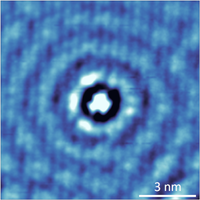
Imaging of never-before-seen concentric patterns around atomic-scale defects in the quantum spin liquid candidate α-RuCl3 opens a new avenue for probing the electronic behavior of this exotic quantum state.

Particle-Hole Asymmetric Ferromagnetism and Spin Textures in the Triangular Hubbard-Hofstadter Model

Jixun K. Ding, Luhang Yang, Wen O. Wang, Ziyan Zhu, Cheng Peng, Peizhi Mai, Edwin W. Huang, Brian Moritz, Philip W. Phillips, Benjamin E. Feldman, and Thomas P. Devereaux

Phys. Rev. X 14, 041025 (2024) - Published 25 October, 2024

A numerical analysis of a triangular lattice model in a perpendicular magnetic field reveals a rich phase diagram not captured by the simple continuum models usually used to study the quantum Hall effect.

Defect-Assisted Domain Nucleation Drives Unique Exchange-Bias Phenomena in MnBi2Te4

Shiqi Yang, Xiaolong Xu, Yuchen Gao, Roger Guzman, Pingfan Gu, Huan Wang, Yuan Huang, Wu Zhou, Tianlong Xia, and Yu Ye

Phys. Rev. X 14, 041024 (2024) - Published 24 October, 2024

Exchange-bias phenomena have a potential role to play in ultra-high-density magnetic storage. Observations of a unique exchange-bias phenomenon offer new avenues for the design of such devices.

Electronic Band Structure of a Superconducting Nickelate Probed by the Seebeck Coefficient in the Disordered Limit

G. Grissonnanche, G. A. Pan, H. LaBollita, D. Ferenc Segedin, Q. Song, H. Paik, C. M. Brooks, E. Beauchesne-Blanchet, J. L. Santana González, A. S. Botana, J. A. Mundy, and B. J. Ramshaw

Phys. Rev. X 14, 041021 (2024) - Published 23 October, 2024

Thermoelectric measurements reveal that the metallic state in nickelate superconductors is that of a conventional metal, providing a clearer starting point for understanding this otherwise unconventional type of superconductivity.

Coherent Coupling of a Diamond Tin-Vacancy Center to a Tunable Open Microcavity

Yanik Herrmann, Julius Fischer, Julia M. Brevoord, Colin Sauerzapf, Leonardo G. C. Wienhoven, Laurens J. Feije, Matteo Pasini, Martin Eschen, Maximilian Ruf, Matthew J. Weaver, and Ronald Hanson

Phys. Rev. X 14, 041013 (2024) - Published 15 October, 2024

Embedding a diamond color center in an open optical resonator provides fully tunable control over the light-matter interaction at the single-photon level, paving the way for novel quantum-technology platforms.

Observing Quantum Measurement Collapse as a Learnability Phase Transition

Utkarsh Agrawal, Javier Lopez-Piqueres, Romain Vasseur, Sarang Gopalakrishnan, and Andrew C. Potter

Phys. Rev. X 14, 041012 (2024) - Published 15 October, 2024

Experiments with a quantum computer reveal how measurements at small scale lead to the collapse of macroscopic quantities into well-defined values, thus shedding light on how classical physics emerges from quantum physics at large scales.

Planar Thermal Hall Effect from Phonons in Cuprates

Lu Chen, Léna Le Roux, Gaël Grissonnanche, Marie-Eve Boulanger, Steven Thériault, Ruixing Liang, D. A. Bonn, W. N. Hardy, S. Pyon, T. Takayama, H. Takagi, Ke-Jun Xu, Zhi-Xun Shen, and Louis Taillefer

Phys. Rev. X 14, 041011 (2024) - Published 11 October, 2024

A systematic study of the unusual “planar thermal Hall effect” in cuprates reveals a contribution from phonons, adding a piece to the puzzle of understanding the baffling phonon thermal Hall effect.

Nanometer-Scale Acoustic Wave Packets Generated by Stochastic Core-Level Photoionization Events

Yijing Huang, Peihao Sun, Samuel W. Teitelbaum, Haoyuan Li, Yanwen Sun, Nan Wang, Sanghoon Song, Takahiro Sato, Matthieu Chollet, Taito Osaka, Ichiro Inoue, Ryan A. Duncan, Hyun D. Shin, Johann Haber, Jinjian Zhou, Marco Bernardi, Mingqiang Gu, James M. Rondinelli, Mariano Trigo, Makina Yabashi, Alexei A. Maznev, Keith A. Nelson, Diling Zhu, and David A. Reis

Phys. Rev. X 14, 041010 (2024) - Published 10 October, 2024

A first-of-its-kind analysis of acoustic waves generated in crystalline materials following x-ray excitation helps inform broader efforts to understand x-ray interactions with matter.

Sign In to Your Journals Account

Filter

Subject

Filter

Article Lookup

Enter a citation