Browse by Subject

Probing Symmetries of Quantum Many-Body Systems through Gap Ratio Statistics

Olivier Giraud, Nicolas Macé, Éric Vernier, and Fabien Alet

Phys. Rev. X 12, 011006 (2022) - Published 10 January, 2022

The statistics of ratios between successive energy levels in certain quantum systems can reveal additional, possibly hidden, symmetries as well as distinguish between regular and chaotic behavior.

Gapless Topological Phases and Symmetry-Enriched Quantum Criticality

Ruben Verresen, Ryan Thorngren, Nick G. Jones, and Frank Pollmann

Phys. Rev. X 11, 041059 (2021) - Published 23 December, 2021

A theoretical framework explains the interplay between topology and quantum critical points and leads to the discovery of surprising new examples.

Realization of Real-Time Fault-Tolerant Quantum Error Correction

C. Ryan-Anderson, J. G. Bohnet, K. Lee, D. Gresh, A. Hankin, J. P. Gaebler, D. Francois, A. Chernoguzov, D. Lucchetti, N. C. Brown, T. M. Gatterman, S. K. Halit, K. Gilmore, J. A. Gerber, B. Neyenhuis, D. Hayes, and R. P. Stutz

Phys. Rev. X 11, 041058 (2021) - Published 23 December, 2021

An experiment shows that errors in quantum computation can be repeatedly corrected on the fly.

Revealing the Influence of Molecular Chirality on Tunnel-Ionization Dynamics

E. Bloch, S. Larroque, S. Rozen, S. Beaulieu, A. Comby, S. Beauvarlet, D. Descamps, B. Fabre, S. Petit, R. Taïeb, A. J. Uzan, V. Blanchet, N. Dudovich, B. Pons, and Y. Mairesse

Phys. Rev. X 11, 041056 (2021) - Published 21 December, 2021

When tunneling through a rotating chiral barrier, electron wave packets retain a signature of the barrier dynamics in both their amplitude and phase.

Emerging Dissipative Phases in a Superradiant Quantum Gas with Tunable Decay

Francesco Ferri, Rodrigo Rosa-Medina, Fabian Finger, Nishant Dogra, Matteo Soriente, Oded Zilberberg, Tobias Donner, and Tilman Esslinger

Phys. Rev. X 11, 041046 (2021) - Published 7 December, 2021

By coupling a quantum gas to a lossy optical cavity and driving it with lasers, an out-of-equilibrium phase of matter emerges that sheds light on how macroscopic properties connect to microscopic processes in driven, dissipative matter.

Quantum Variational Optimization of Ramsey Interferometry and Atomic Clocks

Raphael Kaubruegger, Denis V. Vasilyev, Marius Schulte, Klemens Hammerer, and Peter Zoller

Phys. Rev. X 11, 041045 (2021) - Published 6 December, 2021

Variational quantum algorithms could help researchers improve the performance of optical atomic clocks and of other quantum-metrology schemes.

Collapse and Revival of an Artificial Atom Coupled to a Structured Photonic Reservoir

Vinicius S. Ferreira, Jash Banker, Alp Sipahigil, Matthew H. Matheny, Andrew J. Keller, Eunjong Kim, Mohammad Mirhosseini, and Oskar Painter

Phys. Rev. X 11, 041043 (2021) - Published 2 December, 2021

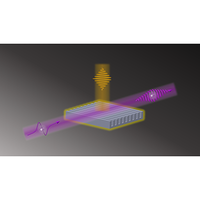
A superconducting quantum circuit coupled to a tailored waveguide reservoir provides a platform for exploring non-Markovian quantum-optical dynamics, in which the reservoir maintains a memory of past events.

Quantum Nature of Dielectric Laser Accelerators

Yuval Adiv, Kangpeng Wang, Raphael Dahan, Payton Broaddus, Yu Miao, Dylan Black, Kenneth Leedle, Robert L. Byer, Olav Solgaard, R. Joel England, and Ido Kaminer

Phys. Rev. X 11, 041042 (2021) - Published 1 December, 2021

A first observation of quantum features in a laser-driven electron accelerator provides a path to novel accelerator designs and highlights how classical behavior emerges from quantum interactions.

Randomized Compiling for Scalable Quantum Computing on a Noisy Superconducting Quantum Processor

Akel Hashim, Ravi K. Naik, Alexis Morvan, Jean-Loup Ville, Bradley Mitchell, John Mark Kreikebaum, Marc Davis, Ethan Smith, Costin Iancu, Kevin P. O’Brien, Ian Hincks, Joel J. Wallman, Joseph Emerson, and Irfan Siddiqi

Phys. Rev. X 11, 041039 (2021) - Published 24 November, 2021

Randomized compiling, a technique in quantum computing for turning coherent errors into stochastic noise, improves the performance of quantum algorithms and their predictability.

Virtual Distillation for Quantum Error Mitigation

William J. Huggins, Sam McArdle, Thomas E. O’Brien, Joonho Lee, Nicholas C. Rubin, Sergio Boixo, K. Birgitta Whaley, Ryan Babbush, and Jarrod R. McClean

Phys. Rev. X 11, 041036 (2021) - Published 19 November, 2021

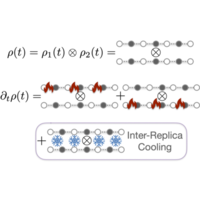
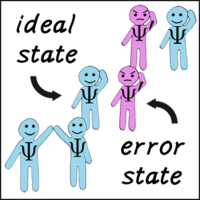
A new approach for suppressing noise in quantum computation uses multiple copies of a quantum state to cancel out certain kinds of noise, using much less overhead than traditional techniques.

Integrated Optical Addressing of a Trapped Ytterbium Ion

M. Ivory, W. J. Setzer, N. Karl, H. McGuinness, C. DeRose, M. Blain, D. Stick, M. Gehl, and L. P. Parazzoli

Phys. Rev. X 11, 041033 (2021) - Published 16 November, 2021

A surface ion trap with integrated waveguides produces no additional heating and modest frequency shifts due to photoinduced charging when uv light is delivered to an ion, thus providing the stability needed for compact quantum timekeeping devices.

Quantum Simulation of Antiferromagnetic Heisenberg Chain with Gate-Defined Quantum Dots

C. J. van Diepen, T.-K. Hsiao, U. Mukhopadhyay, C. Reichl, W. Wegscheider, and L. M. K. Vandersypen

Phys. Rev. X 11, 041025 (2021) - Published 4 November, 2021

Researchers successfully use an array of quantum dots to create and study a Heisenberg spin chain.

Universal Limitations on Quantum Key Distribution over a Network

Siddhartha Das, Stefan Bäuml, Marek Winczewski, and Karol Horodecki

Phys. Rev. X 11, 041016 (2021) - Published 22 October, 2021

A universal framework for assessing the security of quantum-based communication describes bounds for generating secure keys and requirements for any entanglement-based protocol that distributes those keys among trusted users.

Effective Theory for the Measurement-Induced Phase Transition of Dirac Fermions

M. Buchhold, Y. Minoguchi, A. Altland, and S. Diehl

Phys. Rev. X 11, 041004 (2021) - Published 7 October, 2021

A new theory of measurement-induced phase transitions reveals the effective degrees of freedom at the transition, which capture the structural change in the wave function at large distances and describes the transition in macroscopic observables.

Design Principles for Long-Range Energy Transfer at Room Temperature

Andrea Mattioni, Felipe Caycedo-Soler, Susana F. Huelga, and Martin B. Plenio

Phys. Rev. X 11, 041003 (2021) - Published 6 October, 2021

The control of molecular-level quantum effects in artificial photosynthetic membranes is a powerful tuning knob for optimizing long-range energy transport, according to a theoretical study.

Theory of Ergodic Quantum Processes

Ramis Movassagh and Jeffrey Schenker

Phys. Rev. X 11, 041001 (2021) - Published 1 October, 2021

A new universality theorem for how a large class of quantum systems behaves over long periods of time paves the way for improved quantum devices and fundamental insight into the evolution of generic quantum systems.

Reinforcement Learning for Many-Body Ground-State Preparation Inspired by Counterdiabatic Driving

Jiahao Yao, Lin Lin, and Marin Bukov

Phys. Rev. X 11, 031070 (2021) - Published 30 September, 2021

A new machine-learning-based approach to controlling quantum many-body systems provides a fast and efficient way to prepare many-body ground states on quantum simulators.

Quantum Coding with Low-Depth Random Circuits

Michael J. Gullans, Stefan Krastanov, David A. Huse, Liang Jiang, and Steven T. Flammia

Phys. Rev. X 11, 031066 (2021) - Published 24 September, 2021

Quantum error-correction codes generated by random circuits can offer robust performance with low circuit depth, suggesting that practical error correction is within reach on near-term quantum devices.

Signatures of Quantum Phase Transitions after Quenches in Quantum Chaotic One-Dimensional Systems

Asmi Haldar, Krishnanand Mallayya, Markus Heyl, Frank Pollmann, Marcos Rigol, and Arnab Das

Phys. Rev. X 11, 031062 (2021) - Published 20 September, 2021

Locating quantum phase transitions is key to understanding drastic changes in the behavior of low-temperature matter. A new nonequilibrium protocol promises an easier way to do so.

Exponential Error Suppression for Near-Term Quantum Devices

Bálint Koczor

Phys. Rev. X 11, 031057 (2021) - Published 15 September, 2021

A new scheme could offer a technologically viable solution for remedying computational errors in near-term quantum devices.

Sign In to Your Journals Account

Filter

Filter

Article Lookup

Enter a citation