Browse by Subject

Qubit-Reuse Compilation with Mid-Circuit Measurement and Reset

Matthew DeCross, Eli Chertkov, Megan Kohagen, and Michael Foss-Feig

Phys. Rev. X 13, 041057 (2023) - Published 22 December, 2023

A technique for compressing a quantum program into a small number of qubits pushes quantum computing closer to its goal of solving meaningful problems that cannot be solved on classical computers.

A Race-Track Trapped-Ion Quantum Processor

S. A. Moses et al.

Phys. Rev. X 13, 041052 (2023) - Published 18 December, 2023

Major technical improvements to a quantum computer based on trapped ions could bring a large-scale version closer to reality.

Midcircuit Measurements on a Single-Species Neutral Alkali Atom Quantum Processor

T. M. Graham, L. Phuttitarn, R. Chinnarasu, Y. Song, C. Poole, K. Jooya, J. Scott, A. Scott, P. Eichler, and M. Saffman

Phys. Rev. X 13, 041051 (2023) - Published 15 December, 2023

Shelving data qubits in protected hyperfine states while measuring an ancilla qubit allows for robust midcircuit measurements in a neutral atom array, a key step toward extending the lifetime of atomic quantum memories.

Theory of Free Fermions under Random Projective Measurements

Igor Poboiko, Paul Pöpperl, Igor V. Gornyi, and Alexander D. Mirlin

Phys. Rev. X 13, 041046 (2023) - Published 8 December, 2023

A new analytic theory of a monitored 1D free-fermion system shows the absence of a measurement-induced entanglement phase transition conjectured in recent studies.

Exponential Quantum Speedup in Simulating Coupled Classical Oscillators

Ryan Babbush, Dominic W. Berry, Robin Kothari, Rolando D. Somma, and Nathan Wiebe

Phys. Rev. X 13, 041041 (2023) - Published 4 December, 2023

An algorithm for simulating coupled classical oscillators on a quantum computer offers a new example of quantum advantage, requiring far fewer resources than simulations on a classical computer.

A Postquantum Theory of Classical Gravity?

Jonathan Oppenheim

Phys. Rev. X 13, 041040 (2023) - Published 4 December, 2023

A proposed model unites quantum theory with classical gravity by assuming that states evolve in a probabilistic way, like a game of chance.

Microwave-Based Quantum Control and Coherence Protection of Tin-Vacancy Spin Qubits in a Strain-Tuned Diamond-Membrane Heterostructure

Xinghan Guo, Alexander M. Stramma, Zixi Li, William G. Roth, Benchen Huang, Yu Jin, Ryan A. Parker, Jesús Arjona Martínez, Noah Shofer, Cathryn P. Michaels, Carola P. Purser, Martin H. Appel, Evgeny M. Alexeev, Tianle Liu, Andrea C. Ferrari, David D. Awschalom, Nazar Delegan, Benjamin Pingault, Giulia Galli, F. Joseph Heremans, Mete Atatüre, and Alexander A. High

Phys. Rev. X 13, 041037 (2023) - Published 29 November, 2023

Strain engineering of diamond provides a way to realize high-performance tin-vacancy spin qubits that avoid many of the trade-offs inherent to optical quantum control techniques.

Midcircuit Operations Using the omg Architecture in Neutral Atom Arrays

Joanna W. Lis, Aruku Senoo, William F. McGrew, Felix Rönchen, Alec Jenkins, and Adam M. Kaufman

Phys. Rev. X 13, 041035 (2023) - Published 22 November, 2023

Three research groups have exploited the nuclear spins of ytterbium-171 to manipulate qubits before they are read out—an approach that could lead to efficient error-correction schemes for trapped-atom computing platforms.

Midcircuit Qubit Measurement and Rearrangement in a Yb171 Atomic Array

M. A. Norcia et al.

Phys. Rev. X 13, 041034 (2023) - Published 22 November, 2023

Three research groups have exploited the nuclear spins of ytterbium-171 to manipulate qubits before they are read out—an approach that could lead to efficient error-correction schemes for trapped-atom computing platforms.

Demonstrating Scalable Randomized Benchmarking of Universal Gate Sets

Jordan Hines, Marie Lu, Ravi K. Naik, Akel Hashim, Jean-Loup Ville, Brad Mitchell, John Mark Kriekebaum, David I. Santiago, Stefan Seritan, Erik Nielsen, Robin Blume-Kohout, Kevin Young, Irfan Siddiqi, Birgitta Whaley, and Timothy Proctor

Phys. Rev. X 13, 041030 (2023) - Published 14 November, 2023

A new approach to benchmarking large-scale quantum devices overcomes existing hurdles, scales to thousands of qubit, and can test a variety of universal gate sets.

Majorana Loop Models for Measurement-Only Quantum Circuits

Kai Klocke and Michael Buchhold

Phys. Rev. X 13, 041028 (2023) - Published 9 November, 2023

A connection between a subclass of quantum circuits and existing frameworks of statistical mechanics allows one to extract genuine quantum-mechanical properties from the boundary of a classical model.

Erasure Qubits: Overcoming the T1 Limit in Superconducting Circuits

Aleksander Kubica, Arbel Haim, Yotam Vaknin, Harry Levine, Fernando Brandão, and Alex Retzker

Phys. Rev. X 13, 041022 (2023) - Published 1 November, 2023

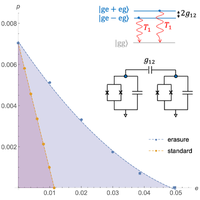
A simple scheme to convert amplitude-damping noise in superconducting circuits to easier-to-correct heralded erasure noise overcomes conventional limits on quantum information fidelity.

Tackling Sampling Noise in Physical Systems for Machine Learning Applications: Fundamental Limits and Eigentasks

Fangjun Hu, Gerasimos Angelatos, Saeed A. Khan, Marti Vives, Esin Türeci, Leon Bello, Graham E. Rowlands, Guilhem J. Ribeill, and Hakan E. Türeci

Phys. Rev. X 13, 041020 (2023) - Published 30 October, 2023

A framework to quantify the computational capacity of arbitrary physical systems in the presence of sampling noise provides a tool for best harnessing them for machine learning.

Observation of a Prethermal U(1) Discrete Time Crystal

Andrew Stasiuk and Paola Cappellaro

Phys. Rev. X 13, 041016 (2023) - Published 26 October, 2023

Observation of a time crystal—a periodically driven state that breaks time-translation symmetry—at room temperature bolsters the case for using the state as a near-term robust quantum memory.

Hotter is Easier: Unexpected Temperature Dependence of Spin Qubit Frequencies

Brennan Undseth, Oriol Pietx-Casas, Eline Raymenants, Mohammad Mehmandoost, Mateusz T. Mądzik, Stephan G. J. Philips, Sander L. de Snoo, David J. Michalak, Sergey V. Amitonov, Larysa Tryputen, Brian Paquelet Wuetz, Viviana Fezzi, Davide Degli Esposti, Amir Sammak, Giordano Scappucci, and Lieven M. K. Vandersypen

Phys. Rev. X 13, 041015 (2023) - Published 25 October, 2023

Control signals can shift the frequency of spin-based qubits. New experiments show that this effect corresponds to a temperature increase and can be counterintuitively suppressed by operating at a higher temperature than normal.

High-Threshold Codes for Neutral-Atom Qubits with Biased Erasure Errors

Kaavya Sahay, Junlan Jin, Jahan Claes, Jeff D. Thompson, and Shruti Puri

Phys. Rev. X 13, 041013 (2023) - Published 24 October, 2023

A new model of qubit noise that is motivated by neutral atom qubits leads to much higher rates of error correction in tailored error-correcting codes.

Temporal Entanglement in Chaotic Quantum Circuits

Alessandro Foligno, Tianci Zhou, and Bruno Bertini

Phys. Rev. X 13, 041008 (2023) - Published 11 October, 2023

To simulate the action of an effective bath in a chaotic system of many quantum particles, one needs resources that grow exponentially in time.

Disentangling Losses in Tantalum Superconducting Circuits

Kevin D. Crowley, Russell A. McLellan, Aveek Dutta, Nana Shumiya, Alexander P. M. Place, Xuan Hoang Le, Youqi Gang, Trisha Madhavan, Matthew P. Bland, Ray Chang, Nishaad Khedkar, Yiming Cady Feng, Esha A. Umbarkar, Xin Gui, Lila V. H. Rodgers, Yichen Jia, Mayer M. Feldman, Stephen A. Lyon, Mingzhao Liu, Robert J. Cava, Andrew A. Houck, and Nathalie P. de Leon

Phys. Rev. X 13, 041005 (2023) - Published 6 October, 2023

Tantalum-based superconducting qubits have shown great promise in extending qubit lifetimes. New systematic measurements identify the key sources of loss and noise in this material system.  

Testing Quantum Theory by Generalizing Noncontextuality

Markus P. Müller and Andrew J. P. Garner

Phys. Rev. X 13, 041001 (2023) - Published 2 October, 2023

An analysis of what kind of effective statistical behavior is plausible if physics is assumed to be fundamentally quantum sets the stage for more robust tests of the validity of quantum theory.

High-Fidelity, Frequency-Flexible Two-Qubit Fluxonium Gates with a Transmon Coupler

Leon Ding, Max Hays, Youngkyu Sung, Bharath Kannan, Junyoung An, Agustin Di Paolo, Amir H. Karamlou, Thomas M. Hazard, Kate Azar, David K. Kim, Bethany M. Niedzielski, Alexander Melville, Mollie E. Schwartz, Jonilyn L. Yoder, Terry P. Orlando, Simon Gustavsson, Jeffrey A. Grover, Kyle Serniak, and William D. Oliver

Phys. Rev. X 13, 031035 (2023) - Published 25 September, 2023

Coupling fluxonium qubits with a tunable transmon coupler offers advantages in robustness, extensibility, and fidelities for single- and two-qubit gate operations.


Sign In to Your Journals Account

Filter

Filter

Article Lookup

Enter a citation