Browse by Subject

Certifying Ground-State Properties of Many-Body Systems

Jie Wang, Jacopo Surace, Irénée Frérot, Benoît Legat, Marc-Olivier Renou, Victor Magron, and Antonio Acín

Phys. Rev. X 14, 031006 (2024) - Published 11 July, 2024

A new numerical method provides upper and lower bounds on arbitrary ground-state observables for many-body quantum systems.

Mitigating Temporal Fragility in the XY Surface Code

Pei-Kai Tsai, Yue Wu, and Shruti Puri

Phys. Rev. X 14, 031003 (2024) - Published 9 July, 2024

A quantum error-correcting code known as the XY surface code loses some of its ability to tolerate errors when states are prepared and measured. A new method of preparation and measurement mitigates this loss.

Long-Range Entanglement from Measuring Symmetry-Protected Topological Phases

Nathanan Tantivasadakarn, Ryan Thorngren, Ashvin Vishwanath, and Ruben Verresen

Phys. Rev. X 14, 021040 (2024) - Published 7 June, 2024

Measuring certain quantum states with short-range entanglement can give rise to long-range entanglement, an insight with direct practical significance for preparing exotic many-body states in quantum devices.

Wave-Function Network Description and Kolmogorov Complexity of Quantum Many-Body Systems

T. Mendes-Santos, M. Schmitt, A. Angelone, A. Rodriguez, P. Scholl, H. J. Williams, D. Barredo, T. Lahaye, A. Browaeys, M. Heyl, and M. Dalmonte

Phys. Rev. X 14, 021029 (2024) - Published 21 May, 2024

A network-theory-based framework for describing quantum mechanical wave functions enables the discovery of a very deep inner structure—that of a scale-free network.

Exact Results for a Boundary-Driven Double Spin Chain and Resource-Efficient Remote Entanglement Stabilization

Andrew Lingenfelter, Mingxing Yao, Andrew Pocklington, Yu-Xin Wang (王语馨), Abdullah Irfan, Wolfgang Pfaff, and Aashish A. Clerk

Phys. Rev. X 14, 021028 (2024) - Published 20 May, 2024

Exact solutions for the steady state of two spin-chain models provides an experimentally friendly scheme for efficiently stabilizing large entangled states between remote systems.

Long-Lived Circular Rydberg Qubits of Alkaline-Earth Atoms in Optical Tweezers

C. Hölzl, A. Götzelmann, E. Pultinevicius, M. Wirth, and F. Meinert

Phys. Rev. X 14, 021024 (2024) - Published 3 May, 2024

Researchers record the longest Rydberg-atom lifetime by placing strontium atoms in “circular” states, where the outer electrons move in planet-like orbits.

Testing the Quantumness of Gravity without Entanglement

Ludovico Lami, Julen S. Pedernales, and Martin B. Plenio

Phys. Rev. X 14, 021022 (2024) - Published 1 May, 2024

A proposed experiment could bring scientists closer to answering the long-standing question of whether gravity is a classical or a quantum phenomenon.

Autoparametric Resonance Extending the Bit-Flip Time of a Cat Qubit up to 0.3 s

A. Marquet, A. Essig, J. Cohen, N. Cottet, A. Murani, E. Albertinale, S. Dupouy, A. Bienfait, T. Peronnin, S. Jezouin, R. Lescanne, and B. Huard

Phys. Rev. X 14, 021019 (2024) - Published 26 April, 2024

Cat qubits—a promising route for quantum error correction—can be stabilized with engineered dissipation. A method for increasing the dissipation rate shows greater resiliency of such a qubit to bit-flip errors.

Realization of a Programmable Multipurpose Photonic Quantum Memory with Over-Thousand Qubit Manipulations

Sheng Zhang, Jixuan Shi, Zhaibin Cui, Ye Wang, Yukai Wu, Luming Duan, and Yunfei Pu

Phys. Rev. X 14, 021018 (2024) - Published 25 April, 2024

A new quantum memory, based on a neutral-atom cloud, demonstrates the ability to manipulate a large stream of optical qubits and to support key applications essential to future, large-scale quantum networks.

Lower Bounds on Ground-State Energies of Local Hamiltonians through the Renormalization Group

Ilya Kull, Norbert Schuch, Ben Dive, and Miguel Navascués

Phys. Rev. X 14, 021008 (2024) - Published 9 April, 2024

A method of obtaining precise lower bounds on the minimum energy for quantum many-body systems with local interactions can be applied to a wide range of problems in quantum many-body physics.

Indirect Cooling of Weakly Coupled Trapped-Ion Mechanical Oscillators

Pan-Yu Hou, Jenny J. Wu, Stephen D. Erickson, Giorgio Zarantonello, Adam D. Brandt, Daniel C. Cole, Andrew C. Wilson, Daniel H. Slichter, and Dietrich Leibfried

Phys. Rev. X 14, 021003 (2024) - Published 2 April, 2024

Certain motional modes in trapped-ion crystals are hard to cool. A technique to do so indirectly involves transferring motional quanta from these modes to ones that cool more efficiently.

Conditional-not Displacement: Fast Multioscillator Control with a Single Qubit

Asaf A. Diringer, Eliya Blumenthal, Avishay Grinberg, Liang Jiang, and Shay Hacohen-Gourgy

Phys. Rev. X 14, 011055 (2024) - Published 26 March, 2024

A new method for fast entangling operations on quantum states does so 100 times faster than previous approaches and requires only a single control element, offering a fast control platform for quantum information processing.

Demonstrating a Long-Coherence Dual-Rail Erasure Qubit Using Tunable Transmons

H. Levine et al.

Phys. Rev. X 14, 011051 (2024) - Published 20 March, 2024

Researchers have realized a recently proposed qubit in which the errors mostly involve erasure of the qubit state, an advance that could help simplify the architecture of fault-tolerant quantum computers.

Exciton Transport in a Germanium Quantum Dot Ladder

T.-K. Hsiao, P. Cova Fariña, S. D. Oosterhout, D. Jirovec, X. Zhang, C. J. van Diepen, W. I. L. Lawrie, C.-A. Wang, A. Sammak, G. Scappucci, M. Veldhorst, E. Demler, and L. M. K. Vandersypen

Phys. Rev. X 14, 011048 (2024) - Published 14 March, 2024

The creation and movement of excitons, or bound electron-hole pairs, in a quantum dot array establishes a potential platform for future studies of a wide range of excitonic phenomena.

Correlation Spectroscopy with Multiqubit-Enhanced Phase Estimation

H. Hainzer, D. Kiesenhofer, T. Ollikainen, M. Bock, F. Kranzl, M. K. Joshi, G. Yoeli, R. Blatt, T. Gefen, and C. F. Roos

Phys. Rev. X 14, 011033 (2024) - Published 29 February, 2024

Correlation spectroscopy, where multiple qubits exposed to the same noise are probed simultaneously, extends the possible probe time beyond single-particle coherence.

Shortcuts to Adiabaticity in Krylov Space

Kazutaka Takahashi and Adolfo del Campo

Phys. Rev. X 14, 011032 (2024) - Published 28 February, 2024

Shortcuts to adiabaticity provide fast protocols for quantum state preparation. A new way to construct the auxiliary controls for guiding the system’s dynamics boosts their application to many-body systems.

Realization of an Extremely Anisotropic Heisenberg Magnet in Rydberg Atom Arrays

Kangheun Kim, Fan Yang, Klaus Mølmer, and Jaewook Ahn

Phys. Rev. X 14, 011025 (2024) - Published 21 February, 2024

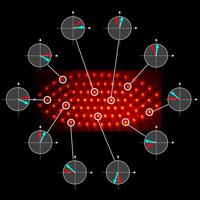
A new approach to constructing quantum spin Hamiltonians in a neutral-atom quantum simulator reveals never-before-seen phenomena in magnon bound states.

Sparse Random Hamiltonians Are Quantumly Easy

Chi-Fang Chen, Alexander M. Dalzell, Mario Berta, Fernando G. S. L. Brandão, and Joel A. Tropp

Phys. Rev. X 14, 011014 (2024) - Published 9 February, 2024

Identification of a large class of Hamiltonians that are easy to solve on quantum computers but difficult on classical ones provides a possible path to practical quantum advantage in the simulation of quantum systems.

Continuous-Variable Quantum State Designs: Theory and Applications

Joseph T. Iosue, Kunal Sharma, Michael J. Gullans, and Victor V. Albert

Phys. Rev. X 14, 011013 (2024) - Published 8 February, 2024

Quantum t-designs—ensembles of states that mimic uniform averaging—for infinite-dimensional spaces do not exist, but an alternative “rigged t-design” is possible.

Microwave Photon-Number Amplification

R. Albert, J. Griesmar, F. Blanchet, U. Martel, N. Bourlet, and M. Hofheinz

Phys. Rev. X 14, 011011 (2024) - Published 5 February, 2024

A new photon-number amplification scheme, which combines the advantages of a single-photon detector and a power meter, could lead to new photon-detection possibilities in quantum-sensing and quantum-computing applications.

Sign In to Your Journals Account

Filter

Filter

Article Lookup

Enter a citation