Browse by Subject

Analytical Formalism for the Interaction of Two-Level Quantum Systems with Metal Nanoresonators

Jianji Yang, Mathias Perrin, and Philippe Lalanne

Phys. Rev. X 5, 021008 (2015) - Published 17 April, 2015

Hybrid nanostructures composed of both typical atoms and metallic nanoparticles such as nanoresonators host a variety of optical properties. Analytical modeling is used to derive the optical responses of such materials in a computationally feasible way.

Wigner Function Negativity and Contextuality in Quantum Computation on Rebits

Nicolas Delfosse, Philippe Allard Guerin, Jacob Bian, and Robert Raussendorf

Phys. Rev. X 5, 021003 (2015) - Published 2 April, 2015

Quantum computation commonly relies on qubits, but rebits—states with real density matrices—can be used as well. Researchers show how the contextuality of two-level states is necessary for quantum computation.

Quantum Coherence, Time-Translation Symmetry, and Thermodynamics

Matteo Lostaglio, Kamil Korzekwa, David Jennings, and Terry Rudolph

Phys. Rev. X 5, 021001 (2015) - Published 1 April, 2015

Quantum mechanics and thermodynamics are fundamental fields of physics. Scientists show how the processing of quantum coherence is constrained by the laws of thermodynamics.

Erratum: Glassy Chimeras could be blind to quantum speedup: Designing better benchmarks for quantum annealing machines [Phys. Rev. X 4, 021008 (2014)]

Martin Weigel, Helmut G. Katzgraber, Jonathan Machta, Firas Hamze, and Ruben S. Andrist (Octomore Collaboration)

Phys. Rev. X 5, 019901 (2015) - Published 30 January, 2015

Deterministic Writing and Control of the Dark Exciton Spin Using Single Short Optical Pulses

I. Schwartz, E. R. Schmidgall, L. Gantz, D. Cogan, E. Bordo, Y. Don, M. Zielinski, and D. Gershoni

Phys. Rev. X 5, 011009 (2015) - Published 30 January, 2015

Quantum information processing relies on controlling electronic and nuclear spins. Scientists experimentally demonstrate that the spins of a certain kind of optical excitation have relatively long coherence lifetimes and, furthermore, can be reliably controlled.

Integrated Source of Spectrally Filtered Correlated Photons for Large-Scale Quantum Photonic Systems

Nicholas C. Harris, Davide Grassani, Angelica Simbula, Mihir Pant, Matteo Galli, Tom Baehr-Jones, Michael Hochberg, Dirk Englund, Daniele Bajoni, and Christophe Galland

Phys. Rev. X 4, 041047 (2014) - Published 19 December, 2014

The creation of quantum-correlated photon pairs is a necessary step toward realizing quantum simulation and ultimately quantum computing. Using a millimeter-scale silicon-on-insulator chip, scientists successfully separate correlated photon pairs from background pump photons, where the latter are more numerous by a factor exceeding 10 billion.

Measurement-Free Topological Protection Using Dissipative Feedback

Keisuke Fujii, Makoto Negoro, Nobuyuki Imoto, and Masahiro Kitagawa

Phys. Rev. X 4, 041039 (2014) - Published 1 December, 2014

Quantum computing is susceptible to noise, which can require parallel measurements of many individual particles to correct. A new “measurement-free” scheme is proposed to protect quantum information in a topological way.

Coherent versus Measurement Feedback: Linear Systems Theory for Quantum Information

Naoki Yamamoto

Phys. Rev. X 4, 041029 (2014) - Published 14 November, 2014

Deciding whether to conduct a measurement is a fundamental tenant of quantum physics. A new analysis finds situations in the linear regime where measurement-based feedback control of a quantum system has no merit.

Local Convertibility and the Quantum Simulation of Edge States in Many-Body Systems

Fabio Franchini, Jian Cui, Luigi Amico, Heng Fan, Mile Gu, Vladimir Korepin, Leong Chuan Kwek, and Vlatko Vedral

Phys. Rev. X 4, 041028 (2014) - Published 13 November, 2014

Quantum simulators pave the way for quantum computers, which promise to be smaller and faster than current classical machines. Researchers show that Majorana edge states can result in genuinely quantum long-range correlations, which are a fundamental property of quantum machines.

Optimizing the Choice of Spin-Squeezed States for Detecting and Characterizing Quantum Processes

Lee A. Rozema, Dylan H. Mahler, Robin Blume-Kohout, and Aephraim M. Steinberg

Phys. Rev. X 4, 041025 (2014) - Published 7 November, 2014

Quantum metrology is focused on making exquisitely precise measurements. New results show that different techniques are optimal for noise detection and noise characterization.

Analyzing Many-Body Localization with a Quantum Computer

Bela Bauer and Chetan Nayak

Phys. Rev. X 4, 041021 (2014) - Published 3 November, 2014

A small quantum computer with a limited number of qubits seems feasible in the coming years. By emulating quantum simulation on such a computer, researchers show that it can be used to resolve long-standing questions about disordered interacting electrons.

Observation and Interpretation of Motional Sideband Asymmetry in a Quantum Electromechanical Device

A. J. Weinstein, C. U. Lei, E. E. Wollman, J. Suh, A. Metelmann, A. A. Clerk, and K. C. Schwab

Phys. Rev. X 4, 041003 (2014) - Published 7 October, 2014

Electromagnetic resonators can be used to probe the quantum properties of mechanical objects. Scientists show that an imbalance between phonon absorption and emission—a distinct quantum signature—can be traced back to quantum fluctuations of either mechanical or microwave fields, depending on the measurement details.

Thermalization, Error Correction, and Memory Lifetime for Ising Anyon Systems

Courtney G. Brell, Simon Burton, Guillaume Dauphinais, Steven T. Flammia, and David Poulin

Phys. Rev. X 4, 031058 (2014) - Published 30 September, 2014

Error-correction protocols needed to combat thermal noise and allow the use of non-Abelian anyons in quantum computing technologies are demonstrated.

Quantum Random Number Generation on a Mobile Phone

Bruno Sanguinetti, Anthony Martin, Hugo Zbinden, and Nicolas Gisin

Phys. Rev. X 4, 031056 (2014) - Published 29 September, 2014

Generating random numbers is critical to securing both communications and data. New results reveal how consumer hardware such as mobile phones can generate random numbers with a quantum origin.

Publisher’s Note: Hall Effect Gyrators and Circulators [Phys. Rev. X 4, 021019 (2014)]

Giovanni Viola and David P. DiVincenzo

Phys. Rev. X 4, 039902 (2014) - Published 19 September, 2014

Induced Self-Stabilization in Fractional Quantum Hall States of Light

Eliot Kapit, Mohammad Hafezi, and Steven H. Simon

Phys. Rev. X 4, 031039 (2014) - Published 3 September, 2014

Superconducting quantum circuits are susceptible to losing photons. Scientists provide a blueprint for how lost photons can be passively refilled by coupling the primary circuit to a second lattice of intentionally bad qubits, with a much faster loss rate than the primary lattice.

Photonic Architecture for Scalable Quantum Information Processing in Diamond

Kae Nemoto, Michael Trupke, Simon J. Devitt, Ashley M. Stephens, Burkhard Scharfenberger, Kathrin Buczak, Tobias Nöbauer, Mark S. Everitt, Jörg Schmiedmayer, and William J. Munro

Phys. Rev. X 4, 031022 (2014) - Published 4 August, 2014

Building a quantum computer has long been thought to require futuristic technologies. New calculations reveal that physical qubits can be assembled that are scalable and function at the readily accessible temperature of 4 K.

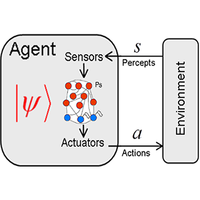
Quantum Speedup for Active Learning Agents

Giuseppe Davide Paparo, Vedran Dunjko, Adi Makmal, Miguel Angel Martin-Delgado, and Hans J. Briegel

Phys. Rev. X 4, 031002 (2014) - Published 8 July, 2014

Artificial intelligence will only become more ubiquitous with time. Scientists reveal that using quantum physics in autonomous learning agents yields a quadratic increase in speed in active learning.

Multimode Storage and Retrieval of Microwave Fields in a Spin Ensemble

C. Grezes, B. Julsgaard, Y. Kubo, M. Stern, T. Umeda, J. Isoya, H. Sumiya, H. Abe, S. Onoda, T. Ohshima, V. Jacques, J. Esteve, D. Vion, D. Esteve, K. Mølmer, and P. Bertet

Phys. Rev. X 4, 021049 (2014) - Published 16 June, 2014

Quantum computing promises to tackle computational problems that are intractable with classical computers. Researchers demonstrate that spin ensembles can store quantum information over longer times than previously achieved, a significant step toward a quantum memory.

Quantum Bidding in Bridge

Sadiq Muhammad, Armin Tavakoli, Maciej Kurant, Marcin Pawłowski, Marek Żukowski, and Mohamed Bourennane

Phys. Rev. X 4, 021047 (2014) - Published 12 June, 2014

In a game of duplicate bridge, better information sharing between two partners about their cards means better chances of winning. Researchers devise, and experimentally demonstrate, the first quantum information-sharing protocol that lets players improve their bids, expanding the understanding and use of quantum resources.

Sign In to Your Journals Account

Filter

Filter

Article Lookup

Enter a citation