Browse by Subject

Majorana Fermion Surface Code for Universal Quantum Computation

Sagar Vijay, Timothy H. Hsieh, and Liang Fu

Phys. Rev. X 5, 041038 (2015) - Published 10 December, 2015

Fault-tolerant quantum computation has been a long-standing goal in many fields of physics. A new model shows how logical qubits can be encoded using anyon excitations from Majorana fermions arranged on a two-dimensional lattice.

Quantum Nondemolition Measurement of a Nonclassical State of a Massive Object

F. Lecocq, J. B. Clark, R. W. Simmonds, J. Aumentado, and J. D. Teufel

Phys. Rev. X 5, 041037 (2015) - Published 7 December, 2015

The act of a quantum measurement reduces the uncertainty in the motion of a vibrating membrane below the fundamental quantum limit.

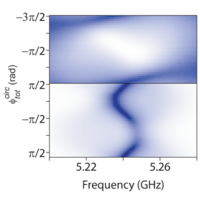
Reconfigurable Josephson Circulator/Directional Amplifier

K. M. Sliwa, M. Hatridge, A. Narla, S. Shankar, L. Frunzio, R. J. Schoelkopf, and M. H. Devoret

Phys. Rev. X 5, 041020 (2015) - Published 5 November, 2015

Superconducting qubit experiments cannot be conducted without nonreciprocal devices such as circulators and directional amplifiers. Researchers show that both of these kinds of devices can be realized using a single Josephson circuit.

Photon Temporal Modes: A Complete Framework for Quantum Information Science

B. Brecht, Dileep V. Reddy, C. Silberhorn, and M. G. Raymer

Phys. Rev. X 5, 041017 (2015) - Published 30 October, 2015

Because photons interact weakly with themselves and experience low decoherence, they are a promising avenue for quantum information science. Theorists show how the temporal modes of single-photon states can form an alphabet for communication across a quantum information network.

Generalized Multiphoton Quantum Interference

Max Tillmann, Si-Hui Tan, Sarah E. Stoeckl, Barry C. Sanders, Hubert de Guise, René Heilmann, Stefan Nolte, Alexander Szameit, and Philip Walther

Phys. Rev. X 5, 041015 (2015) - Published 27 October, 2015

Particle interference is a critical component of optical quantum computing and communication. Now, researchers examine multiphoton quantum interference both theoretically and experimentally by manipulating the distinguishability of photons.

Extractable Work from Correlations

Martí Perarnau-Llobet, Karen V. Hovhannisyan, Marcus Huber, Paul Skrzypczyk, Nicolas Brunner, and Antonio Acín

Phys. Rev. X 5, 041011 (2015) - Published 22 October, 2015

Quantum effects such as coherence and entanglement increase a system’s ability to store energy.

Self-Referenced Continuous-Variable Quantum Key Distribution Protocol

Daniel B. S. Soh, Constantin Brif, Patrick J. Coles, Norbert Lütkenhaus, Ryan M. Camacho, Junji Urayama, and Mohan Sarovar

Phys. Rev. X 5, 041010 (2015) - Published 21 October, 2015

Quantum technology that enables two distant parties to securely communicate is of great interest in cryptography. New research shows how implementations of quantum key distribution can be significantly simplified by not co-transmitting a local oscillator reference between the two communicating parties.

Generating the Local Oscillator “Locally” in Continuous-Variable Quantum Key Distribution Based on Coherent Detection

Bing Qi, Pavel Lougovski, Raphael Pooser, Warren Grice, and Miljko Bobrek

Phys. Rev. X 5, 041009 (2015) - Published 21 October, 2015

Secure cryptography has been a long-standing goal of quantum applications. Now, researchers experimentally show how a quantum setup can transmit a pattern of 1s and 0s over a 25-km optical fiber by interfering two independent lasers.

Resource Theory of Steering

Rodrigo Gallego and Leandro Aolita

Phys. Rev. X 5, 041008 (2015) - Published 15 October, 2015

Quantum key distribution, a process employed in encrypted transactions, relies on Einstein-Podolsky-Rosen steering when one party has untrusted devices. For the first time, a formal framework of steering as a physical resource is presented.

Resource Costs for Fault-Tolerant Linear Optical Quantum Computing

Ying Li, Peter C. Humphreys, Gabriel J. Mendoza, and Simon C. Benjamin

Phys. Rev. X 5, 041007 (2015) - Published 14 October, 2015

A theoretical analysis quantifies the technical resources required to build a quantum computer based on photons.

Experimental Realization of Quantum Tomography of Photonic Qudits via Symmetric Informationally Complete Positive Operator-Valued Measures

N. Bent, H. Qassim, A. A. Tahir, D. Sych, G. Leuchs, L. L. Sánchez-Soto, E. Karimi, and R. W. Boyd

Phys. Rev. X 5, 041006 (2015) - Published 12 October, 2015

Quantum states play key roles in advanced cryptographic methods. Now, experiments show that quantum state tomography can be optimized by employing certain mathematical constructions.

Single-Shot Fault-Tolerant Quantum Error Correction

Héctor Bombín

Phys. Rev. X 5, 031043 (2015) - Published 28 September, 2015

The goal of achieving quantum computation requires overcoming the limitation of quantum noise. A new approach shows how noisy local information about noise can be used to reliably correct errors for an ensemble of qubits on a lattice.

Experimental Determination of Multipartite Entanglement with Incomplete Information

G. H. Aguilar, S. P. Walborn, P. H. Souto Ribeiro, and L. C. Céleri

Phys. Rev. X 5, 031042 (2015) - Published 24 September, 2015

Characterizing the entangled states of quantum objects is both time and resource demanding. Now, researchers experimentally demonstrate an optical setup for partially characterizing entangled states in a much more efficient manner.

Universal Quantum Transducers Based on Surface Acoustic Waves

M. J. A. Schuetz, E. M. Kessler, G. Giedke, L. M. K. Vandersypen, M. D. Lukin, and J. I. Cirac

Phys. Rev. X 5, 031031 (2015) - Published 10 September, 2015

Surface acoustic waves may work as a “quantum bus” that carries information to different parts of a quantum computer.

Practical Security Bounds Against the Trojan-Horse Attack in Quantum Key Distribution

M. Lucamarini, I. Choi, M. B. Ward, J. F. Dynes, Z. L. Yuan, and A. J. Shields

Phys. Rev. X 5, 031030 (2015) - Published 9 September, 2015

Researchers propose an approach to safeguard optical quantum key distribution systems against Trojan-horse attacks.

Seeking Quantum Speedup Through Spin Glasses: The Good, the Bad, and the Ugly

Helmut G. Katzgraber, Firas Hamze, Zheng Zhu, Andrew J. Ochoa, and H. Munoz-Bauza

Phys. Rev. X 5, 031026 (2015) - Published 1 September, 2015

While manufacturing limitations are imposing constraints on Moore’s law, researchers are searching for novel computing architectures based on quantum-mechanical effects. However, it remains to be shown that quantum annealing techniques consistently outperform classical simulated annealing to minimize optimization problems.

Improved Quantum Magnetometry beyond the Standard Quantum Limit

J. B. Brask, R. Chaves, and J. Kołodyński

Phys. Rev. X 5, 031010 (2015) - Published 22 July, 2015

Quantum effects are very sensitive to noise, which is a fundamental limit in all experiments. Researchers show that they nevertheless enable precise measurements of magnetic fields in a noisy environment.

Scalable Integration of Long-Lived Quantum Memories into a Photonic Circuit

Sara L. Mouradian, Tim Schröder, Carl B. Poitras, Luozhou Li, Jordan Goldstein, Edward H. Chen, Michael Walsh, Jaime Cardenas, Matthew L. Markham, Daniel J. Twitchen, Michal Lipson, and Dirk Englund

Phys. Rev. X 5, 031009 (2015) - Published 21 July, 2015

Quantum networks built out of distinct quantum bits (qubits) connected via photons may enable quantum computation and long-distance communication. The high yield integration of high-quality solid-state qubits into an on-chip photonic circuit could provide a stable and scalable architecture to build such a network.

Digital Quantum Simulation of Spin Models with Circuit Quantum Electrodynamics

Y. Salathé, M. Mondal, M. Oppliger, J. Heinsoo, P. Kurpiers, A. Potočnik, A. Mezzacapo, U. Las Heras, L. Lamata, E. Solano, S. Filipp, and A. Wallraff

Phys. Rev. X 5, 021027 (2015) - Published 17 June, 2015

Quantum simulations are expected to vastly outperform classical simulations when modeling the dynamics of interacting spin systems. A digital quantum simulation shows that spin dynamics can be studied and predicted, laying the groundwork for applications in quantum magnetism.

Formation of Quantum Phase Slip Pairs in Superconducting Nanowires

A. Belkin, M. Belkin, V. Vakaryuk, S. Khlebnikov, and A. Bezryadin

Phys. Rev. X 5, 021023 (2015) - Published 10 June, 2015

For quantum computing to be practical, the effects of decoherence on quantum information must be minimized. Discovery of a regime in which transitions that conserve parity are much more likely to occur than those that do not opens the door to parity-based information processing proposals to protect quantum information.

Sign In to Your Journals Account

Filter

Filter

Article Lookup

Enter a citation