Browse by Subject

Single-Shot Quantum Nondemolition Detection of Individual Itinerant Microwave Photons

Jean-Claude Besse, Simone Gasparinetti, Michele C. Collodo, Theo Walter, Philipp Kurpiers, Marek Pechal, Christopher Eichler, and Andreas Wallraff

Phys. Rev. X 8, 021003 (2018) - Published 3 April, 2018

A new approach to detecting single microwave photons offers nondestructive detection and a high detection fidelity, paving the way to novel applications in remote entanglement and quantum computation.

Towards a Complete Classification of Symmetry-Protected Topological Phases for Interacting Fermions in Three Dimensions and a General Group Supercohomology Theory

Qing-Rui Wang and Zheng-Cheng Gu

Phys. Rev. X 8, 011055 (2018) - Published 30 March, 2018

A new analysis presents a complete classification scheme for symmetry-protected topological phases in three-dimensional systems of interacting fermions, extending previous work in classifying such phases in bosonic matter.

Dynamics of Quantum Causal Structures

Esteban Castro-Ruiz, Flaminia Giacomini, and Časlav Brukner

Phys. Rev. X 8, 011047 (2018) - Published 21 March, 2018

A new theoretical framework describes the dynamics of causal structures in quantum mechanics and finds that a scenario where the order of events is definite cannot transform into one where the order of events is not well defined, and vice versa, if the dynamics is continuous and reversible.

Spin of a Multielectron Quantum Dot and Its Interaction with a Neighboring Electron

Filip K. Malinowski, Frederico Martins, Thomas B. Smith, Stephen D. Bartlett, Andrew C. Doherty, Peter D. Nissen, Saeed Fallahi, Geoffrey C. Gardner, Michael J. Manfra, Charles M. Marcus, and Ferdinand Kuemmeth

Phys. Rev. X 8, 011045 (2018) - Published 21 March, 2018

An experimental investigation shows how multielectron quantum dots could function as mediators of information in larger scale quantum computers and give rise to novel computational functionality.

Low-Depth Quantum Simulation of Materials

Ryan Babbush, Nathan Wiebe, Jarrod McClean, James McClain, Hartmut Neven, and Garnet Kin-Lic Chan

Phys. Rev. X 8, 011044 (2018) - Published 21 March, 2018

A proposed quantum algorithm for simulating the electronic structure of materials improves on the efficiency of current approaches, offering a path towards demonstrating quantum supremacy in physical applications.

Engineering Vibrationally Assisted Energy Transfer in a Trapped-Ion Quantum Simulator

Dylan J Gorman, Boerge Hemmerling, Eli Megidish, Soenke A. Moeller, Philipp Schindler, Mohan Sarovar, and Hartmut Haeffner

Phys. Rev. X 8, 011038 (2018) - Published 7 March, 2018

A quantum simulator made of two trapped-ion qubits can model quantum effects occurring during energy-transfer processes in molecules.

Towards Quantum Simulation with Circular Rydberg Atoms

T. L. Nguyen, J. M. Raimond, C. Sayrin, R. Cortiñas, T. Cantat-Moltrecht, F. Assemat, I. Dotsenko, S. Gleyzes, S. Haroche, G. Roux, Th. Jolicoeur, and M. Brune

Phys. Rev. X 8, 011032 (2018) - Published 26 February, 2018

Quantum simulation can provide insight into physical systems that are too complex for traditional computing techniques. A new proposal describes how a quantum simulator could be realized using laser-trapped circular Rydberg atoms, whose long lifetimes and stability are beneficial for simulations lasting up to seconds.

Extreme Quantum Memory Advantage for Rare-Event Sampling

Cina Aghamohammadi, Samuel P. Loomis, John R. Mahoney, and James P. Crutchfield

Phys. Rev. X 8, 011025 (2018) - Published 13 February, 2018

A new theoretical analysis shows how to greatly improve upon the computational requirements of modeling extreme rare events in complex systems by implementing a quantum algorithm for rare-event sampling.

Computation of Molecular Spectra on a Quantum Processor with an Error-Resilient Algorithm

J. I. Colless, V. V. Ramasesh, D. Dahlen, M. S. Blok, M. E. Kimchi-Schwartz, J. R. McClean, J. Carter, W. A. de Jong, and I. Siddiqi

Phys. Rev. X 8, 011021 (2018) - Published 12 February, 2018

Excited-state energies of the hydrogen molecule have been calculated using a two-qubit quantum computer.

Fully Quantum Fluctuation Theorems

Johan Åberg

Phys. Rev. X 8, 011019 (2018) - Published 6 February, 2018

A new generalization of Crooks fluctuation theorem, which describes randomness in thermodynamic work, incorporates both thermal and quantum phenomena—a key step in understanding the dynamics of single molecules and atoms.

Photon-Mediated Quantum Gate between Two Neutral Atoms in an Optical Cavity

Stephan Welte, Bastian Hacker, Severin Daiss, Stephan Ritter, and Gerhard Rempe

Phys. Rev. X 8, 011018 (2018) - Published 6 February, 2018

Quantum communication requires the ability for network nodes to send and receive photons as well as process quantum information. New experiments demonstrate just such a quantum gate, realized by two neutral atoms coupled by an optical photon.

Contextual Advantage for State Discrimination

David Schmid and Robert W. Spekkens

Phys. Rev. X 8, 011015 (2018) - Published 2 February, 2018

A new technique for quantifying nonclassicality helps to identify the boundary between classical and quantum behavior in state discrimination protocols, which may lead to practical advantages for quantum information processing.

Rigorous Free-Fermion Entanglement Renormalization from Wavelet Theory

Jutho Haegeman, Brian Swingle, Michael Walter, Jordan Cotler, Glen Evenbly, and Volkher B. Scholz

Phys. Rev. X 8, 011003 (2018) - Published 9 January, 2018

The preparation of particular quantum states will be essential to future quantum computers, and one approach is to manipulate electrons and their interactions. A new analysis provides rigorous preparation procedures for metallic states in one and two dimensions.

Assessing the Progress of Trapped-Ion Processors Towards Fault-Tolerant Quantum Computation

A. Bermudez, X. Xu, R. Nigmatullin, J. O’Gorman, V. Negnevitsky, P. Schindler, T. Monz, U. G. Poschinger, C. Hempel, J. Home, F. Schmidt-Kaler, M. Biercuk, R. Blatt, S. Benjamin, and M. Müller

Phys. Rev. X 7, 041061 (2017) - Published 13 December, 2017

As small prototype quantum processors progress to large-scale, fault-tolerant computers, it is increasingly necessary to quantitatively assess the performance of quantum error correction. A new benchmark offers just such an assessment of trapped-ion quantum processors.

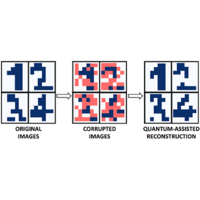
Quantum-Assisted Learning of Hardware-Embedded Probabilistic Graphical Models

Marcello Benedetti, John Realpe-Gómez, Rupak Biswas, and Alejandro Perdomo-Ortiz

Phys. Rev. X 7, 041052 (2017) - Published 30 November, 2017

Quantum computing could greatly speed up machine learning techniques that rely on sampling complex probability distributions, but limitations prevent demonstrations of feasibility. A new technique implemented on a quantum annealer surpasses these limitations and shows how quantum computing can assist in machine learning tasks.

Widely Tunable On-Chip Microwave Circulator for Superconducting Quantum Circuits

Benjamin J. Chapman, Eric I. Rosenthal, Joseph Kerckhoff, Bradley A. Moores, Leila R. Vale, J. A. B. Mates, Gene C. Hilton, Kevin Lalumière, Alexandre Blais, and K. W. Lehnert

Phys. Rev. X 7, 041043 (2017) - Published 22 November, 2017

A device that routes microwave signals could help researchers scale up quantum-computing architectures.

Simultaneous, Full Characterization of a Single-Photon State

Tim Thomay, Sergey V. Polyakov, Olivier Gazzano, Elizabeth Goldschmidt, Zachary D. Eldredge, Tobias Huber, Vivien Loo, and Glenn S. Solomon

Phys. Rev. X 7, 041036 (2017) - Published 15 November, 2017

Advances in quantum optics and quantum information technologies increasingly require a way to fully understand the state of single indistinguishable photons. While previous approaches have needed two or more measurements, a new experiment demonstrates a way to characterize single-photon states with just one measurement.

Deterministic Generation of All-Photonic Quantum Repeaters from Solid-State Emitters

Donovan Buterakos, Edwin Barnes, and Sophia E. Economou

Phys. Rev. X 7, 041023 (2017) - Published 27 October, 2017

Quantum repeaters allow for reliable transmission of quantum information over long distances. One possible approach relies on highly entangled photons. A new protocol provides a way to generate arbitrarily large states of entangled photons using just one emitter coupled to a single qubit.

Acoustic Traps and Lattices for Electrons in Semiconductors

M. J. A. Schuetz, J. Knörzer, G. Giedke, L. M. K. Vandersypen, M. D. Lukin, and J. I. Cirac

Phys. Rev. X 7, 041019 (2017) - Published 24 October, 2017

Electrons and quasiparticles in solids could be trapped and moved using surface acoustic waves.

Driven Quantum Dynamics: Will It Blend?

Leonardo Banchi, Daniel Burgarth, and Michael J. Kastoryano

Phys. Rev. X 7, 041015 (2017) - Published 20 October, 2017

Random number generation plays a pivotal role in quantum information applications (such as encryption), but generating random quantum operations requires exceptionally complex resources. A new theoretical analysis shows that an interacting many-body system can blend classical randomness through its dynamics to create quantum randomness.

Sign In to Your Journals Account

Filter

Filter

Article Lookup

Enter a citation