Browse by Subject

Resetting Uncontrolled Quantum Systems

Miguel Navascués

Phys. Rev. X 8, 031008 (2018) - Published 11 July, 2018

A quantum information protocol offers the possibility of resetting the state of a quantum system to some earlier state, paving the way for an experimental realization of a “time warp.”

Of Local Operations and Physical Wires

Dario Egloff, Juan M. Matera, Thomas Theurer, and Martin B. Plenio

Phys. Rev. X 8, 031005 (2018) - Published 6 July, 2018

Unifying different perspectives on what separates quantum states from classical states provides for a new framework for understanding the quantum-classical divide, paving the way for a better understanding of quantum computing platforms and biological systems.

Controllable Photonic Time-Bin Qubits from a Quantum Dot

J. P. Lee, L. M. Wells, B. Villa, S. Kalliakos, R. M. Stevenson, D. J. P. Ellis, I. Farrer, D. A. Ritchie, A. J. Bennett, and A. J. Shields

Phys. Rev. X 8, 021078 (2018) - Published 27 June, 2018

A new technique for encoding information in a single photon reduces the amount of loss and packs more information into a single photon compared to other methods, and it does so with fewer components.

Entanglement Structure: Entanglement Partitioning in Multipartite Systems and Its Experimental Detection Using Optimizable Witnesses

He Lu, Qi Zhao, Zheng-Da Li, Xu-Fei Yin, Xiao Yuan, Jui-Chen Hung, Luo-Kan Chen, Li Li, Nai-Le Liu, Cheng-Zhi Peng, Yeong-Cherng Liang, Xiongfeng Ma, Yu-Ao Chen, and Jian-Wei Pan

Phys. Rev. X 8, 021072 (2018) - Published 21 June, 2018

A new tool for characterizing entanglement in many-body quantum systems offers a step toward creating true large-scale entanglement among many particles, which itself will be essential for practical quantum computing devices.

Global Passivity in Microscopic Thermodynamics

Raam Uzdin and Saar Rahav

Phys. Rev. X 8, 021064 (2018) - Published 12 June, 2018

The second law of thermodynamics can be described using the Clausius inequality, the main link between classical and quantum thermodynamics. A new thermodynamic framework addresses long-standing limitations of this inequality and reveals new bounds relevant to quantum technology experiments.

Verification of Many-Qubit States

Yuki Takeuchi and Tomoyuki Morimae

Phys. Rev. X 8, 021060 (2018) - Published 7 June, 2018

New protocols for verifying quantum states offer a robust and versatile way to check on the accuracy of quantum computing products in the presence of any type of noise and for a variety of quantum states.

Logical Qubit in a Linear Array of Semiconductor Quantum Dots

Cody Jones, Michael A. Fogarty, Andrea Morello, Mark F. Gyure, Andrew S. Dzurak, and Thaddeus D. Ladd

Phys. Rev. X 8, 021058 (2018) - Published 1 June, 2018

A linear array of quantum dots could provide a way to build a practical and reliable logical qubit—a simple quantum processor that uses active error correction—out of proven components in the near future.

High-Threshold Fault-Tolerant Quantum Computation with Analog Quantum Error Correction

Kosuke Fukui, Akihisa Tomita, Atsushi Okamoto, and Keisuke Fujii

Phys. Rev. X 8, 021054 (2018) - Published 25 May, 2018

A type of quantum bit known as the Gottesman-Kitaev-Preskill qubit could be a key ingredient for practical, fault-tolerant quantum computers, but it has stringent requirements that are beyond current capabilities. New calculations propose a way to reduce these requirements to be achievable in near-term setups.

Quantum Boltzmann Machine

Mohammad H. Amin, Evgeny Andriyash, Jason Rolfe, Bohdan Kulchytskyy, and Roger Melko

Phys. Rev. X 8, 021050 (2018) - Published 23 May, 2018

A new machine-learning algorithm demonstrates the performance of a quantum Boltzmann machine, a quantum extension of a popular classical neural network, paving the way for quantum approaches to machine learning.

Disjointness of Stabilizer Codes and Limitations on Fault-Tolerant Logical Gates

Tomas Jochym-O’Connor, Aleksander Kubica, and Theodore J. Yoder

Phys. Rev. X 8, 021047 (2018) - Published 21 May, 2018

A new analysis quantifies computational limitations on stabilizer codes (codes that correct errors in quantum information) for practical operations and provides insight into how to design stabilizer codes for useful and interesting applications.

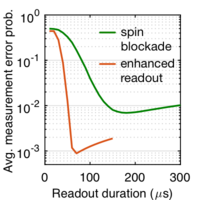
High-Fidelity Single-Shot Readout for a Spin Qubit via an Enhanced Latching Mechanism

Patrick Harvey-Collard, Benjamin D’Anjou, Martin Rudolph, N. Tobias Jacobson, Jason Dominguez, Gregory A. Ten Eyck, Joel R. Wendt, Tammy Pluym, Michael P. Lilly, William A. Coish, Michel Pioro-Ladrière, and Malcolm S. Carroll

Phys. Rev. X 8, 021046 (2018) - Published 21 May, 2018

A new approach to reading spin-based qubits achieves readout fidelities higher than 99.86%, the lowest error rate to date. The technique combines speed and accuracy and could be used in many types of spin-based quantum computers.

Resource Theory of Quantum Memories and Their Faithful Verification with Minimal Assumptions

Denis Rosset, Francesco Buscemi, and Yeong-Cherng Liang

Phys. Rev. X 8, 021033 (2018) - Published 8 May, 2018

For quantum technologies to reach their full potential, there needs to be a way to benchmark quantum-based memory devices. A new proposal lays out a way to compare and test quantum memories.

At the Limits of Criticality-Based Quantum Metrology: Apparent Super-Heisenberg Scaling Revisited

Marek M. Rams, Piotr Sierant, Omyoti Dutta, Paweł Horodecki, and Jakub Zakrzewski

Phys. Rev. X 8, 021022 (2018) - Published 19 April, 2018

Contrary to claims that a fundamental limit of precision in quantum metrology can be broken in certain circumstances, a new analysis shows that this is not the case once one takes into account the time needed to perform the needed operations.

Classical Causal Models for Bell and Kochen-Specker Inequality Violations Require Fine-Tuning

Eric G. Cavalcanti

Phys. Rev. X 8, 021018 (2018) - Published 13 April, 2018

A new analysis puts quantum nonlocality and contextuality—key resources for quantum computing—on equal theoretical footing as violations of classical causality.

Experimental Demonstration of Quantum Stationary Light Pulses in an Atomic Ensemble

Kwang-Kyoon Park, Young-Wook Cho, Young-Tak Chough, and Yoon-Ho Kim

Phys. Rev. X 8, 021016 (2018) - Published 13 April, 2018

A new experiment demonstrates a quantum stationary light pulse—a nonclassical approach to stopping light—in a cold atomic ensemble, which could pave the way toward novel quantum materials, optics, and devices.

Operator Hydrodynamics, OTOCs, and Entanglement Growth in Systems without Conservation Laws

C. W. von Keyserlingk, Tibor Rakovszky, Frank Pollmann, and S. L. Sondhi

Phys. Rev. X 8, 021013 (2018) - Published 11 April, 2018

Thermalization and information scrambling can provide insight into fields as diverse as many-body quantum physics, quantum field theory, and holography. A new theoretical analysis of one-dimensional spin chains reveals details about how information moves and entanglement grows in such systems.

Observation of Entangled States of a Fully Controlled 20-Qubit System

Nicolai Friis, Oliver Marty, Christine Maier, Cornelius Hempel, Milan Holzäpfel, Petar Jurcevic, Martin B. Plenio, Marcus Huber, Christian Roos, Rainer Blatt, and Ben Lanyon

Phys. Rev. X 8, 021012 (2018) - Published 10 April, 2018

Two new methods for detecting quantum entanglement—a critical ingredient for useful quantum technologies—successfully do so in a system of 20 qubits, the largest fully controllable entangled system to date.

Fundamental Work Cost of Quantum Processes

Philippe Faist and Renato Renner

Phys. Rev. X 8, 021011 (2018) - Published 10 April, 2018

A new theoretical analysis derives a precise fundamental lower limit to the work cost for processing information in any type of system, thereby cornering a new microscopic formulation of thermodynamics and shedding light on how far the second law can be applied.

Metropolitan Quantum Key Distribution with Silicon Photonics

Darius Bunandar, Anthony Lentine, Catherine Lee, Hong Cai, Christopher M. Long, Nicholas Boynton, Nicholas Martinez, Christopher DeRose, Changchen Chen, Matthew Grein, Douglas Trotter, Andrew Starbuck, Andrew Pomerene, Scott Hamilton, Franco N. C. Wong, Ryan Camacho, Paul Davids, Junji Urayama, and Dirk Englund

Phys. Rev. X 8, 021009 (2018) - Published 6 April, 2018

Field tests of a silicon photonics quantum-key-distribution encoder demonstrate a scalable, affordable, high-speed solution to securing long-distance communication networks against intrusions from quantum computers.

Coherent Oscillations inside a Quantum Manifold Stabilized by Dissipation

S. Touzard, A. Grimm, Z. Leghtas, S. O. Mundhada, P. Reinhold, C. Axline, M. Reagor, K. Chou, J. Blumoff, K. M. Sliwa, S. Shankar, L. Frunzio, R. J. Schoelkopf, M. Mirrahimi, and M. H. Devoret

Phys. Rev. X 8, 021005 (2018) - Published 4 April, 2018

New experiments present experimental evidence for the dynamical quantum Zeno effect, in which a stabilizing friction leads to a continuous phase change among degenerate states in a quantum superposition.

Sign In to Your Journals Account

Filter

Filter

Article Lookup

Enter a citation