Recent Articles

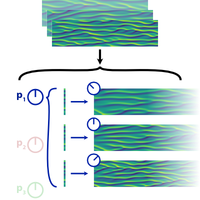
Extracting Interpretable Physical Parameters from Spatiotemporal Systems Using Unsupervised Learning

Peter Y. Lu, Samuel Kim, and Marin Soljačić

Phys. Rev. X 10, 031056 (2020) - Published 11 September, 2020

A new approach to analyzing systems with complex dynamics uses machine learning to extract physical parameters and predict their behavior all without knowledge of the underlying system.

Construction and Classification of Symmetry-Protected Topological Phases in Interacting Fermion Systems

Qing-Rui Wang and Zheng-Cheng Gu

Phys. Rev. X 10, 031055 (2020) - Published 10 September, 2020

A classification of symmetry-protected topological phases in systems of interacting fermions provides a road map for discovering new types of topological phases in strongly correlated electron systems.

Measuring the Intra-Atomic Exchange Energy in Rare-Earth Adatoms

Marina Pivetta, François Patthey, Igor Di Marco, Arya Subramonian, Olle Eriksson, Stefano Rusponi, and Harald Brune

Phys. Rev. X 10, 031054 (2020) - Published 9 September, 2020

The first measurements of exchange energies among electrons within single rare-earth atoms provide a glimpse at the intra-atomic interactions, improving our fundamental understanding of magnetism at the atomic scale.

Normal State Properties of Quantum Critical Metals at Finite Temperature

Avraham Klein, Andrey V. Chubukov, Yoni Schattner, and Erez Berg

Phys. Rev. X 10, 031053 (2020) - Published 8 September, 2020

Accounting for finite temperature properties of interacting electrons resolves apparent contradictions between computer simulations of non-Fermi-liquid metals and the theory used to describe them.

Uncovering Non-Fermi-Liquid Behavior in Hund Metals: Conformal Field Theory Analysis of an SU(2)×SU(3) Spin-Orbital Kondo Model

E. Walter, K. M. Stadler, S.-S. B. Lee, Y. Wang, G. Kotliar, A. Weichselbaum, and J. von Delft

Phys. Rev. X 10, 031052 (2020) - Published 3 September, 2020

A numerical and theoretical analysis explains the origin of non-Fermi-liquid behavior in Hund metals by studying how the spins and orbits of electrons screen local impurities.

Multiterminal Josephson Effect

Natalia Pankratova, Hanho Lee, Roman Kuzmin, Kaushini Wickramasinghe, William Mayer, Joseph Yuan, Maxim G. Vavilov, Javad Shabani, and Vladimir E. Manucharyan

Phys. Rev. X 10, 031051 (2020) - Published 2 September, 2020

Experiments realize a multiterminal Josephson junction, in which superconducting phase-coherence builds up between multiple supercurrents, providing a tool for exploring novel superconductivity and fault-tolerant quantum computing.

Robust Encoding of a Qubit in a Molecule

Victor V. Albert, Jacob P. Covey, and John Preskill

Phys. Rev. X 10, 031050 (2020) - Published 1 September, 2020

A new proposal for how to encode quantum information in the rotational states of individual molecules could protect these qubits from losing information as a result of noise.

Microspheres with Atomic-Scale Tolerances Generate Hyperdegeneracy

Jacob Kher-Alden, Shai Maayani, Leopoldo L. Martin, Mark Douvidzon, Lev Deych, and Tal Carmon

Phys. Rev. X 10, 031049 (2020) - Published 31 August, 2020

Tiny oil droplets levitated in optical tweezers can host several hundred light modes with similar energies, a feature that could be exploited for sensing and telecommunications.

Quantifying Decoherence in Attosecond Metrology

C. Bourassin-Bouchet, L. Barreau, V. Gruson, J.-F. Hergott, F. Quéré, P. Salières, and T. Ruchon

Phys. Rev. X 10, 031048 (2020) - Published 28 August, 2020

A new analysis shows how to measure the density matrix of an ionized electron to reconstruct its wave packet and identify sources of quantum decoherence.

Does VO2 Host a Transient Monoclinic Metallic Phase?

Luciana Vidas, Daniel Schick, Elías Martínez, Daniel Perez-Salinas, Alberto Ramos-Álvarez, Simon Cichy, Sergi Batlle-Porro, Allan S. Johnson, Kent A. Hallman, Richard F. Haglund, Jr., and Simon Wall

Phys. Rev. X 10, 031047 (2020) - Published 27 August, 2020

Experiments show that evidence for a novel phase in vanadium dioxide is explainable in terms of heating differences that result from comparing different techniques.

Rydberg Composites

Andrew L. Hunter, Matthew T. Eiles, Alexander Eisfeld, and Jan M. Rost

Phys. Rev. X 10, 031046 (2020) - Published 26 August, 2020

Filling the wave function of a Rydberg atom with a tunable number of neutral atoms can break the high level of energy degeneracy in these systems in surprising ways.

Rethinking Mean-Field Glassy Dynamics and Its Relation with the Energy Landscape: The Surprising Case of the Spherical Mixed p-Spin Model

Giampaolo Folena, Silvio Franz, and Federico Ricci-Tersenghi

Phys. Rev. X 10, 031045 (2020) - Published 25 August, 2020

An analysis of a common model used to describe glassy relaxation challenges predictions of its behavior at low temperature, showing that it relaxes to a state dependent upon the initial temperature.

Continual Learning of Multiple Memories in Mechanical Networks

Menachem Stern, Matthew B. Pinson, and Arvind Murugan

Phys. Rev. X 10, 031044 (2020) - Published 25 August, 2020

A network of nonlinear elastic connections can learn and remember multiple stable states as it is manipulated, a mechanical analog to the continual learning exhibited by neural networks.

Jahn-Teller Effect and Spin-Orbit Coupling: Friends or Foes?

Sergey V. Streltsov and Daniel I. Khomskii

Phys. Rev. X 10, 031043 (2020) - Published 24 August, 2020

Spin-orbit coupling in crystals can strongly modify the Jahn-Teller effect, in which interactions between electrons and the lattice drive the system from highly symmetric arrangements.

Control of Light by Topological Solitons in Soft Chiral Birefringent Media

Andrew J. Hess, Guilhem Poy, Jung-Shen B. Tai, Slobodan Žumer, and Ivan I. Smalyukh

Phys. Rev. X 10, 031042 (2020) - Published 21 August, 2020

Vortexlike patterns of liquid-crystal molecules can interact with light in a manner akin to lenses and might be useful for all-optical information processing.

Symmetry-Protected Self-Correcting Quantum Memories

Sam Roberts and Stephen D. Bartlett

Phys. Rev. X 10, 031041 (2020) - Published 20 August, 2020

Symmetry and topology can provide for self-correcting quantum codes in a 3D topologically ordered spin lattice, a key insight for building quantum memories that correct their own errors without active control.

Tensor-Network Method to Simulate Strongly Interacting Quantum Thermal Machines

Marlon Brenes, Juan José Mendoza-Arenas, Archak Purkayastha, Mark T. Mitchison, Stephen R. Clark, and John Goold

Phys. Rev. X 10, 031040 (2020) - Published 19 August, 2020

A new modeling and computational approach allow for more complete simulations of particle and heat flow through tiny quantum devices.

Decoding Sources of Energy Variability in a Laser-Plasma Accelerator

Andreas R. Maier, Niels M. Delbos, Timo Eichner, Lars Hübner, Sören Jalas, Laurids Jeppe, Spencer W. Jolly, Manuel Kirchen, Vincent Leroux, Philipp Messner, Matthias Schnepp, Maximilian Trunk, Paul A. Walker, Christian Werle, and Paul Winkler

Phys. Rev. X 10, 031039 (2020) - Published 18 August, 2020

Experiments trace variations in the energy of a laser-plasma electron beam to properties of the drive laser, establishing a technique for stabilizing compact next-generation sources of high-energy electrons.

Undecidability of the Spectral Gap in One Dimension

Johannes Bausch, Toby S. Cubitt, Angelo Lucia, and David Perez-Garcia

Phys. Rev. X 10, 031038 (2020) - Published 17 August, 2020

A new analysis proves that it is not possible for numerical algorithms to determine if a 1D quantum system has a spectral gap, showing that basic properties of even simple systems are, in some instances, impossible to predict.

Feshbach Resonances in p-Wave Three-Body Recombination within Fermi-Fermi Mixtures of Open-Shell Li6 and Closed-Shell Yb173 Atoms

Alaina Green, Hui Li, Jun Hui See Toh, Xinxin Tang, Katherine C. McCormick, Ming Li, Eite Tiesinga, Svetlana Kotochigova, and Subhadeep Gupta

Phys. Rev. X 10, 031037 (2020) - Published 14 August, 2020

A study of an ultracold mixture of fermionic atoms reveals the mechanism underlying tunable interactions among those atoms, a key insight for understanding some quantum systems.

Sign In to Your Journals Account

Filter

Recent Issues

Vol. 16, Iss. 4
October - December 2026
Vol. 16, Iss. 3
July - September 2026
Vol. 16, Iss. 2
April - June 2026
Vol. 16, Iss. 1
January - March 2026
Category
Article Type

Filter

Article Lookup

Enter a citation