Recent Articles

Erratum: Ab Initio Magneto-Optical Spectrum of Group-IV Vacancy Color Centers in Diamond [Phys. Rev. X 8, 021063 (2018)]

Gergő Thiering and Adam Gali

Phys. Rev. X 10, 039901 (2020) - Published 21 July, 2020

Absence of Superconductivity in the Pure Two-Dimensional Hubbard Model

Mingpu Qin, Chia-Min Chung, Hao Shi, Ettore Vitali, Claudius Hubig, Ulrich Schollwöck, Steven R. White, and Shiwei Zhang (Simons Collaboration on the Many-Electron Problem)

Phys. Rev. X 10, 031016 (2020) - Published 21 July, 2020

For parameters most relevant to superconductivity, a common model for describing high-temperature superconductivity in cuprates is nonsuperconducting in its ground state.

Speed-Ups to Isothermality: Enhanced Quantum Thermal Machines through Control of the System-Bath Coupling

Nicola Pancotti, Matteo Scandi, Mark T. Mitchison, and Martí Perarnau-Llobet

Phys. Rev. X 10, 031015 (2020) - Published 20 July, 2020

Controlling the system-bath coupling in a heat engine leads to the construction of Carnot engines with greatly increased efficiency, a useful insight for the design of improved quantum-based thermal machines.

Electrical Probes of the Non-Abelian Spin Liquid in Kitaev Materials

David Aasen, Roger S. K. Mong, Benjamin M. Hunt, David Mandrus, and Jason Alicea

Phys. Rev. X 10, 031014 (2020) - Published 17 July, 2020

Tailored circuits joined to a quantum spin liquid provide a way to electrically probe the spin liquid’s fractionalized excitations, a key step toward harnessing such systems for fault-tolerant quantum computing.

Distinct Topological Surface States on the Two Terminations of MnBi4Te7

Xuefeng Wu, Jiayu Li, Xiao-Ming Ma, Yu Zhang, Yuntian Liu, Chun-Sheng Zhou, Jifeng Shao, Qiaoming Wang, Yu-Jie Hao, Yue Feng, Eike F. Schwier, Shiv Kumar, Hongyi Sun, Pengfei Liu, Kenya Shimada, Koji Miyamoto, Taichi Okuda, Kedong Wang, Maohai Xie, Chaoyu Chen, Qihang Liu, Chang Liu, and Yue Zhao

Phys. Rev. X 10, 031013 (2020) - Published 16 July, 2020

Experiments reveal that unusual surface behavior at the terminations of a recently discovered magnetic topological insulator depends on the interplay between different building blocks within the material.

Microgels at Interfaces Behave as 2D Elastic Particles Featuring Reentrant Dynamics

Fabrizio Camerin, Nicoletta Gnan, José Ruiz-Franco, Andrea Ninarello, Lorenzo Rovigatti, and Emanuela Zaccarelli

Phys. Rev. X 10, 031012 (2020) - Published 15 July, 2020

Despite their complexity, microgels confined to a liquid-liquid interface can be described through relatively simple interactions that reveal the presence of intriguing behavior at high density.

Dynamics of Many-Body Photon Bound States in Chiral Waveguide QED

Sahand Mahmoodian, Giuseppe Calajó, Darrick E. Chang, Klemens Hammerer, and Anders S. Sørensen

Phys. Rev. X 10, 031011 (2020) - Published 14 July, 2020

A proposed optical waveguide would take a light pulse and break it into sets of strongly correlated photons, which may give a leg up to certain quantum technologies.

Strictly Linear Light Cones in Long-Range Interacting Systems of Arbitrary Dimensions

Tomotaka Kuwahara and Keiji Saito

Phys. Rev. X 10, 031010 (2020) - Published 13 July, 2020

Quantum systems with long-range interactions have a finite speed at which information can propagate, a speed that is determined by the dimensionality of the system.

Hierarchy of Linear Light Cones with Long-Range Interactions

Minh C. Tran, Chi-Fang Chen, Adam Ehrenberg, Andrew Y. Guo, Abhinav Deshpande, Yifan Hong, Zhe-Xuan Gong, Alexey V. Gorshkov, and Andrew Lucas

Phys. Rev. X 10, 031009 (2020) - Published 13 July, 2020

Quantum systems with certain long-range interactions exhibit a hierarchy of limits on information transfer rates—a set of nested “light cones”—that set fundamental restrictions for a range of quantum-based technologies.

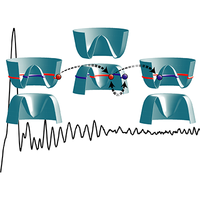
Generalized Boundary Condition Applied to Lieb-Schultz-Mattis-Type Ingappabilities and Many-Body Chern Numbers

Yuan Yao and Masaki Oshikawa

Phys. Rev. X 10, 031008 (2020) - Published 10 July, 2020

Particle trajectories that mimic spiral stairways can reveal low-energy properties that might otherwise be missed in electronic crystals, an insight that could aid the search for new quantum materials.

Electron-Hole Interference in an Inverted-Band Semiconductor Bilayer

Matija Karalic, Antonio Štrkalj, Michele Masseroni, Wei Chen, Christopher Mittag, Thomas Tschirky, Werner Wegscheider, Thomas Ihn, Klaus Ensslin, and Oded Zilberberg

Phys. Rev. X 10, 031007 (2020) - Published 9 July, 2020

Coupled semiconductor layers of InAs and GaSb can be used to realize a Fabry-Pérot interferometer in which electrons and holes incident at all angles lead to an interference pattern.

Coherent Multispin Exchange Coupling in a Quantum-Dot Spin Chain

Haifeng Qiao, Yadav P. Kandel, Kuangyin Deng, Saeed Fallahi, Geoffrey C. Gardner, Michael J. Manfra, Edwin Barnes, and John M. Nichol

Phys. Rev. X 10, 031006 (2020) - Published 8 July, 2020

A new method for controlling interactions among multiple electron spins allows for efficient information transfer between distant qubits, opening the door to many scalable quantum computing applications.

Stochastic and Quantum Thermodynamics of Driven RLC Networks

Nahuel Freitas, Jean-Charles Delvenne, and Massimiliano Esposito

Phys. Rev. X 10, 031005 (2020) - Published 7 July, 2020

A theory for describing heat flow in simple electronic circuits reveals limits of traditional analysis techniques, paving the way for design improvements in the design of thermal machines with electronic circuits.

Room-Temperature Amplification of Terahertz Radiation by Grating-Gate Graphene Structures

Stephane Boubanga-Tombet, Wojciech Knap, Deepika Yadav, Akira Satou, Dmytro B. But, Vyacheslav V. Popov, Ilya V. Gorbenko, Valentin Kachorovskii, and Taiichi Otsuji

Phys. Rev. X 10, 031004 (2020) - Published 6 July, 2020

Paving the way for new tunable plasmonic THz amplifiers, experiments show the first observation of energy transfer from dc current to plasmons, leading to THz amplification.

Quantum Metrology with Strongly Interacting Spin Systems

Hengyun Zhou, Joonhee Choi, Soonwon Choi, Renate Landig, Alexander M. Douglas, Junichi Isoya, Fedor Jelezko, Shinobu Onoda, Hitoshi Sumiya, Paola Cappellaro, Helena S. Knowles, Hongkun Park, and Mikhail D. Lukin

Phys. Rev. X 10, 031003 (2020) - Published 2 July, 2020

A new approach to quantum sensing uses a tailored control pulse sequence to overcome sensor-sensor interactions that have plagued previous designs, setting the stage for nanoscale sensing with newfound sensitivity.

Robust Dynamic Hamiltonian Engineering of Many-Body Spin Systems

Joonhee Choi, Hengyun Zhou, Helena S. Knowles, Renate Landig, Soonwon Choi, and Mikhail D. Lukin

Phys. Rev. X 10, 031002 (2020) - Published 2 July, 2020

A new framework for engineering quantum many-body systems uses pulsed periodic driving to tailor the system’s Hamiltonian, setting the stage for improved quantum applications such as information processing, metrology, and simulation.

Fragile Phases as Affine Monoids: Classification and Material Examples

Zhi-Da Song, Luis Elcoro, Yuan-Feng Xu, Nicolas Regnault, and B. Andrei Bernevig

Phys. Rev. X 10, 031001 (2020) - Published 1 July, 2020

A complete classification of a subset of so-called “fragile” topological states offers predictions for hundreds of realistic materials in which these exotic and little-understood states may appear.

One-Way Quantum Repeater Based on Near-Deterministic Photon-Emitter Interfaces

Johannes Borregaard, Hannes Pichler, Tim Schröder, Mikhail D. Lukin, Peter Lodahl, and Anders S. Sørensen

Phys. Rev. X 10, 021071 (2020) - Published 30 June, 2020

A proposed protocol for a one-way quantum repeater could enable robust long-distance quantum communication with significantly fewer resources than other proposals.

Probing the Wave Function and Dynamics of the Quintet Multiexciton State with Coherent Control in a Singlet Fission Material

S. L. Bayliss, L. R. Weiss, F. Kraffert, D. B. Granger, J. E. Anthony, J. Behrends, and R. Bittl

Phys. Rev. X 10, 021070 (2020) - Published 29 June, 2020

An experimental technique allows researchers to probe and utilize the properties of enigmatic multiexciton quintet states (with a spin of 2), a state that is otherwise difficult to study but has potential applications in spin-based technologies.

Algorithmic Complexity of Multiplex Networks

Andrea Santoro and Vincenzo Nicosia

Phys. Rev. X 10, 021069 (2020) - Published 26 June, 2020

A new measure of complexity of multilayer networks shows that these systems can encode an optimal amount of additional information compared to their single-layer counterparts and provides a powerful tool for their analysis.

Sign In to Your Journals Account

Filter

Recent Issues

Vol. 16, Iss. 4
October - December 2026
Vol. 16, Iss. 3
July - September 2026
Vol. 16, Iss. 2
April - June 2026
Vol. 16, Iss. 1
January - March 2026
Category
Article Type

Filter

Article Lookup

Enter a citation