Recent Articles

Information Processing and the Second Law of Thermodynamics: An Inclusive, Hamiltonian Approach

Sebastian Deffner and Christopher Jarzynski

Phys. Rev. X 3, 041003 (2013) - Published 17 October, 2013

Coupling thermodynamics together with information processing is highly nontrivial conceptually, as demonstrated by the notion of Maxwell’s demon. Theorists present a fundamental framework that generalizes the second law of thermodynamics to include the physical effects of information processing.

Publisher’s Note: Nanoscale Fourier-Transform Magnetic Resonance Imaging [Phys. Rev. X 3, 031016 (2013)]

John M. Nichol, Tyler R. Naibert, Eric R. Hemesath, Lincoln J. Lauhon, and Raffi Budakian

Phys. Rev. X 3, 049901 (2013) - Published 16 October, 2013

Stretching Polymers in Droplet-Pinch-Off Experiments

F. Ingremeau and H. Kellay

Phys. Rev. X 3, 041002 (2013) - Published 14 October, 2013

Visualizing in polymeric liquid how the microscopic polymer molecules react to, and back-act on, the macroscopic liquid flow requires observations of very different scales and is obviously challenging technically. A new experiment overcomes this challenge and shows directly how the extension of individual polymer molecules are tied to the flow properties in an engineered slender thinning filaments of a flowing polymer solution.

Quantum Amplification by Superradiant Emission of Radiation

Anatoly A. Svidzinsky, Luqi Yuan, and Marlan O. Scully

Phys. Rev. X 3, 041001 (2013) - Published 8 October, 2013

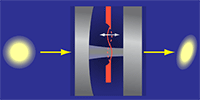
Light amplification in lasers usually relies on populating higher energy levels with more light emitters than lower energy levels. Scientists propose a new way of amplifying light without such population inversion, based on their discovery of resonant superradiant emission from an atomic ensemble interacting with a driving light field.

Nanoscale Fourier-Transform Magnetic Resonance Imaging

John M. Nichol, Tyler R. Naibert, Eric R. Hemesath, Lincoln J. Lauhon, and Raffi Budakian

Phys. Rev. X 3, 031016 (2013) - Published 26 September, 2013

Pushing the spatial resolution of magnetic resonance imaging (MRI) from the millimeter to nanometer range requires very large magnetic field gradients and must overcome the noise due to quantum spin fluctuations. A new approach, radically different from the conventional MRI techniques, meets these demands and succeeds in imaging proton spins in a solid sample with a spatial resolution of roughly 10 nm.

Publisher’s Note: Reply to “Comment on ‘Ultrafast Demagnetization Measurements Using Extreme Ultraviolet Light: Comparison of Electronic and Magnetic Contributions’ ” [Phys. Rev. X 3, 038002 (2013)PRXHAE2160-3308]

Emrah Turgut, Patrik Grychtol, Chan La-O-Vorakiat, Daniel E. Adams, Henry C. Kapteyn, Margaret M. Murnane, Stefan Mathias, Martin Aeschlimann, Claus M. Schneider, Justin M. Shaw, Hans T. Nembach, and Thomas J. Silva

Phys. Rev. X 3, 039901 (2013) - Published 17 September, 2013

Entanglement Growth in Quench Dynamics with Variable Range Interactions

J. Schachenmayer, B. P. Lanyon, C. F. Roos, and A. J. Daley

Phys. Rev. X 3, 031015 (2013) - Published 13 September, 2013

Recent advances in quantum simulators allow the use of systems of trapped ions to create and simulate spin models with a controllable interaction range. Scientists report timely and counterintuitive theoretical findings about the temporal growth of quantum entanglement in a suddenly “quenched” quantum spin chain based on trapped ions.

Subwavelength Localization of Atomic Excitation Using Electromagnetically Induced Transparency

J. A. Miles, Z. J. Simmons, and D. D. Yavuz

Phys. Rev. X 3, 031014 (2013) - Published 11 September, 2013

By illuminating atoms with two colors of light that drive interfering transitions, researchers selectively excite the atoms in a region much smaller than the light wavelength.

All-Optical Switching and Router via the Direct Quantum Control of Coupling between Cavity Modes

Keyu Xia (夏可宇) and Jason Twamley

Phys. Rev. X 3, 031013 (2013) - Published 5 September, 2013

Classical optical communication and quantum information processing based on photonic networks require photonics signals to be switched on and off or routed via optical cavities and waveguides in the networks. Large-bandwidth and nearly perfect switching as well as low-loss, multiport routing remains challenging. A new proposal achieves these goals, relying on controlling the coupling between two neighboring cavities in a transmission path with a three-level atomic scatter of photons.

Reply to “Comment on ‘Ultrafast Demagnetization Measurements Using Extreme Ultraviolet Light: Comparison of Electronic and Magnetic Contributions’ ”

Emrah Turgut, Patrik Grychtol, Chan La-O-Vorakiat, Daniel E. Adams, Henry C. Kapteyn, Margaret M. Murnane, Stefan Mathias, Martin Aeschlimann, Claus M. Schneider, Justin M. Shaw, Hans T. Nembach, and Thomas J. Silva

Phys. Rev. X 3, 038002 (2013) - Published 4 September, 2013

In reply to the Comment by Vodungbo et al. on their original paper, Phys. Rev. X 2, 011005 (2012), Turget et al. conclusively demonstrate with additional experiments that the theoretical criticism Vodungbo et al. have raised can be safely laid to rest as far as practical experiments are concerned.

Comment on “Ultrafast Demagnetization Measurements Using Extreme Ultraviolet Light: Comparison of Electronic and Magnetic Contributions”

Boris Vodungbo, Julien Gautier, Guillaume Lambert, Philippe Zeitoun, and Jan Lüning

Phys. Rev. X 3, 038001 (2013) - Published 4 September, 2013

Time-resolved T-MOKE using high-order harmonics is a very promising technique to study ultrafast magnetization dynamics in solid-state materials. It was claimed in Phys. Rev. X 2, 011005 (2012) that this technique was free of any nonmagnetic artifact. Vodungbo et al. show theoretically that this claim may not hold in general.

Strong Optomechanical Squeezing of Light

T. P. Purdy, P.-L. Yu, R. W. Peterson, N. S. Kampel, and C. A. Regal

Phys. Rev. X 3, 031012 (2013) - Published 3 September, 2013

New ways of making low-noise beams of light could lead to more sensitive optical interferometry measurements.

Gate-Defined Wires in HgTe Quantum Wells: From Majorana Fermions to Spintronics

Johannes Reuther, Jason Alicea, and Amir Yacoby

Phys. Rev. X 3, 031011 (2013) - Published 26 August, 2013

Materials allowing precise control over the response of spins to electric and magnetic fields are highly desirable in spintronics. Scientists demonstrate that electrical-gate-defined wires in HgTe quantum wells offer great potential as such a material platform with their extraordinary tunability of the electronic spin-orbit coupling and g factors. They explore a particularly enticing application where such wires are used in the detection of Majorana fermions and in Majorana-fermion-based topological quantum computing.

Pinning the Order: The Nature of Quantum Criticality in the Hubbard Model on Honeycomb Lattice

Fakher F. Assaad and Igor F. Herbut

Phys. Rev. X 3, 031010 (2013) - Published 26 August, 2013

A new algorithm of quantum Monte Carlo simulations designed to detect very weak magnetic order allows high-resolution studies of the correlation between magnetic order and electrical insulation in Mott insulators. Specific investigations of the Hubbard model on honeycomb lattice—a paradigmatic model for Mott insulators—show that the correlation emerges through a continuous quantum phase transition belonging to a new universality class.

Deterministic Many-Resonator W Entanglement of Nearly Arbitrary Microwave States via Attractive Bose-Hubbard Simulation

A. A. Gangat, I. P. McCulloch, and G. J. Milburn

Phys. Rev. X 3, 031009 (2013) - Published 21 August, 2013

Recent advances in fabricating superconducting circuits have allowed large numbers of microwave resonators and superconducting qubits to be employed in such circuits, but shared quantum entanglement among the photonics states of the resonators has not been attempted. Theorists now present a proposal that uses superconducting circuits to simulate a particular many-body quantum model that until now has been experimentally inaccessible and to create a type of shared quantum entanglement with the simulation.

Anyons in Integer Quantum Hall Magnets

Armin Rahmani, Rodrigo A. Muniz, and Ivar Martin

Phys. Rev. X 3, 031008 (2013) - Published 21 August, 2013

Anyons—particles with fractional electron charge that exist only in two-dimensional systems—are known to occur in materials exhibiting the fractional quantum Hall effect but were not expected in those exhibiting the integer quantum Hall effect. Now, a new study shows that chiral magnets with itinerant electrons, which exhibit the integer quantum Hall effect, can in fact host anyons, thus opening a new avenue for the search for these exotic particles.

Security of Device-Independent Quantum Key Distribution in the Bounded-Quantum-Storage Model

S. Pironio, Ll. Masanes, A. Leverrier, and A. Acín

Phys. Rev. X 3, 031007 (2013) - Published 9 August, 2013

Current security proofs for device-independent quantum key distribution have significant limitations, such as very low noise tolerance, requiring the use of many devices, or applying to a given Bell inequality only. A new proof—with the only assumption that the eavesdropper does not have a long-term quantum memory—tolerates realistic noise levels, uses only two devices, and broadens the security certification to the test of any Bell inequality.

Device-Independent Quantum Key Distribution with Local Bell Test

Charles Ci Wen Lim, Christopher Portmann, Marco Tomamichel, Renato Renner, and Nicolas Gisin

Phys. Rev. X 3, 031006 (2013) - Published 30 July, 2013

Existing protocols for device-independent quantum key distribution solve the problem of inadvertently flawed devices, but still rely on two-party Bell tests across almost lossless quantum channels that are hard to realize over long distances. Now theorists propose a new device-independent protocol that allows Bell testing to be carried out by only one party, potentially enabling long-distance key distributions.

Anomalous Edge States and the Bulk-Edge Correspondence for Periodically Driven Two-Dimensional Systems

Mark S. Rudner, Netanel H. Lindner, Erez Berg, and Michael Levin

Phys. Rev. X 3, 031005 (2013) - Published 23 July, 2013

When a topological insulator is “driven” by an applied electromagnetic field, its behavior cannot be predicted based on how it acts when the driving is absent. Theorists show that new conducting edge states can appear and that a new topological invariant, instead of the well-known Chern number, is needed to classify conducting edge states in driven topological insulators.

Iron-Based Superconductors as Odd-Parity Superconductors

Jiangping Hu

Phys. Rev. X 3, 031004 (2013) - Published 16 July, 2013

What does the layered structure of iron-based, high-temperature superconductors mean for the symmetry of the electron-pairing mechanism responsible for their superconductivity? A new theory predicts that the spatial symmetry of the single trilayer building block of these materials leads to a new form of electron pairing characterized by odd parity and spin singlet, in contrast to the conventional even-parity, spin-singlet form.

Sign In to Your Journals Account

Filter

Recent Issues

Vol. 16, Iss. 4
October - December 2026
Vol. 16, Iss. 3
July - September 2026
Vol. 16, Iss. 2
April - June 2026
Vol. 16, Iss. 1
January - March 2026
Category
Article Type

Filter

Article Lookup

Enter a citation