Recent Articles

Double Quantum Dot Floquet Gain Medium

J. Stehlik, Y.-Y. Liu, C. Eichler, T. R. Hartke, X. Mi, M. J. Gullans, J. M. Taylor, and J. R. Petta

Phys. Rev. X 6, 041027 (2016) - Published 7 November, 2016

Light-matter interactions on the level of single photons will be important in next-generation communications and electronic devices. A new experiment shows how a confined electron can repeatedly emit a microwave photon.

Topological Quantum Fluctuations and Traveling Wave Amplifiers

Vittorio Peano, Martin Houde, Florian Marquardt, and Aashish A. Clerk

Phys. Rev. X 6, 041026 (2016) - Published 1 November, 2016

Devices in which photons are naturally protected both against internal losses and backscattering would be valuable for amplifying quantum signals. A new approach proposes an amplifier where such protection is present and has a topological origin.

Generalized Liquid Crystals: Giant Fluctuations and the Vestigial Chiral Order of I, O, and T Matter

Ke Liu (刘科 子竞), Jaakko Nissinen, Robert-Jan Slager, Kai Wu, and Jan Zaanen

Phys. Rev. X 6, 041025 (2016) - Published 31 October, 2016

Nematic liquid crystals are widely used in the electronics industry. The variety of possible forms of nematic liquid crystals are investigated using techniques borrowed from high-energy physics.

Low-Noise Amplification and Frequency Conversion with a Multiport Microwave Optomechanical Device

C. F. Ockeloen-Korppi, E. Damskägg, J.-M. Pirkkalainen, T. T. Heikkilä, F. Massel, and M. A. Sillanpää

Phys. Rev. X 6, 041024 (2016) - Published 28 October, 2016

High-precision quantum measurements often require signal amplification. A new technique shows how weak electromagnetic signals can be both amplified and modulated in frequency.

Frictional Sliding without Geometrical Reflection Symmetry

Michael Aldam, Yohai Bar-Sinai, Ilya Svetlizky, Efim A. Brener, Jay Fineberg, and Eran Bouchbinder

Phys. Rev. X 6, 041023 (2016) - Published 28 October, 2016

Friction plays a key role in everyday life. A new study shows that frictional resistance depends on the geometry of the bodies in frictional contact.

Hidden Connectivity in Networks with Vulnerable Classes of Nodes

Sebastian M. Krause, Michael M. Danziger, and Vinko Zlatić

Phys. Rev. X 6, 041022 (2016) - Published 27 October, 2016

Many networks—electronic, physical, or biological—have mutually shared vulnerabilities that render them significantly less secure and robust. Now, the conditions necessary for secure connectivity within a network characterized by vulnerabilities affecting many nodes are calculated

Chiral Anomaly from Strain-Induced Gauge Fields in Dirac and Weyl Semimetals

D. I. Pikulin, Anffany Chen, and M. Franz

Phys. Rev. X 6, 041021 (2016) - Published 27 October, 2016

In certain materials, mechanical strain can mimic the effects of real electromagnetic fields. A theoretical examination explores how Dirac and Weyl semimetals respond to both torsional and unidirectional strain.

Origin and Magnitude of ‘Designer’ Spin-Orbit Interaction in Graphene on Semiconducting Transition Metal Dichalcogenides

Zhe Wang, Dong-Keun Ki, Jun Yong Khoo, Diego Mauro, Helmuth Berger, Leonid S. Levitov, and Alberto F. Morpurgo

Phys. Rev. X 6, 041020 (2016) - Published 26 October, 2016

Spin-orbit interactions are responsible for intriguing phenomena such as topological insulating states. Now, scientists study the spin-orbit interactions of electrons directly at the interface between graphene and transition-metal dichalcogenides.

Directly Characterizing the Relative Strength and Momentum Dependence of Electron-Phonon Coupling Using Resonant Inelastic X-Ray Scattering

T. P. Devereaux, A. M. Shvaika, K. Wu, K. Wohlfeld, C. J. Jia, Y. Wang, B. Moritz, L. Chaix, W.-S. Lee, Z.-X. Shen, G. Ghiringhelli, and L. Braicovich

Phys. Rev. X 6, 041019 (2016) - Published 25 October, 2016

Many copper-based materials exhibit coupling between their electrons and excitations known as phonons. Now, researchers demonstrate a tool to accurately study the details of this coupling.

Parity-Time Symmetric Nonlocal Metasurfaces: All-Angle Negative Refraction and Volumetric Imaging

Francesco Monticone, Constantinos A. Valagiannopoulos, and Andrea Alù

Phys. Rev. X 6, 041018 (2016) - Published 25 October, 2016

Lenses are critical to a variety of fields of science, but optical aberrations such as astigmatism are common problems. A “perfect” lens made of two metasurfaces is theoretically developed.

Fluctuating Work: From Quantum Thermodynamical Identities to a Second Law Equality

Álvaro M. Alhambra, Lluis Masanes, Jonathan Oppenheim, and Christopher Perry

Phys. Rev. X 6, 041017 (2016) - Published 24 October, 2016

The second law of thermodynamics plays an important role in both everyday life—think of hot coffee cooling off—and a range of scientific disciplines. Now, researchers prove a more accurate version of the second law, which states precisely by how much the hot coffee cools off, as well as being relevant to small quantum systems.

Fluctuating States: What is the Probability of a Thermodynamical Transition?

Álvaro M. Alhambra, Jonathan Oppenheim, and Christopher Perry

Phys. Rev. X 6, 041016 (2016) - Published 24 October, 2016

The second law of thermodynamics is concerned with what state formations are allowed by nature. Now, drawing inspiration from quantum information theory, researchers show that for microscopic or quantum systems, one can perform an outlawed state transformation.

Binary Black Hole Mergers in the First Advanced LIGO Observing Run

B. P. Abbott et al. (LIGO Scientific Collaboration and Virgo Collaboration)

Phys. Rev. X 6, 041015 (2016) - Published 21 October, 2016

Advanced LIGO has observed three binary black hole merger events using sensitive interferometers located in Washington state and Louisiana. Based on estimates of the stellar-mass binary black hole merger rate, researchers are confident that additional detections will result from Advanced LIGO’s second run.

Improved Analysis of GW150914 Using a Fully Spin-Precessing Waveform Model

B. P. Abbott et al. (LIGO Scientific Collaboration and Virgo Collaboration)

Phys. Rev. X 6, 041014 (2016) - Published 21 October, 2016

Observational astronomy devoted to the detection of ripples in spacetime was born in 2015 with the first detection of gravitational waves. Now, researchers use updated complete spin models to estimate the black hole component masses of the objects involved in the GW150914 coalescence event.

High-Quality CrO2 Nanowires for Dissipation-less Spintronics

Amrita Singh, Charlotte Jansen, Kaveh Lahabi, and Jan Aarts

Phys. Rev. X 6, 041012 (2016) - Published 18 October, 2016

Information storage can be accomplished using quantum mechanical spin. Now, researchers have demonstrated a ferromagnetic nanostructure that can carry spin-polarized supercurrents.

Dynamic Atomic Reconstruction: How Fe3O4 Thin Films Evade Polar Catastrophe for Epitaxy

C. F. Chang, Z. Hu, S. Klein, X. H. Liu, R. Sutarto, A. Tanaka, J. C. Cezar, N. B. Brookes, H.-J. Lin, H. H. Hsieh, C. T. Chen, A. D. Rata, and L. H. Tjeng

Phys. Rev. X 6, 041011 (2016) - Published 18 October, 2016

On atomic scales, some materials can destabilize because of electrostatic forces. Based on experimental evidence, researchers now theorize how exactly atoms rearrange to overcome this destabilization.

Thermal Transport in Crystals as a Kinetic Theory of Relaxons

Andrea Cepellotti and Nicola Marzari

Phys. Rev. X 6, 041013 (2016) - Published 17 October, 2016

A recasting of the theory that underlies thermal transport in electrical insulators relies on new vibrational modes called relaxons.

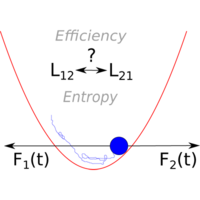
Brownian Duet: A Novel Tale of Thermodynamic Efficiency

Karel Proesmans, Yannik Dreher, Momčilo Gavrilov, John Bechhoefer, and Christian Van den Broeck

Phys. Rev. X 6, 041010 (2016) - Published 17 October, 2016

The stochastic thermodynamic properties of an isothermal Brownian engine consisting of a micron-sized colloidal particle are calculated analytically and tested experimentally.

Genome-Wide Motif Statistics are Shaped by DNA Binding Proteins over Evolutionary Time Scales

Long Qian and Edo Kussell

Phys. Rev. X 6, 041009 (2016) - Published 14 October, 2016

Short stretches of DNA that can inappropriately bind regulatory proteins are statistically rare in many genomes, suggesting that evolutionary pressure works against them.

Wave-front Transformation with Gradient Metasurfaces

Nasim Mohammadi Estakhri and Andrea Alù

Phys. Rev. X 6, 041008 (2016) - Published 14 October, 2016

Metasurfaces are engineered systems that enable advanced control of electromagnetic waves over deeply subwavelength thicknesses. Researchers make a careful study of the use of metasurfaces to transform the impinging optical wave front.

Sign In to Your Journals Account

Filter

Recent Issues

Vol. 16, Iss. 4
October - December 2026
Vol. 16, Iss. 3
July - September 2026
Vol. 16, Iss. 2
April - June 2026
Vol. 16, Iss. 1
January - March 2026
Category
Article Type

Filter

Article Lookup

Enter a citation