Highlights

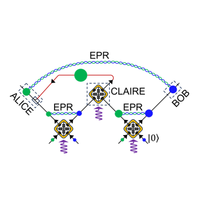
Entangled Dual-Comb Spectroscopy

Abdulkarim Hariri, Shuai Liu, Haowei Shi, Quntao Zhuang, Xudong Fan, and Zheshen Zhang

Phys. Rev. X 15, 041009 (2025) - Published 15 October, 2025

Entangled dual-comb spectroscopy combines a classical comb with an entangled quantum comb to suppress photon noise, achieving faster, more precise measurements than classical methods and enabling advanced sensing and metrology applications.

Radon Removal in XENONnT down to the Solar Neutrino Level

E. Aprile et al. (XENON Collaboration)

Phys. Rev. X 15, 031079 (2025) - Published 30 September, 2025

Using advanced cryogenic distillation, the XENONnT experiment cuts radon levels in its 10-tonne liquid xenon detector to just 430 atoms per tonne, enabling ultrapure conditions for detecting faint dark matter signals.

Teleportation and Entanglement Swapping of Continuous Quantum Variables of Microwave Radiation

Baleegh Abdo, William Shanks, Oblesh Jinka, J. R. Rozen, and Jason Orcutt

Phys. Rev. X 15, 031075 (2025) - Published 25 September, 2025

A superconducting Josephson mixer generates continuous-variable entanglement between microwave modes, enabling teleportation and entanglement swapping with fidelities beyond classical limits—key steps toward scalable quantum networks.

Quantum Effects in Gravity Beyond the Newton Potential from a Delocalized Quantum Source

Lin-Qing Chen and Flaminia Giacomini

Phys. Rev. X 15, 031063 (2025) - Published 4 September, 2025

New predictions from linearized quantum gravity show that delocalized sources and gravitational-field commutators could offer stronger evidence for future experiments that gravity is inherently quantum.

Operating Semiconductor Qubits without Individual Barrier Gates

Alexander S. Ivlev, Damien R. Crielaard, Marcel Meyer, William I. L. Lawrie, Nico W. Hendrickx, Amir Sammak, Yuta Matsumoto, Lieven M. K. Vandersypen, Giordano Scappucci, Corentin Déprez, and Menno Veldhorst

Phys. Rev. X 15, 031042 (2025) - Published 14 August, 2025

A new method for controlling spin qubits in quantum dots reduces wiring complexity by tuning qubit energy levels instead of individual barriers, enabling scalable architectures without sacrificing performance.

Bolometric Superconducting Optical Nanoscopy (BOSON)

Ran Jing, Boyi Zhou, Dingchen Kang, Wenjun Zheng, Zijian Zhou, Heng Wang, Xinzhong Chen, Juntao Yao, Bing Cheng, Ji-Hoon Park, Lukas Wehmeier, Zhenbing Dai, Shoujing Chen, Christopher D. Prainito, G. L. Carr, Ilya Charaev, Denis Bandurin, Genda Gu, Qiang Li, Karl K. Berggren, D. N. Basov, Xu Du, and Mengkun Liu

Phys. Rev. X 15, 031027 (2025) - Published 25 July, 2025

BOSON—an ultralow-power optical nanoscopy technique using superconducting sensors—enables high-resolution imaging of superconductor transition edges as well as weak polaritonic signals, opening new frontiers in quantum sensing.

Scalable Parallel Measurement of Individual Nitrogen-Vacancy Centers

Matthew Cambria, Saroj Chand, Caitlin Mary Reiter, and Shimon Kolkowitz

Phys. Rev. X 15, 031015 (2025) - Published 14 July, 2025

Two independent groups optimize diamond-based quantum sensing by using more than 100 such sensors in parallel.

Massively Multiplexed Nanoscale Magnetometry with Diamond Quantum Sensors

Kai-Hung Cheng, Zeeshawn Kazi, Jared Rovny, Bichen Zhang, Lila S. Nassar, Jeff D. Thompson, and Nathalie P. de Leon

Phys. Rev. X 15, 031014 (2025) - Published 14 July, 2025

Two independent groups optimize diamond-based quantum sensing by using more than 100 such sensors in parallel.

Multipolar Anisotropy in Anomalous Hall Effect from Spin-Group Symmetry Breaking

Zheng Liu, Mengjie Wei, Wenzhi Peng, Dazhi Hou, Yang Gao, and Qian Niu

Phys. Rev. X 15, 031006 (2025) - Published 7 July, 2025

A new symmetry-breaking scenario provides a comprehensive description of magnetic behavior associated with the anomalous Hall effect.

Emergent Dimer-Model Topological Order and Quasiparticle Excitations in Liquid Crystals: Combinatorial Vortex Lattices

Cuiling Meng, Jin-Sheng Wu, Žiga Kos, Jörn Dunkel, Cristiano Nisoli, and Ivan I. Smalyukh

Phys. Rev. X 15, 021084 (2025) - Published 6 June, 2025

Liquid crystals can be coaxed into hosting an easily reconfigurable lattice of vortices useful for information encoding.

Hyperdisordered Cell Packing on a Growing Surface

R. J. H. Ross, Giovanni D. Masucci, Chun Yen Lin, Teresa L. Iglesias, Sam Reiter, and Simone Pigolotti

Phys. Rev. X 15, 021064 (2025) - Published 22 May, 2025

In rapidly growing oval squid, skin pigment cells form a “hyperdisordered” pattern where density fluctuations grow with scale, revealing a novel link between growth and patterning that may apply broadly across biological systems.

Searching for Dark Matter with the Th229 Nuclear Lineshape from Laser Spectroscopy

Elina Fuchs, Fiona Kirk, Eric Madge, Chaitanya Paranjape, Ekkehard Peik, Gilad Perez, Wolfram Ratzinger, and Johannes Tiedau

Phys. Rev. X 15, 021055 (2025) - Published 15 May, 2025

Ultralight dark matter particles may leave traces in the light emitted by laser-excited thorium nuclei.

Automated Discovery of Coupled-Mode Setups

Jonas Landgraf, Vittorio Peano, and Florian Marquardt

Phys. Rev. X 15, 021038 (2025) - Published 2 May, 2025

A machine-learning algorithm rapidly generates designs that can be simpler than those developed by humans.

Experimental Mode-Pairing Quantum Key Distribution Surpassing the Repeaterless Bound

Likang Zhang, Wei Li, Jiawei Pan, Yichen Lu, Wenwen Li, Zheng-Ping Li, Yizhi Huang, Xiongfeng Ma, Feihu Xu, and Jian-Wei Pan

Phys. Rev. X 15, 021037 (2025) - Published 2 May, 2025

Researchers have shown that they can distribute quantum keys under realistic conditions using commercial lasers.

Modular Autonomous Virtualization System for Two-Dimensional Semiconductor Quantum Dot Arrays

Anantha S. Rao, Donovan Buterakos, Barnaby van Straaten, Valentin John, Cécile X. Yu, Stefan D. Oosterhout, Lucas Stehouwer, Giordano Scappucci, Menno Veldhorst, Francesco Borsoi, and Justyna P. Zwolak

Phys. Rev. X 15, 021034 (2025) - Published 30 April, 2025

Machine learning automates the control of a large and highly connected array of semiconductor quantum dots.

Deep-Learning Generation of High-Resolution Images of Live Cells in Culture Using Tri-Frequency Acoustic Images

Natsumi Fujiwara, Midori Uno, Hiroki Fukuda, Akira Nagakubo, Shao Ying Tan, Masahiro Kino-oka, and Hirotsugu Ogi

Phys. Rev. X 15, 021015 (2025) - Published 15 April, 2025

A new method for obtaining high-resolution images of cells from low-resolution ultrasound data enables longer, noninvasive monitoring of organisms.

Classification of Joint Quantum Measurements Based on Entanglement Cost of Localization

Jef Pauwels, Alejandro Pozas-Kerstjens, Flavio Del Santo, and Nicolas Gisin

Phys. Rev. X 15, 021013 (2025) - Published 14 April, 2025

A powerful framework allows scientists to understand and classify joint quantum measurements—procedures essential for many quantum technologies.

Control of Solid-State Nuclear Spin Qubits Using an Electron Spin-1/2

Hans K. C. Beukers, Christopher Waas, Matteo Pasini, Hendrik B. van Ommen, Zarije Ademi, Mariagrazia Iuliano, Nina Codreanu, Julia M. Brevoord, Tim Turan, Tim H. Taminiau, and Ronald Hanson

Phys. Rev. X 15, 021011 (2025) - Published 11 April, 2025

Improved methods for using electron spins to sense and control nuclear spins could benefit many quantum technologies.

Spin-Photon Entanglement of a Single Er3+ Ion in the Telecom Band

Mehmet T. Uysal, Łukasz Dusanowski, Haitong Xu, Sebastian P. Horvath, Salim Ourari, Robert J. Cava, Nathalie P. de Leon, and Jeff D. Thompson

Phys. Rev. X 15, 011071 (2025) - Published 26 March, 2025

Experiments with erbium ions show that they can be used to create entangled photons in the telecom band—an important step in building quantum repeaters.

Topology and Nuclear Size Determine Cell Packing on Growing Lung Spheroids

Wenhui Tang, Jessie Huang, Adrian F. Pegoraro, James H. Zhang, Yiwen Tang, Darrell N. Kotton, Dapeng Bi, and Ming Guo

Phys. Rev. X 15, 011067 (2025) - Published 21 March, 2025

Experiments suggest that cells pack in more ordered patterns as the relative sizes of their nuclei grow.

Sign In to Your Journals Account

Filter

Filter

Article Lookup

Enter a citation