Recent Articles

Tuning of nodal line states via chemical alloying in Co2CrX (X=Ga, Ge) Heusler compounds for a large anomalous Hall effect

Ujjawal Modanwal, Gaurav K. Shukla, Ajit K. Jena, Satadeep Bhattacharjee, Sunil Wilfred D'Souza, Jan Minár, and Sanjay Singh

Phys. Rev. Materials 8, 034203 (2024) - Published 22 March, 2024

Thin film growth of the Weyl semimetal NbAs

Wilson Yánez-Parreño, Yu-Sheng Huang, Supriya Ghosh, Saurav Islam, Javier E. Gómez, Emma Steinebronn, Anthony Richardella, Luis Avilés-Félix, Alejandro Butera, K. Andre Mkhoyan, and Nitin Samarth

Phys. Rev. Materials 8, 034204 (2024) - Published 22 March, 2024

Characterization of single in situ prepared interfaces composed of niobium and a selectively grown (Bi1−xSbx)2Te3 topological insulator nanoribbon

Kevin Janßen, Philipp Rüßmann, Sergej Liberda, Michael Schleenvoigt, Xiao Hou, Abdur Rehman Jalil, Florian Lentz, Stefan Trellenkamp, Benjamin Bennemann, Erik Zimmermann, Gregor Mussler, Peter Schüffelgen, Claus-Michael Schneider, Stefan Blügel, Detlev Grützmacher, Lukasz Plucinski, and Thomas Schäpers

Phys. Rev. Materials 8, 034205 (2024) - Published 22 March, 2024

Machine learning-driven structure prediction for iron hydrides

Hossein Tahmasbi, Kushal Ramakrishna, Mani Lokamani, and Attila Cangi

Phys. Rev. Materials 8, 033803 (2024) - Published 21 March, 2024

Comprehending the potential correlation between strain performances and phase boundary characteristics of BNT-based systems

Xiaojun Wu, Chao Wu, Lanji Wen, Jie Yin, and Jiagang Wu

Phys. Rev. Materials 8, 034406 (2024) - Published 21 March, 2024

Local step-flow dynamics in thin film growth with desorption

Xiaozhi Zhang, Jeffrey G. Ulbrandt, Peco Myint, Andrei Fluerasu, Lutz Wiegart, Yugang Zhang, Christie Nelson, Karl F. Ludwig, and Randall L. Headrick

Phys. Rev. Materials 8, 033403 (2024) - Published 20 March, 2024

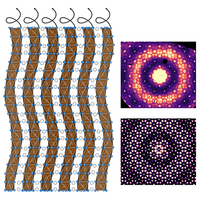
Disorder and diffuse scattering in single-chirality (TaSe4)2I crystals

Jacob A. Christensen, Simon Bettler, Kejian Qu, Jeffrey Huang, Soyeun Kim, Yinchuan Lu, Chengxi Zhao, Jin Chen, Matthew J. Krogstad, Toby J. Woods, Fahad Mahmood, Pinshane Y. Huang, Peter Abbamonte, and Daniel P. Shoemaker

Phys. Rev. Materials 8, 034202 (2024) - Published 20 March, 2024

The chiral charge density wave material (TaSe4)2I contains a half-filled Ta d-orbital, which creates Weyl points in a metallic band structure. However, historical measurements show insulating electrical transport. The authors use single-crystal diffraction and transmission electron microscopy to show that large single crystals have pristine chirality: they can exhibit a single enantiomer over millimeters. They resolve the contradiction in transport by showing a consistent iodine deficiency of more than 10%. These vacancies produce structural modulations visible in diffuse scattering and represent a new competing interaction in a class of materials with fragile electronic states.

Valley splitting depending on the size and location of a silicon quantum dot

Jonas R. F. Lima and Guido Burkard

Phys. Rev. Materials 8, 036202 (2024) - Published 19 March, 2024

Sampling vacancy configurations with large relaxations using Smart Darting

D. Tanguy

Phys. Rev. Materials 8, 033604 (2024) - Published 18 March, 2024

Effect of Sn on stacking fault energies in zirconium and its hydrides

P. Chakraborty, I. Mouton, B. Gault, A. Tehranchi, J. Neugebauer, and T. Hickel

Phys. Rev. Materials 8, 033605 (2024) - Published 18 March, 2024

Phase field crystal modeling of grain boundary structures in diamond cubic systems

Kevin H. Blixt and Håkan Hallberg

Phys. Rev. Materials 8, 033606 (2024) - Published 18 March, 2024

Equivariant graph neural network interatomic potential for Green-Kubo thermal conductivity in phase change materials

Sung-Ho Lee, Jing Li, Valerio Olevano, and Benoit Sklénard

Phys. Rev. Materials 8, 033802 (2024) - Published 18 March, 2024

Effect of point defects and lattice distortions on the structural, electronic, and magnetic properties of Co2MnAl Heusler alloy

Amar Kumar, Sujeet Chaudhary, and Sharat Chandra

Phys. Rev. Materials 8, 034405 (2024) - Published 18 March, 2024

Exciton binding energy and the origin of yellow-light emission in CH3NH3PbBr3 single crystals

I. V. Zhevstovskikh, N. S. Averkiev, M. N. Sarychev, O. I. Semenova, and O. E. Tereshchenko

Phys. Rev. Materials 8, 034601 (2024) - Published 18 March, 2024

Ab initio study of transition paths between (meta)stable phases of Nb and Ta-substituted Nb

Susanne Kunzmann, Thomas Hammerschmidt, Gabi Schierning, and Anna Grünebohm

Phys. Rev. Materials 8, 033603 (2024) - Published 15 March, 2024

Disordered ground state in a spin-orbit coupled pseudospin-12 cobalt-based metal-organic framework magnet with orthogonal spin dimers

Sebin J. Sebastian, S. Mohanty, A. Nath, M. P. Saravanan, S. Mandal, A. A. Tsirlin, and R. Nath

Phys. Rev. Materials 8, 034403 (2024) - Published 15 March, 2024

Tunable Gilbert damping and magnetization in B-rich Fe1−xBx thin films

Mohammad M. Qaid, Camillo Ballani, Frank Syrowatka, Tobias Peters, Günter Reiss, Gregor Buettel, Uwe Hartmann, and Georg Schmidt

Phys. Rev. Materials 8, 034404 (2024) - Published 15 March, 2024

Structural transformations driven by local disorder at interfaces

Yanyan Liang, Grisell Díaz Leines, Ralf Drautz, and Jutta Rogal

Phys. Rev. Materials 8, 033402 (2024) - Published 14 March, 2024

Optical tuning of the diamond Fermi level measured by correlated scanning probe microscopy and quantum defect spectroscopy

Christian Pederson, Rajiv Giridharagopal, Fang Zhao, Scott T. Dunham, Yevgeny Raitses, David S. Ginger, and Kai-Mei C. Fu

Phys. Rev. Materials 8, 036201 (2024) - Published 14 March, 2024

Precise control of diamond’s surface termination is crucial for electronic devices and the charge stability of shallow, implanted color centers for quantum devices, such as the nitrogen-vacancy (NV) and silicon-vacancy (SiV) center. Previously, such surface control relied on aggressive treatments, such as annealing, plasma exposure, or strong acids, but here the authors demonstrate a novel technique utilizing a laser under ambient conditions. This technique is demonstrated on NV and SiV centers, with optical spatial resolution and continuous optical feedback. They are able to image the change in the diamond’s work function through Kelvin probe force microscopy, and determine the mechanism as laser-assisted oxidation.

Crystallographic map: A general lattice and basis formalism enabling efficient and discretized exploration of crystallographic phase space

David Mrdjenovich and Kristin A. Persson

Phys. Rev. Materials 8, 033401 (2024) - Published 13 March, 2024

Sign In to Your Journals Account

Filter

Recent Issues

Vol. 10, Iss. 11
November 2026
Vol. 10, Iss. 10
October 2026
Vol. 10, Iss. 9
September 2026
Vol. 10, Iss. 8
August 2026
Category
Article Type
Section

Filter

Article Lookup

Enter a citation