Recent Articles

Crystal growth, transport, and magnetic properties of quasi-one-dimensional La3MnBi5

Cuiwei Zhang, Yaxian Wang, Jiaxin Zheng, Liang Du, Yong Li, Xin Han, Enke Liu, Quansheng Wu, and Youguo Shi

Phys. Rev. Materials 8, 034402 (2024) - Published 13 March, 2024

Temperature-induced structural and electronic phase transitions in λ-phase Ti3O5

K. Yoshimatsu, H. Nakao, and H. Kumigashira

Phys. Rev. Materials 8, 035002 (2024) - Published 13 March, 2024

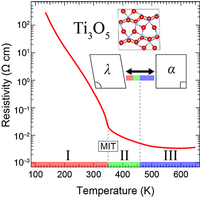
Metastable λ-Ti3O5, which undergoes phase transition to other polymorphs by external stimuli such as light, pressure, and temperature, is a candidate material for optolectronic and heat-storage devices. Here, the authors investigate the changes in the electrical and structural properties of λ-Ti3O5 with a single-crystalline thin film form across the temperature-induced phase transition. Resistivity and synchrotron X-ray diffraction measurements unveils a complex phase diagram divided into three temperature regions, which is composed of metal-insulator transition and second-order structural phase transition.

Chemomechanics in alloy phase stability

Sesha Sai Behara, John C. Thomas, Brian Puchala, and Anton Van der Ven

Phys. Rev. Materials 8, 033801 (2024) - Published 12 March, 2024

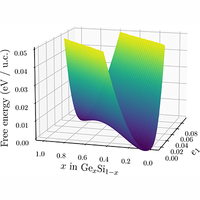
This work introduces a first-principles statistical mechanics method to calculate the free energies of crystalline alloys, including dependence on temperature, composition, and strain. The approach extends the alloy cluster expansion to include an explicit dependence on homogeneous strain in addition to site occupation variables that track chemical ordering. The method is applied to the Si-Ge binary alloy and is used to analyze phase stability under arbitrary epitaxial constraints. As a surrogate model, the new cluster expansion is a convenient compromise between the more restrictive configuration-only cluster expansions and machine-learned interatomic potentials, which require a substantially larger effort to train.

Tunable metal-insulator transition in strained V2O3 thin films epitaxially grown on SiC substrates

G. D. Zhang, L. Hu, S. Wang, R. H. Wei, R. R. Zhang, W. H. Song, X. B. Zhu, and Y. P. Sun

Phys. Rev. Materials 8, 035001 (2024) - Published 8 March, 2024

Modifying ring structures in lithium borate glasses under compression: MD simulations using a machine-learning potential

Shingo Urata, Aik Rui Tan, and Rafael Gómez-Bombarelli

Phys. Rev. Materials 8, 033602 (2024) - Published 7 March, 2024

Phonon softening and electron-phonon coupling in the topological nodal-line semimetal ZrGeSe

Weiyao Zhao, Enamul Haque, Lei Guo, David Cortie, Lei Chen, Bahadir Salmankurt, Xiaolin Wang, Ren-Kui Zheng, Nikhil V. Medhekar, Julie Karel, and Kirrily C. Rule

Phys. Rev. Materials 8, 034201 (2024) - Published 7 March, 2024

Erratum: Prediction of strong topological insulator phase in kagome metal RV6Ge6 [Phys. Rev. Materials 7, 104204 (2023)]

Taosif Ahsan, Chia-Hsiu Hsu, Md. Shafayat Hossain, and M. Zahid Hasan

Phys. Rev. Materials 8, 039901 (2024) - Published 7 March, 2024

Metastable network phases from controlled self-assembly of high-χ block copolymers

Cheng-Yen Chang, Yun-Hao Chen, and Rong-Ming Ho

Phys. Rev. Materials 8, 030301 (2024) - Published 6 March, 2024

Various phases from the self-assembly of block copolymer (BCP) as the outcome of microphase separation thermodynamically have been studied for decades. This review proposed a facile approach for creating metastable network phases with triply periodic minimal surface (TPMS) by using selective solvent with controlled evaporation for casting. The combination of BCP/solvent equilibrium state and kinetic control for solvent evaporation offers the opportunity to capture the local minimum metastable states with high packing frustration, giving the formation of double primitive and double diamond as well as double gyroid phases from controlled self-assembly of high-χ BCPs. The controlled windows for those network phases can be further expanded by using star-block copolymers due to the topological effect on self-assembly.

Searching for low thermal conductivity materials for thermal barrier coatings: A theoretical approach

Majid Zeraati, Artem R. Oganov, Tao Fan, and Sergey F. Solodovnikov

Phys. Rev. Materials 8, 033601 (2024) - Published 6 March, 2024

Nanoscale electronic inhomogeneities in 1T-TaS2

B. Campbell, J. V. Riffle, A. de la Torre, Q. Wang, K. W. Plumb, and S. M. Hollen

Phys. Rev. Materials 8, 034002 (2024) - Published 6 March, 2024

In 1T-TaS2, native defects create electronic inhomogeneities spanning 5-10 nanometers that coexist with a well-formed commensurate charge density wave with a 1.3 nm period. Over these inhomogeneities, the band center shifts by up to 60meV and the gap varies by more than 100 meV. Surprisingly, the charge density wave order is unperturbed. These results reopen questions of how disorder affects charge density wave phases in correlated systems and emphasize the importance of real-space measurements in resolving the structural and electronic properties of quantum materials.

Multiple localized-itinerant dualities in magnetism of 5f electron systems: The case of UPt2Si2

L. M. Sandratskii, V. M. Silkin, and L. Havela

Phys. Rev. Materials 8, 034401 (2024) - Published 6 March, 2024

Low mechanical loss and high refractive index in amorphous Ta2O5 films grown by magnetron sputtering

M. Molina-Ruiz, K. Shukla, A. Ananyeva, G. Vajente, M. R. Abernathy, T. H. Metcalf, X. Liu, A. Markosyan, R. Bassiri, M. M. Fejer, M. Fazio, L. Yang, C. S. Menoni, and F. Hellman

Phys. Rev. Materials 8, 035603 (2024) - Published 6 March, 2024

Characterization of the low electric field and zero-temperature two-level-system loss in hydrogenated amorphous silicon

Fabien Defrance, Andrew D. Beyer, Shibo Shu, Jack Sayers, and Sunil R. Golwala

Phys. Rev. Materials 8, 035602 (2024) - Published 5 March, 2024

Impact of atomic reconstruction on optical spectra of twisted TMD homobilayers

Joakim Hagel, Samuel Brem, Johannes Abelardo Pineiro, and Ermin Malic

Phys. Rev. Materials 8, 034001 (2024) - Published 4 March, 2024

Lateral solid phase epitaxy of yttrium iron garnet

Sebastian Sailler, Darius Pohl, Heike Schlörb, Bernd Rellinghaus, Andy Thomas, Sebastian T. B. Goennenwein, and Michaela Lammel

Phys. Rev. Materials 8, L020402 (2024) - Published 29 February, 2024

Yttrium iron garnet (YIG) is a prototypical material in the fields of spintronics and magnonics due to its exceptional magnetic properties. However, up to now, the focus has been on planar YIG thin films owing to the challenges associated with manufacturing non-planar structures. Here, the authors demonstrate the fabrication of single crystalline YIG via lateral solid phase epitaxy on top of an artificially defined SiOx mesa over micrometer length scales. The reported results lay the foundation for the development of non-planar, epitaxial YIG thin films as well as free standing YIG structures, while still maintaining complete control over the crystal orientation.

Robust Zeeman-type band splitting in sliding ferroelectrics

Homayoun Jafari, Evgenii Barts, Przemysław Przybysz, Karma Tenzin, Paweł J. Kowalczyk, Paweł Dabrowski, and Jagoda Sławińska

Phys. Rev. Materials 8, 024005 (2024) - Published 28 February, 2024

Linear electro-optic effect in trigonal LiNbO3: A first-principles study

Inhwan Kim and Alexander A. Demkov

Phys. Rev. Materials 8, 025202 (2024) - Published 28 February, 2024

Structural, optical, and electronic properties of single crystals of 4H lead-based hexagonal hybrid perovskite

Florent Pawula, Ali Fakih, Stanislav Péchev, Ramzy Daou, Daniele Mantione, Oleg Lebedev, Antoine Maignan, Georges Hadziioannou, Sylvie Hébert, and Guillaume Fleury

Phys. Rev. Materials 8, 025403 (2024) - Published 28 February, 2024

Detecting nitrogen-vacancy-hydrogen centers on the nanoscale using nitrogen-vacancy centers in diamond

Christoph Findler, Rémi Blinder, Karolina Schüle, Priyadharshini Balasubramanian, Christian Osterkamp, and Fedor Jelezko

Phys. Rev. Materials 8, 026203 (2024) - Published 28 February, 2024

Guiding diamond spin qubit growth with computational methods

Jonathan C. Marcks, Mykyta Onizhuk, Nazar Delegan, Yu-Xin Wang (王语馨), Masaya Fukami, Maya Watts, Aashish A. Clerk, F. Joseph Heremans, Giulia Galli, and David D. Awschalom

Phys. Rev. Materials 8, 026204 (2024) - Published 28 February, 2024
Spin defects in semiconductors play a major role in quantum technologies. Synthesizing high-quality spin qubits relies on controlling the incorporation of noise sources, such as other, unwanted spin defects, into the host crystal. In this work, the authors provide quantitative calculations of the coherence properties of spin qubits in diamond. They incorporate these results into an existing materials synthesis platform to develop predictive models and in situ feedback for more reliable creation of qubits tailored to applications.

Sign In to Your Journals Account

Filter

Recent Issues

Vol. 10, Iss. 11
November 2026
Vol. 10, Iss. 10
October 2026
Vol. 10, Iss. 9
September 2026
Vol. 10, Iss. 8
August 2026
Category
Article Type
Section

Filter

Article Lookup

Enter a citation