Recent Articles

Local laser-induced solid-phase recrystallization of phosphorus-implanted Si/SiGe heterostructures for contacts below 4.2 K

Malte Neul, Isabelle V. Sprave, Laura K. Diebel, Lukas G. Zinkl, Florian Fuchs, Yuji Yamamoto, Christian Vedder, Dominique Bougeard, and Lars R. Schreiber

Phys. Rev. Materials 8, 043801 (2024) - Published 12 April, 2024

Polarizability models for simulations of finite temperature Raman spectra from machine learning molecular dynamics

Ethan Berger and Hannu-Pekka Komsa

Phys. Rev. Materials 8, 043802 (2024) - Published 12 April, 2024

While the efficacy of machine learning (ML) force fields in simulating molecular dynamics (MD) trajectories has already been well established, simulating Raman spectra from them requires polarizability models which are much less explored. In this work, three polarizability models are compared using three widely different materials, namely boron arsenide, 2D molybdenum disulfide and inorganic halide perovskites. The Raman spectra are obtained in combination with ML MD and compared to experiments, allowing us to highlight the advantages and shortcomings of each model.

Annealing-induced evolution of boron-doped polycrystalline diamond

Gufei Zhang, Ramiz Zulkharnay, Fabian Ganss, Yujie Guo, Mohammed Alkhalifah, Limin Yang, Sen Zhang, Shengqiang Zhou, Peng Li, Yejun Li, Victor V. Moshchalkov, Jiaqi Zhu, and Paul W. May

Phys. Rev. Materials 8, 044802 (2024) - Published 12 April, 2024

Stable and unstable tiling patterns formed by ABC miktoarm star triblock terpolymers of symmetric interactions

Cody Hawthorne, Juntong He, and Qiang Wang

Phys. Rev. Materials 8, 045604 (2024) - Published 11 April, 2024

ABC miktoarm triblock terpolymer melts (or simply stars) are unique due to their tendency to self-assemble into nanostructures rarely found in other block copolymer systems, such as the various tiling patterns. Several discrepancies, however, exist among previous self-consistent field (SCF) calculations of symmetrically interacting stars, where the repulsion between different types of segments is the same. These are resolved with the authors’ high-accuracy SCF calculations that include all known tiling patterns, as well as several lamellar-type phases known to bound the regions occupied by the tiling patterns in the parameter space of block volume fractions fP (P=A,B,C). Both the (3.4.6.4) tiling pattern and the 3D phase of hierarchical-hexagonal lamellae (HHL) are found to be stable for the first time, and their stability mechanisms including the important (32.4.3.4) tiling pattern are revealed.

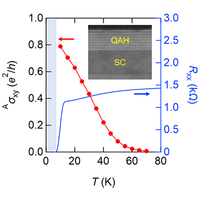
Molecular beam epitaxy of superconducting FeSexTe1−x thin films interfaced with magnetic topological insulators

Yuki Sato, Soma Nagahama, Ilya Belopolski, Ryutaro Yoshimi, Minoru Kawamura, Atsushi Tsukazaki, Naoya Kanazawa, Kei S. Takahashi, Masashi Kawasaki, and Yoshinori Tokura

Phys. Rev. Materials 8, L041801 (2024) - Published 11 April, 2024

The observation of Majorana anyons is a long-sought challenge in physics, but has been hindered by lack of high-quality materials. The authors fabricate a heterostructure with an atomically sharp interface between a quantum anomalous Hall insulator and superconductor, for the first time. This unique quantum material should enable the unambiguous observation of chiral Majorana edge states and braiding of non-Abelian anyons without magnetic field.

Chemical trend of radiative recombination in III-nitrides

Zheng Liu, Si-Yuan Xu, Su-Huai Wei, and Xie Zhang

Phys. Rev. Materials 8, 044602 (2024) - Published 10 April, 2024

Computational studies of the order-disorder transition in block copolymer topological blends

Rahul Kumar, Amy D. Goodson, Haroon Alli, Clayton Chamness, Isabella L. Miserocchi, Henry S. Ashbaugh, and Julie N. L. Albert

Phys. Rev. Materials 8, 045603 (2024) - Published 10 April, 2024

Self-assembly of blends consisting of linear and cyclic block copolymers is a potential route to obtain nanostructures needed for soft nanolithography. Blending offers an attractive strategy to modulate the feature size of the ordered morphology by controlling the relative fraction of blend components of dissimilar molecular weights. At the same time, knowledge of the blend order-disorder transition (ODT) is essential to ensure self-assembly. This study shows that polymer size and topology mismatch affect the blend ODT. Specifically, clustering of blend components in the disordered phase near the transition is an important feature of the ODT and can be used to explain why topological blends exhibit ODTs at higher segregation strengths than one might expect based on the ODTs of individual components.

Structural and thermodynamic characterization of CuZr metallic glass nanoparticles: Insights from atomistic simulations

Xuezhen Ren, Suyue Yuan, Emily J. Gurniak, and Paulo S. Branicio

Phys. Rev. Materials 8, 046001 (2024) - Published 10 April, 2024

Influence of pinholes and weak-points in aluminum-oxide Josephson junctions

K. Bayros, M. J. Cyster, J. S. Smith, and J. H. Cole

Phys. Rev. Materials 8, 046202 (2024) - Published 10 April, 2024

THz and sub-THz antiferromagnetic magnons via magnetoacoustic resonances excited by picosecond strain pulses in NiO

Andrei V. Azovtsev and Nikolay A. Pertsev

Phys. Rev. Materials 8, 044404 (2024) - Published 9 April, 2024

Structural routes to stabilize superconducting La3Ni2O7 at ambient pressure

Luke C. Rhodes and Peter Wahl

Phys. Rev. Materials 8, 044801 (2024) - Published 9 April, 2024

Pyroresistive response of percolating conductive polymer composites

Ettore Barbieri, Emiliano Bilotti, Yi Liu, and Claudio Grimaldi

Phys. Rev. Materials 8, 045602 (2024) - Published 9 April, 2024

Micromechanical measurements of local plastic events in granular materials

Jie Zheng, Aile Sun, and Jie Zhang

Phys. Rev. Materials 8, 045801 (2024) - Published 9 April, 2024

Crystallization dynamics of amorphous yttrium iron garnet thin films

Sebastian Sailler, Gregor Skobjin, Heike Schlörb, Benny Boehm, Olav Hellwig, Andy Thomas, Sebastian T. B. Goennenwein, and Michaela Lammel

Phys. Rev. Materials 8, 043402 (2024) - Published 8 April, 2024

Interfacial magnetic characteristics of nearly compensated gadolinium iron garnet

Karthik Srinivasan, Alexander J. Grutter, Thomas E. Gage, Paige Quarterman, Christy J. Kinane, Andrew J. Caruana, Guichuan Yu, Javier Garcia-Barriocanal, Sean Langridge, and Bethanie J. H. Stadler

Phys. Rev. Materials 8, 044403 (2024) - Published 5 April, 2024

Bidisperse ring polymers: Topological glass to stacking

Projesh Kumar Roy, Pinaki Chaudhuri, and Satyavani Vemparala

Phys. Rev. Materials 8, 045601 (2024) - Published 5 April, 2024

Charge state and entropic effects affecting the formation and dynamics of divacancies in 3C-SiC

Cunzhi Zhang, Francois Gygi, and Giulia Galli

Phys. Rev. Materials 8, 046201 (2024) - Published 5 April, 2024

First-principles analysis of intercalated Pb structures under buffer-layer graphene on SiC(0001): Pb(111)-, plumbene-, and amorphous-like Pb layers

Yong Han, Marek Kolmer, James W. Evans, and Michael C. Tringides

Phys. Rev. Materials 8, 044002 (2024) - Published 4 April, 2024

Intrinsic spin Hall effect in topological semimetals with single Dirac nodal ring

Jiali Chen, Run-Wu Zhang, Zhi-Ming Yu, Wei Jiang, and Yugui Yao

Phys. Rev. Materials 8, 044201 (2024) - Published 3 April, 2024

Magnon-drag and field-direction dependent thermopower in low-damping ferromagnetic Co25Fe75 alloy thin films

M. R. Natale, D. J. Wesenberg, and B. L. Zink

Phys. Rev. Materials 8, 044402 (2024) - Published 3 April, 2024

Sign In to Your Journals Account

Filter

Recent Issues

Vol. 10, Iss. 11
November 2026
Vol. 10, Iss. 10
October 2026
Vol. 10, Iss. 9
September 2026
Vol. 10, Iss. 8
August 2026
Category
Article Type
Section

Filter

Article Lookup

Enter a citation