Recent Articles

Domain walls and defects in ferroelectric inorganic halide perovskites CsGeX3 (X = Cl, Br, I)

Kristoffer Eggestad, Benjamin A. D. Williamson, and Sverre M. Selbach

Phys. Rev. Materials 10, 064403 (2026) - Published 1 June, 2026

Large in-plane rotating magnetocaloric effect in manganite thin films

Zhifei Zhu, Xiaolan Tao, Wentao Liao, Jinfeng Zhai, Pan He, Hangwen Guo, Wenbin Wang, Yinyan Zhu, and Jian Shen

Phys. Rev. Materials 10, 065401 (2026) - Published 1 June, 2026

Magnetic phase diagram and spin Hamiltonian of antiferromagnet Cs2CoI4

S. D. Nabi, L. Facheris, V. Romerio, V. Kocsis, K. Yu. Povarov, D. Sheptyakov, J. Lass, D. G. Mazzone, H. Kikuchi, T. Masuda, S. A. Barnett, D. R. Allan, Z. Yan, S. Gvasaliya, and A. Zheludev

Phys. Rev. Materials 10, 054420 (2026) - Published 29 May, 2026

The S=3/2 compound Cs2CoI4 is a new member of the celebrated family of frustrated magnets Cs2MX4 (M = transition metal ion; X = halogen or oxygen). Thermodynamic and neutron scattering measurements reveal a complex magnetic phase diagram and excitation spectrum markedly different from related compounds. A structural phase transition is central to understanding this behavior. Based on the solved low-temperature crystal structure, a spin Hamiltonian is constructed that captures the observed spin dynamics and provides a qualitative understanding of the phase diagram.

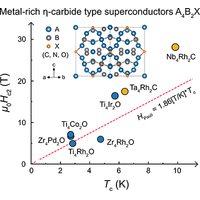
Structure, composition, and high-field superconductivity in metal-rich η-carbide-type compounds

Manuele Balestra, KeYuan Ma, Harald O. Jeschke, and Fabian O. von Rohr

Phys. Rev. Materials 10, 050301 (2026) - Published 28 May, 2026

η-Carbide–type superconductors have recently emerged as a promising family of metal-rich quantum materials exhibiting unusually large upper critical fields. Despite their cubic, centrosymmetric crystal structures, several members exceed the weak-coupling Pauli paramagnetic limit and display signatures of unusual high-field superconductivity. This Research Update summarizes recent advances in synthesis, superconducting properties, pressure tuning, and electronic-structure calculations across the η-carbide family.

Investigating vacancy cluster diffusion mechanisms in FeNiCr concentrated solid solution using the kinetic activation-relaxation technique

Md Mijanur Rahman, Gilles Adjanor, Christophe Domain, and Normand Mousseau

Phys. Rev. Materials 10, 053606 (2026) - Published 27 May, 2026

Electronic structure and elasticity of the Ta-W solid solution

Kareem Abdelmaqsoud, John R. Kitchin, and M. Widom

Phys. Rev. Materials 10, 053605 (2026) - Published 26 May, 2026

A family of rare-earth diamond chain compounds NaBa3RE3Si6O20 (RE=Nd, Gd-Dy): Synthesis and magnetic characterization

Jin Zhou, Andi Liu, Ritao Huang, Yi Yang, Qinghui Li, Qing Zuo, Langsheng Ling, Jinkui Zhao, Hanjie Guo, and Zhaoming Tian

Phys. Rev. Materials 10, 054419 (2026) - Published 26 May, 2026

Stabilization of a nonsuperconducting, orthorhombic phase by overhydrogenating LaFeSiH

M. F. Hansen, C. Lepoittevin, J.-B. Vaney, P. Boullay, V. Nassif, A. Sulpice, H. Mayaffre, M.-H. Julien, S. Tencé, and P. Toulemonde

Phys. Rev. Materials 10, 054802 (2026) - Published 26 May, 2026

Mass enhancement and lone-pair-driven structural distortion in PbCu3V4O12

Ruifeng Tian, Jie Chen, Zhiyan Shao, Feng Wu, Jiayi Guan, Wei Wu, Wanli He, Yuanzhe Li, Yuemei Li, Jin-Ming Chen, Zhiwei Hu, Pengda Ye, Yuxiang Chen, Jiayi Han, Hua Zhang, Baoshan Song, Alexei A. Belik, Yanfeng Guo, Meiling Jin, Jiabin Qiao, Fan Yang, and Xiang Li

Phys. Rev. Materials 10, 055003 (2026) - Published 26 May, 2026

Suppression of vacancy clustering in nonequiatomic NiFeMnCrAl high-entropy alloys

Xiaoyu Gui, Xudong An, Kenichiro Mizohata, Ilja Makkonen, Roger Castellote-Alvarez, Wenyi Huo, Isaac Toda-Caraballo, David San-Martin, Filip Tuomisto, and Eryang Lu

Phys. Rev. Materials 10, 055201 (2026) - Published 26 May, 2026

Ferromagnetic-like behavior emerging from local CoO6 honeycomb motifs in Co-doped NaSbO3 thin films

Hao-Bo Li, Weitao Yan, Shunsuke Kobayashi, Kousuke Ooe, Takahiro Ozawa, Hidefumi Takahashi, Shintaro Ishiwata, Chengchao Zhong, Tong Zhu, Wei-Hua Wang, Hiroshi Takatsu, Hiroshi Kageyama, and Hidekazu Tanaka

Phys. Rev. Materials 10, 054418 (2026) - Published 22 May, 2026

Discovery of interpretable Tc descriptors in conventional superconductors guided by symbolic regression

Fang Han Lim, Jinbo Pan, and Shixuan Du

Phys. Rev. Materials 10, 054803 (2026) - Published 22 May, 2026

A century after the discovery of superconductivity, the search for new superconductors still relies largely on trial and error, challenging researchers to identify the universal design principles that govern why certain materials superconduct at higher temperatures. Here, the authors introduce an interpretable, data-driven approach that pairs Random Forest screening with SISSO symbolic regression to reveal fundamental “material genes” governing Tc in conventional BCS superconductors. Unlike black-box predictors, this study reveals physically meaningful relationships that provide actionable guideline for high Tc: a near half-filled d-orbital per atom combined with moderate heterogeneity in unfilled orbitals.

Relativistic effects in LaBi2 thin films

Reiley Dorrian, Sungmin Song, Jinwoong Kim, Mizuki Ohno, Seung-Hoon Jhi, Nicholas Kioussis, and Joseph Falson

Phys. Rev. Materials 10, 053401 (2026) - Published 21 May, 2026

Relativistic spin-orbit coupling (SOC) is an important ingredient for discovering novel electronic phenomena in quantum materials. In this work, the authors investigate the consequences of strong SOC on the physical properties of the LaPn2 (Pn = Sb, Bi) class of layered square-net materials via the synthesis of LaBi2 thin films. They report a layer-by-layer growth mode, a previously mis-indexed monoclinic structure type, and classify the compound as a good metal displaying superconductivity at ~0.55 K. Compared to LaSb2, density functional theory calculations attribute the enhanced metallic behavior and growth dynamics of LaBi2 to significant relativistic corrections to its electronic band structure.

From surface segregation to glass-glass interfaces: Composition, activation-energy landscapes, and strength in CuZr nanoglasses

Aoyan Liang, Emily J. Gurniak, and Paulo S. Branicio

Phys. Rev. Materials 10, 053604 (2026) - Published 21 May, 2026

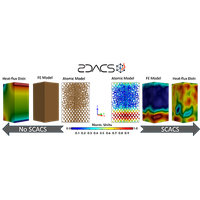
Seamlessly joining length scales: From atomistic thermal graphs to anisotropic continuum conductivity

C. Ugwumadu, D. A. Drabold, and R. M. Tutchton

Phys. Rev. Materials 10, 053804 (2026) - Published 21 May, 2026

From Atoms to Devices: SCACS, Bridging the Longstanding Scale Gap in Heat Transport SCACS (Simulator Collection for Atomic-to-Continuum Scales) is a first-of-its-kind simulation framework that connects atomic-scale material structure directly to device-scale predictions of heat flow. This solves a longstanding problem in science and engineering: how to use atomic-level information to predict the behavior of real materials and devices. Statistical mechanics is a classic example of linking microscopic physics to large-scale properties such as temperature and pressure. In a similar spirit, SCACS links atomic, mesoscopic, and macroscopic descriptions of thermal transport in a continuous and practical way. The method starts from atomistic information, preserves the effects of defects, interfaces, and disorder, and transfers that information into engineering-scale heat-flow simulations. A machine-learning model is used as a computational tool to extend these predictions to much larger systems than would otherwise be practical. The result is a new route for carrying atomic-scale thermal physics into device-scale models, with potential value for designing semiconductors, energy materials, and other technologies where heat management is critical.

Ba4SbRu3O12: A hexagonal perovskite with isolated magnetic clusters on a geometrically frustrated network

Emma A. Pollock, Rabindranath Bag, Lalit Yadav, Sara Haravifard, and Patrick M. Woodward

Phys. Rev. Materials 10, 054416 (2026) - Published 21 May, 2026

Emergence of a spin Hall topological Hall effect in the noncollinear phase of the ferrimagnetic insulator terbium-iron garnet

Mehak Loyal, Akashdeep Akashdeep, Edoardo Mangini, Edgar Galíndez-Ruales, Maja Eich, Nan Wang, Qianqian Lan, Lei Jin, Rafal Dunin-Borkowski, Timo Kuschel, Mathias Kläui, and Gerhard Jakob

Phys. Rev. Materials 10, 054417 (2026) - Published 21 May, 2026

Electronic structure and spin-to-charge conversion in the chalcopyrite CdGeAs2

N. Tarakameh Samani, F. Scali, C. Zucchetti, N. Mignani, F. Mazzola, I. Vobornik, J. Fujii, K. Raju, S. Mani, R. Sankar, M. Puppin, F. Ciccacci, M. Finazzi, E. Carpene, C. Dallera, F. Bottegoni, and A. Crepaldi

Phys. Rev. Materials 10, 054604 (2026) - Published 21 May, 2026

Crossover of nonreciprocal heat transfer in nonlinear phonon hydrodynamic regime

Wanying Liu, Kai Zhang, and Yangyu Guo

Phys. Rev. Materials 10, L053001 (2026) - Published 21 May, 2026

Evaluation of spin mixing conductance in Co2FeGa0.5Ge0.5/Pt bilayer and the effect of ultrathin Cu, Ni, Ru, Ta, or Cr insertion layers

Madhav M. Bhat, H. Suto, T. T. Sasaki, A. Perumal, A. Srinivasan, and Y. Sakuraba

Phys. Rev. Materials 10, 054414 (2026) - Published 20 May, 2026

Sign In to Your Journals Account

Filter

Recent Issues

Vol. 10, Iss. 10
October 2026
Vol. 10, Iss. 9
September 2026
Vol. 10, Iss. 8
August 2026
Vol. 10, Iss. 7
July 2026
Category
Article Type
Section

Filter

Article Lookup

Enter a citation