Highlights

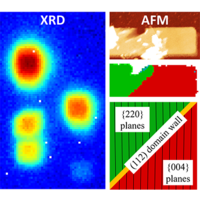
Inducing ferroelastic domains in single-crystal CsPbBr3 perovskite nanowires using atomic force microscopy

Lucas A. B. Marçal, Sandra Benter, Austin Irish, Dmitry Dzhigaev, Eitan Oksenberg, Amnon Rothman, Ella Sanders, Susanna Hammarberg, Zhaojun Zhang, Simone Sala, Alexander Björling, Eva Unger, Anders Mikkelsen, Ernesto Joselevich, Rainer Timm, and Jesper Wallentin

Phys. Rev. Materials 5, L063001 (2021) - Published 1 June, 2021

Understanding and controlling the formation and dynamics of ferroelastic domains can be key to enhance metal halide perovskite device performance, but established methods lack spatial control at the level of single domains. Here, the authors induced the formation of ferroelastic domains in CsPbBr3 nanowires using an atomic force microscope tip, and studied the structural changes using nanofocused x-ray diffraction with a 60-nm beam. The applied stress locally induced lattice tilts that define room temperature-stable ferroelastic domains, which spread spatially and terminated at {112}-type domain walls. While pristine regions show an orthorhombic (004) reflection; regions exposed to higher forces exhibit {220}-type reflections.

Direct growth of MoS2 on electrolytic substrate and realization of high-mobility transistors

Md Hasibul Alam, Sayema Chowdhury, Anupam Roy, Maria Helena Braga, Sanjay K. Banerjee, and Deji Akinwande

Phys. Rev. Materials 5, 054003 (2021) - Published 17 May, 2021

Electrostatic gating with ionic liquids, contributing to the accumulation of high surface charge carriers, has been often exploited in thin-film transistors. However, the intrinsic liquid nature of ionic liquids inhibits them from constituting a practical platform for thin-film devices. To this end, lithium-ion solid electrolytic substrates, often used for battery technology, offer similar benefits as ionic-liquids, with the added advantage of solid-state compatibility. In this work, the authors explore a lithium-ion solid electrolytic substrate for direct growth of MoS2 by chemical vapor deposition method. A near ideal subthreshold swing around 65 mV/dec with field-effect mobility values of 42-49 cm2V−1s−1 has been achieved with the devices on as-grown crystal, back-gated by the solid electrolyte.

Electronic structure of 3∘-twisted bilayer graphene on 4H-SiC(0001)

Takushi Iimori, Anton Visikovskiy, Hitoshi Imamura, Toshio Miyamachi, Miho Kitamura, Koji Horiba, Hiroshi Kumigashira, Kazuhiko Mase, Kan Nakatsuji, Satoru Tanaka, and Fumio Komori

Phys. Rev. Materials 5, L051001 (2021) - Published 13 May, 2021

Interesting electronic properties of a-few-degree-twisted bilayer graphene are caused by the formation of a flat band due to the interlayer interaction and electronic correlation. The authors quantitatively investigated the band structure of wide 3deg-twisted bilayer graphene with clean interface by angle-resolved photoelectron spectroscopy, and compare the results with those of a band calculation using a recently-developed band unfolding method. The observed band structure indicates strong interlayer coupling that renormalizes the band structure including partial flat band features and gap formation. The observed band structure is in good agreement with the calculated results, indicating the importance of the interlayer coupling for the band renormalization.

Antiphase boundary migration as a diffusion mechanism in a P3 sodium layered oxide

Jonas L. Kaufman and Anton Van der Ven

Phys. Rev. Materials 5, 055401 (2021) - Published 3 May, 2021

Sodium-ion batteries have emerged as a promising, cost-effective energy storage solution. Critical to the success of these technologies is the efficient transport of ions within the battery electrodes. Here, the authors use first-principles techniques to examine sodium diffusion in a canonical sodium-ion battery cathode material, revealing a new, unconventional mechanism in which the mobile sodium ions are confined to boundaries between otherwise immobile, ordered regions. They provide evidence of a diffusion mechanism that occurs via the collective motion of the boundaries through the material. This behavior is dramatically different from that which is seen in analogous lithium-ion battery materials, and may extend to related candidate electrode materials for beyond-lithium-ion batteries. These mechanistic insights have important implications for the rate of sodium diffusion, which impacts battery charge/discharge speed.

Temperature-sensitive spatial distribution of defects in PdSe2 flakes

Xiaowei Liu, Yaojia Wang, Qiqi Guo, Shi-Jun Liang, Tao Xu, Bo Liu, Jiabin Qiao, Shengqiang Lai, Junwen Zeng, Song Hao, Chenyi Gu, Tianjun Cao, Chenyu Wang, Yu Wang, Chen Pan, Guangxu Su, Yuefeng Nie, Xiangang Wan, Litao Sun, Zhenlin Wang, Lin He, Bin Cheng, and Feng Miao

Phys. Rev. Materials 5, L041001 (2021) - Published 28 April, 2021

Defect engineering plays an important role in tailoring the electronic transport properties of van der Waals materials. Methods reported so far mainly rely on the exsitu engineering of defect type and concentration, hindering the realization of new types of device functionalities associated with defect engineering. Here, the authors report temperature-sensitive spatial redistribution of defects in PdSe2 thin flakes through scanning tunneling microscopy. The spatial characteristics of defect distribution is strongly related to the electronic transport properties such as anisotropic carrier mobility and phase coherent length, indicating a different avenue for creating novel device functionalities based on insitu modulation of defect distribution.

First-principles design of halide-reduced electrides: Magnetism and topological phases

Tonghua Yu, Motoaki Hirayama, José A. Flores-Livas, Marie-Therese Huebsch, Takuya Nomoto, and Ryotaro Arita

Phys. Rev. Materials 5, 044203 (2021) - Published 19 April, 2021

The authors demonstrate a computational scheme of systematically designing new magnetic electrides derived from known conventional solids. Intuitively, we think of localized electrons attached to ions in a conventional solid. But there is an exceptional class of solids, where some electrons localize at the empty space in between ions: electrides. These materials can be used as catalysts, or in the case they are magnetic, for spintronic devices. Only few magnetic electrides are confirmed, so the authors have implemented state-of-the-art simulations of many interacting particles to computationally predict new magnetic electrides. The key is to start from known materials and tweak them just enough by removing or substituting elements. With this scheme they successfully predicted 30 nonmagnetic and 28 magnetic electrides. Topological phases, which are based on a kind of classification of matter, are revealed in the predicted electrides, highlighting the intimate relation between electrides and topological materials.

3d transition-metal high-entropy Invar alloy developed by adjusting the valence-electron concentration

Ziyuan Rao, Aslı Çakır, Özge Özgün, Dirk Ponge, Dierk Raabe, Zhiming Li, and Mehmet Acet

Phys. Rev. Materials 5, 044406 (2021) - Published 16 April, 2021

Invar and anti-Invar are materials having anomalously low and high thermal expansion coefficients, respectively. In the case of Invar, this is related to magneto-volume fluctuations occurring between a large-volume-high-moment state and an energetically higher-lying small-volume-low-moment state. For anti-Invar it is the opposite. For 3d metals and alloys, the occurrence of both effects is governed by the valence-electron-concentration, e/a. The authors provide a face-lift for Invar alloys by showing that they can also be tailored as 3d high-entropy alloys just by choosing the proper valence-electron-concentration - in this case (e/a)= 8.7 electrons/atom. The study thus presents a method to identify new alloy variants that could combine the functional properties of Invar with beneficial features that have been identified for high-entropy alloys, such as high mechanical strength and excellent corrosion resistance.

Extending Shannon's ionic radii database using machine learning

Ahmer A. B. Baloch, Saad M. Alqahtani, Faisal Mumtaz, Ali H. Muqaibel, Sergey N. Rashkeev, and Fahhad H. Alharbi

Phys. Rev. Materials 5, 043804 (2021) - Published 15 April, 2021

The authors extend the ionic radii database of Shannon’s seminal work using machine learning regression. The developed consolidated table will allow prediction of material properties with high accuracy by considering the definite ionic radius value based on the oxidation state and coordination number. The work is relevant to the evolving material informatics field and has applications in many related fields.

Unit-cell-thick domain in free-standing quasi-two-dimensional ferroelectric material

Yuwei Guo, Berit Goodge, Lifu Zhang, Jie Jiang, Yu Chen, Lena F. Kourkoutis, and Jian Shi

Phys. Rev. Materials 5, 044403 (2021) - Published 12 April, 2021

Understanding the domain structure of two-dimensional materials is of paramount importance for the design of next generation microelectronic devices. Here, the authors employ a Dion–Jacobson layered oxide as a model system to study the ferroelectric domain structure with atomic scale analysis. They reveal the existence of a unit-cell-thick ferroelectric domain size as well as both 180° and 90° domain walls in a free-standing ferroelectric oxide. This may suggest ways to achieve unit-cell-thick domain structures and shed light on promising material solutions for emerging nonvolatile high-density memories and synaptic devices.

Sluggish diffusion in random equimolar FCC alloys

Murray S. Daw and Michael Chandross

Phys. Rev. Materials 5, 043603 (2021) - Published 9 April, 2021

Compositionally complex alloys, also known as high entropy or multiple principle component alloys, can exhibit greatly improved mechanical properties. Researchers often ascribe this to sluggish diffusion that is thought to result from having multiple constituents. Here, the authors present a systematic investigation of diffusion in multielement alloys with molecular dynamics simulations. Only a small minority of the studied alloys show sluggish diffusion, whereas the large majority show diffusion that is faster or even vigorous. The authors find that diffusivities do not correlate with the number of constituents, but instead strongly correlate with the mismatch in lattice constants among the elements.

Preferential hole defect formation in monolayer WSe2 by electron-beam irradiation

Donghan Shin, Gang Wang, Mengjiao Han, Zeyu Lin, Andrew O'Hara, Feiyu Chen, Junhao Lin, and Sokrates T. Pantelides

Phys. Rev. Materials 5, 044002 (2021) - Published 8 April, 2021

A unique dense network of multi-member-ring round hole defects is formed in monolayer WSe2 from the evolution of multivacancies by suitable control of a scanning focused electron beam, whereas the same process leads predominantly to chalcogen-vacancy line defect array in other trigonal-prismatic transition metal dichalcogenide (TMDC) monolayers. Density functional theory (DFT) calculations track the formation of the observed complex multivacancy structures and find that the underlying atomic-scale processes are quasi-thermodynamic, which elaborates the formation mechanism of dense round hole defects in WSe2 monolayers. The high-density round holes in WSe2 hold promise for novel applications such as atomic and molecular sieving.

Valley relaxation of resident electrons and holes in a monolayer semiconductor: Dependence on carrier density and the role of substrate-induced disorder

Jing Li, M. Goryca, K. Yumigeta, H. Li, S. Tongay, and S. A. Crooker

Phys. Rev. Materials 5, 044001 (2021) - Published 5 April, 2021

Analogous to the keen interest in electron, hole, and exciton spin relaxation during the early days of semiconductor spintronics, measurements of valley relaxation in monolayer transition-metal dichalcogenide (TMD) semiconductors such as WSe2 are currently a focus of attention for potential applications in valleytronics. For many notional valleytronic devices, the important parameter is the intrinsic valley relaxation time of the resident electrons and holes that exist in n-type and p-type TMD monolayers. Using optical methods, the authors determine these timescales as a systematic function of carrier density, and study the (important) role of the underlying substrate. Microsecond-long valley relaxation of carriers is revealed at low densities.

Control of the metal-insulator transition in NdNiO3 thin films through the interplay between structural and electronic properties

Y. E. Suyolcu, K. Fürsich, M. Hepting, Z. Zhong, Y. Lu, Y. Wang, G. Christiani, G. Logvenov, P. Hansmann, M. Minola, B. Keimer, P. A. van Aken, and E. Benckiser

Phys. Rev. Materials 5, 045001 (2021) - Published 1 April, 2021

The metal-insulator transition in NdNiO3 macroscopically manifests close-lying energy scales of lattice and electronic degrees of freedom. Hence, epitaxial heterostructures offer fascinating possibilities to manipulate these degrees of freedom. Here, the authors show that the metal-insulator transition in NdNiO3 epitaxial thin films grown on different facets of the same orthorhombic substrate varies over a wide temperature range. Authors’ combined results from electrical transport measurements, scanning transmission electron microscopy, and ab initio theory give detailed insights into the interplay of structural pinning, lattice mismatch, and electronic interactions promoting the complex facet and thickness dependence of the metal-insulator transition in NdNiO3.

Tuneable correlated disorder in alloys

D. Chaney, A. Castellano, A. Bosak, J. Bouchet, F. Bottin, B. Dorado, L. Paolasini, S. Rennie, C. Bell, R. Springell, and G. H. Lander

Phys. Rev. Materials 5, 035004 (2021) - Published 30 March, 2021

Many desirable material properties may be associated with disorder exhibiting local periodicity or correlations. However, few systems allow systematic studies into the effects of intrinsic crystallographic conflict on correlated disorder. The authors use epitaxial matching to stabilize an exemplar system: the pseudo-bcc U1−xMox alloy, which exhibits a significant mismatch between the basis preferred symmetry and the global lattice. Employing diffuse and inelastic x-ray scattering techniques on 300-nm epitaxial films, combined with ab initio modeling, the authors discover a new form of correlated disorder which exhibits strong disorder-phonon coupling that dramatically suppresses phonon lifetimes. These findings have implications across a broad range of materials and could be exploited to develop future functional materials.

Single-crystal growth and magnetic phase diagram of the enantiopure crystal of NdPt2B

Yoshiki J. Sato, Fuminori Honda, Arvind Maurya, Yusei Shimizu, Ai Nakamura, Yoshiya Homma, Dexin Li, Yoshinori Haga, and Dai Aoki

Phys. Rev. Materials 5, 034411 (2021) - Published 15 March, 2021

Chirality, which is a fundamental property of symmetry, can produce unique electronic and magnetic properties. The problem is that many of the chiral inorganic compounds form a racemic mixture consisting of right- and left-handed enantiomers. Here, the authors succeeded in growing the enantiopure single crystal of Nd-based monoaxial chiral magnet, demonstrating the nontrivial magnetic phase diagram in this rare-earth chiral magnet with the DM interaction. This ternary rare-earth platinum boride system provides an attractive platform for examining chiral magnetism and the role of DM interaction.

Large enhancement of thermopower at low magnetic field in compensated semimetals

Xiaozhou Feng and Brian Skinner

Phys. Rev. Materials 5, 024202 (2021) - Published 3 February, 2021

Dirac and Weyl semimetals are promising candidates for high-efficiency thermoelectrics due to their gapless spectrum and high mobility. Recent experiments have shown that the thermopower of Dirac and Weyl materials can be enormously enhanced by a magnetic field, especially when the material exhibits nearly-complete compensation of electron and hole carriers. Here the authors study theoretically the thermopower of compensated conductors, and they show that a strong increase of thermopower with magnetic field arises generically in compensated systems even at relatively low field values. The full field dependence exhibits a number of different regimes, which are mapped out in detail.

Cubic metamaterial crystal supporting broadband isotropic chiral phonons

Yi Chen, Tobias Frenzel, Quan Zhang, Muamer Kadic, and Martin Wegener

Phys. Rev. Materials 5, 025201 (2021) - Published 3 February, 2021

Chiral metamaterials can support chiral phonons leading to acoustical activity, the acoustical counterpart of optical activity. However, the properties of early metamaterial designs have been very highly anisotropic, and chiral acoustical phonons occurred only for selected high-symmetry directions. The authors propose a novel chiral metamaterial based on “twisting” a truncated octahedron in a simple-cubic unit cell. Not supported by crystal symmetry alone but rather by a tuned degeneracy, chiral phonons and large broadband acoustical activity are obtained for all phonon propagation directions in 3D. This result is notable because even isotropic achiral acoustical phonons are rare for crystalline materials.

Multistability of isolated and hydrogenated Ga–O divacancies in β−Ga2O3

Y. K. Frodason, C. Zimmermann, E. F. Verhoeven, P. M. Weiser, L. Vines, and J. B. Varley

Phys. Rev. Materials 5, 025402 (2021) - Published 3 February, 2021

The combination of an ultrawide band gap and controllable n-type conductivity makes monoclinic gallium sesquioxide a promising material for high-power electronics. However, this technological development will require accurate knowledge about the identity and properties of prominent deep-level defects in the material. This work explores close-associate Ga-O divacancies. Owing to the low symmetry of the crystal structure, divacancies can potentially occur in a plethora of crystallographically inequivalent configurations. Hybrid functional calculations were performed to shed light on the relative stability of different divacancy configurations, the energy barriers for transformation between them, and trends in their electrical properties.

Prediction of low-Z collinear and noncollinear antiferromagnetic compounds having momentum-dependent spin splitting even without spin-orbit coupling

Lin-Ding Yuan, Zhi Wang, Jun-Wei Luo, and Alex Zunger

Phys. Rev. Materials 5, 014409 (2021) - Published 19 January, 2021

Antiferromagnetic order offers a non-relativistic route to create spin splitting and spin polarization effects that do not rely on heavy element compounds (with strong spin-orbit coupling, SOC), and could exist even in centrosymmetric crystals. Cases enabling such non-relativistic, SOC-unrelated spin polarization effect are classified as SST-4 (SST-4A and SST-4B) of all seven possible spin splitting prototypes derived in this paper based on magnetic symmetry analysis. The authors uncovered 422 magnetic space groups (160 centrosymmetric and 262 non-centrosymmetric) and 201 candidate antiferromagnets that belong to the SST-4 category. DFT calculations for collinear and noncollinear cases are provided as basis for guiding future experiments.

Superconducting contact and quantum interference between two-dimensional van der Waals and three-dimensional conventional superconductors

Michael R. Sinko, Sergio C. de la Barrera, Olivia Lanes, Kenji Watanabe, Takashi Taniguchi, Susheng Tan, David Pekker, Michael Hatridge, and Benjamin M. Hunt

Phys. Rev. Materials 5, 014001 (2021) - Published 12 January, 2021

Two-dimensional van der Waals superconductors offer a range of properties advantageous for quantum information processing. Integrating these materials into the well-developed platform of aluminum-based superconducting circuits requires robust zero-resistance contacts. Here the authors introduce a simple method for fabricating such contacts between deposited Al and exfoliated few-layer NbSe2 and they demonstrate that the Al/NbSe2 interface exhibits Josephson-junction-like behavior in the presence of magnetic flux. The anomalous periodicity of the interference patterns indicates that the junction phase difference depends on the flux ΦJJ through adjacent regions of the 2D crystal which are an appreciable fraction of the size of the 2D crystal itself, in striking contrast with 3D-3D Josephson junction behavior.

Sign In to Your Journals Account

Filter

Section

Filter

Article Lookup

Enter a citation