Highlights

Predicting magnetic anisotropy energies using site-specific spin-orbit coupling energies and machine learning: Application to iron-cobalt nitrides

Timothy Liao, Weiyi Xia, Masahiro Sakurai, Renhai Wang, Chao Zhang, Huaijun Sun, Kai-Ming Ho, Cai-Zhuang Wang, and James R. Chelikowsky

Phys. Rev. Materials 6, 024402 (2022) - Published 7 February, 2022

The authors present a promising machine learning model, which focuses on site-magnetic-properties for rapid screening in materials design and accelerates computational screening of candidate materials that possess high magnetizations and large magnetic anisotropy energies.

Giant doping response of magnetic anisotropy in MnTe

Duncan H. Moseley, Keith M. Taddei, Jiaqiang Yan, Michael A. McGuire, Stuart Calder, M. M. H. Polash, Daryoosh Vashaee, Xiaofan Zhang, Huaizhou Zhao, David S. Parker, Randy S. Fishman, and Raphaël P. Hermann

Phys. Rev. Materials 6, 014404 (2022) - Published 18 January, 2022

The authors show that minuscule amounts of Li suffice to tune antiferromagnetic MnTe from an easy-plane to easy-axis material. Upon heating towards the Néel temperature of 307 K, the spins do not gradually rotate back to a planar orientation, and instead maintain their axial orientation up to a relatively high temperature of 260 K, before quickly switching back to a planar orientation and crossing into the paramagnetic phase. Calculations indicate MnTe bears two competing magnetic ground states which can be manipulated by slightly shifting the Fermi level via Li-doping. Easy manipulation of the spins in MnTe could have significant implications for future spintronic devices and materials.

Ferroelectric nanodomains in epitaxial GeTe thin films

Boris Croes, Fabien Cheynis, Yide Zhang, Cédric Voulot, Kokou Dodzi Dorkenoo, Salia Cherifi-Hertel, Cristian Mocuta, Michaël Texier, Thomas Cornelius, Olivier Thomas, Marie-Ingrid Richard, Pierre Müller, Stefano Curiotto, and Frédéric Leroy

Phys. Rev. Materials 5, 124415 (2021) - Published 23 December, 2021

In this paper the authors have grown germanium telluride thin films by molecular beam epitaxy on silicon as a proposed system for ferroelectric-based spintronics with high spin-orbit coupling. The structure of ferroelectric domains is explored in a wide range of film thickness. After elucidating the domain wall type and domain volume fraction, the stability of ferroelectric domains with respect to thermomechanical stress is discussed.

Symmetry-enforced topological band crossings in orthorhombic crystals: Classification and materials discovery

Andreas Leonhardt, Moritz M. Hirschmann, Niclas Heinsdorf, Xianxin Wu, Douglas H. Fabini, and Andreas P. Schnyder

Phys. Rev. Materials 5, 124202 (2021) - Published 6 December, 2021

Topological semimetals are highly sought after for their unusual functional properties. The symmetries of a space group can guarantee the existence of band degeneracies with nontrivial topology in its band structures. In this article, the authors list all symmetry enforced band degeneracies in the orthorhombic space groups for spinless band structures, as well as spinful band structures with non-negligible spin-orbit coupling. To connect the results of the symmetry analysis with real materials, criteria for a systematic search in large material databases are introduced and used to provide real material examples for some of the most interesting topological features.

Dynamics of a sheared twist-bend nematic liquid crystal

M. Praveen Kumar, Jakub Karcz, Przemyslaw Kula, and Surajit Dhara

Phys. Rev. Materials 5, 115605 (2021) - Published 29 November, 2021

The discovery of twist-bend nematic liquid crystals with lower symmetry than the ordinary nematic crystals has created immense interest in the field. These crystals are made of achiral dimeric molecules in which the director forms an oblique helicoid with a nanoscale periodicity. In this article the authors have shown that depending on the shear rate and the temperature there are three distinct flow regimes. The observed dynamic stress fluctuations in the intermediate regime, exhibiting regular periodic and quasiperiodic oscillations are akin to the spatiotemporal dynamics predicted in sheared nematogenic fluids.

Singular angular magnetoresistance and sharp resonant features in a high-mobility metal with open orbits, ReO3

Nicholas P. Quirk, Loi T. Nguyen, Jiayi Hu, R. J. Cava, and N. P. Ong

Phys. Rev. Materials 5, 105004 (2021) - Published 27 October, 2021

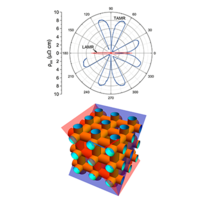
The oxide ReO3 is one of the most conductive materials known. At 4 Kelvin, its resistivity is 6-10 times lower than that in high-purity gold and the electronic mean free path is 25 microns. It has an open Fermi surface comprised of intersecting cylinders. When an external magnetic field is applied, it exhibits a huge magnetoresistance with a highly singular angular dependence. Tilting the field in the longitudinal plane leads to a sharp decrease in the resistivity whereas tilting in the perpendicular direction sharply increases it. The authors analyze the experimental data using the Shockley-Chambers tube integral, showing that slight tilts lead to the obstruction of closed orbits on the Fermi surface which re-attach to form open orbits. The associated shadowing effect leads to a new way to measure the Fermi wavevector. However, the tube integral approach does not account for very narrow peaks observed at small tilt angles.

High-throughput crystal structure solution using prototypes

Sean D. Griesemer, Logan Ward, and Chris Wolverton

Phys. Rev. Materials 5, 105003 (2021) - Published 25 October, 2021

Numerous experimentally observed inorganic compounds are missing from materials databases due to challenges in solving their crystal structures from diffraction data. The authors present a rapid DFT-based structure solution method and use it to conduct high-throughput structure solutions for hundreds of previously unsolved compounds. This effort has yielded 520 experimentally observed, newly solved crystal structures, a remarkable expansion that could prove valuable across a wide range of applications.

Ab initio prediction of nontrivial topological band and superconductivity in stable metallic Si allotropes at ambient pressure

Yoon-Gu Kang, In-Ho Lee, Myung Joon Han, and Kee Joo Chang

Phys. Rev. Materials 5, 104802 (2021) - Published 13 October, 2021

Silicon is a semiconductor and widely used as the key element for modern electronic devices. Various metallic superconducting phases have been reported, but most retain their crystal structure at high pressures. Thus, it remains a challenge to search for potential superconducting Si allotropes. In this article, the authors propose novel metallic Si allotropes that meet the conditions for dynamic, mechanical, and thermal stability at ambient pressure through machine learning and first-principles electronic structure calculations. The new allotropes are superconductors and even exhibit a nontrivial band topology, providing a promising platform for realizing a topological superconducting state in all-Si systems.

Role of locally polar regions in the superconductivity of SrTiO3

Salva Salmani-Rezaie, Hanbyeol Jeong, Ryan Russell, John W. Harter, and Susanne Stemmer

Phys. Rev. Materials 5, 104801 (2021) - Published 6 October, 2021

A possible cooperation between ferroelectric and superconducting order parameters in SrTiO3 has long been suspected. Here, the authors find that the superconducting critical temperature of SrTiO3 correlates with the length scale of polar order. The findings point to spin-orbit coupling as an important ingredient in the superconductivity of SrTiO3. The ability to control the size of the polar domains in thin films opens up new opportunities to control the superconductivity in SrTiO3 and other superconductors that exhibit local polar order

Anisotropic phonon-mediated electronic transport in chiral Weyl semimetals

Christina A. C. Garcia, Dennis M. Nenno, Georgios Varnavides, and Prineha Narang

Phys. Rev. Materials 5, L091202 (2021) - Published 27 September, 2021

Discovery and observations of exotic, quantized optical and electrical responses have sparked renewed interest in nonmagnetic chiral crystals. Here the authors present a first-principles theoretical study of chiral Weyl semimetals with strong and anisotropic electron-phonon coupling, and predict the emergence of hydrodynamics in these systems. The interplay of phonon-mediated interactions and complex Fermi surface topology presents an opportunity to study both superconductivity and hydrodynamic electron transport in these systems. This work opens fundamental and cross-disciplinary questions across the topological, condensed matter, computational, transport and mesoscopic quantum physics communities.

Identifying a critical micelle temperature in simulations of disordered asymmetric diblock copolymer melts

Anshul Chawla, Frank S. Bates, Kevin D. Dorfman, and David C. Morse

Phys. Rev. Materials 5, L092601 (2021) - Published 9 September, 2021

In melts of highly asymmetric diblock copolymers, copolymers self-assemble into spherical micelles. Indirect evidence has long suggested the existence of two distinct characteristic temperatures in such materials: A critical micelle temperature (CMT) at which a dense fluid of micelles appears over a narrow range of temperatures and an order disorder transition (ODT) temperature at which micelles crystallize. In this article, molecular dynamics simulations are used to definitively confirm the correctness of this picture in melts of high molecular weight polymers, and to show that the CMT occurs very near where self-consistent field theory predicts the ODT to occur.

Photoluminescence spectra of point defects in semiconductors: Validation of first-principles calculations

Yu Jin, Marco Govoni, Gary Wolfowicz, Sean E. Sullivan, F. Joseph Heremans, David D. Awschalom, and Giulia Galli

Phys. Rev. Materials 5, 084603 (2021) - Published 24 August, 2021

Optically and magnetically active point defects in semiconductors are interesting platforms for the development of solid-state quantum technologies. Their optical properties are usually probed by measuring photoluminescence spectra, which provide information on excitation energies and on the interaction of electrons with lattice vibrations. The authors present a detailed validation protocol of first principles calculations of photoluminescence spectra of defects in diamond and SiC, necessary for the interpretation of experiments and for robust predictions of the electronic properties of point defects in semiconductors.

Imaging the spin chirality of ferrimagnetic Néel skyrmions stabilized on topological antiferromagnetic Mn3Sn

Teng Xu, Zhen Chen, Heng-An Zhou, Zidong Wang, Yiqing Dong, Lucia Aballe, Michael Foerster, Pierluigi Gargiani, Manuel Valvidares, David M. Bracher, Tatiana Savchenko, Armin Kleibert, Riccardo Tomasello, Giovanni Finocchio, Soong-Guen Je, Mi-Young Im, David A. Muller, and Wanjun Jiang

Phys. Rev. Materials 5, 084406 (2021) - Published 13 August, 2021

Fabricating new skyrmion-hosting materials and characterizing their topological spin textures are crucial for next-generation spintronic devices. Here, the authors successfully stabilize ferrimagnetic Neel-type skyrmions in heavy-metal-free multilayer CoTb films through interfacing with noncollinear antiferromagnet Mn3Sn layers, in which the spin chirality can be controlled by the opposite stacking order. Further, a new Lorentz scanning transmission electron microscopy technique is employed to resolve both the internal spin structure of the skyrmions and their chirality. Their results show how noncollinear topological antiferromagnets can be incorporated to design chiral nanomagnets, and set a possible route for bridging antiferromagnet spintronics with skyrmionics.

Machine learning band gaps from the electron density

Javier Robledo Moreno, Johannes Flick, and Antoine Georges

Phys. Rev. Materials 5, 083802 (2021) - Published 10 August, 2021

The accurate estimation of band gaps of solid-state materials is of great relevance for modern optoelectronic, electronic, and photovoltaic applications. However, the precise ab initio computation of accurate band gaps is a resource intensive task. In this article, inspired by the Hohenberg-Kohn theorem of density-functional theory, the authors demonstrate the possibility of explicitly parametrizing the mapping between the electron density in the unit cell and the corresponding experimental band gap in real materials using deep neural networks. The proposed data-driven approach achieves accuracies comparable to state of the art ab initio approaches, at a much lower computational cost.

Balancing orbital effects and on-site Coulomb repulsion through Na modulations in NaxVO2

Xi Chen, Hao Tang, Yichao Wang, and Xin Li

Phys. Rev. Materials 5, 084402 (2021) - Published 6 August, 2021

A common Na density wave pattern is found to evolve in NaxTiO2, NaxVO2, and NaxCrO2, where the separation of antiphase boundary within the pattern continuously changes with Na composition, corresponding to the incommensurate peak shift found in the in situ x-ray diffraction. More details disclosed by x-ray diffraction analysis, ab initio simulation and theoretical modeling suggest that the unique trimer structure in the P2 stacking of NaxVO2 is a delicate balance between strong electronic correlations and orbital effects, well explaining the metal insulator transition of the material. On the contrary, the remaining materials, due to the lack of such a delicate balance, share a sodium-modulated Peierls-like transition for the dimer formation instead.

Finite-temperature interplay of structural stability, chemical complexity, and elastic properties of bcc multicomponent alloys from ab initio trained machine-learning potentials

Konstantin Gubaev, Yuji Ikeda, Ferenc Tasnádi, Jörg Neugebauer, Alexander V. Shapeev, Blazej Grabowski, and Fritz Körmann

Phys. Rev. Materials 5, 073801 (2021) - Published 8 July, 2021

High-throughput finite-temperature phase stability and materials property predictions directly from first-principles are extremely resource demanding. Here, the authors combine density functional theory calculations with accurate machine-learning potentials and an active learning scheme to obtain fast, yet highly accurate interatomic potentials. The approach is used to analyze the bcc-ω phase stability and elastic properties of a series of bcc TiZrHfTax alloys. The phase stability is evaluated by analyzing the projections of atomic displacements from molecular dynamics trajectories revealing fingerprints of bcc-ω martensitic transformations.

Charge carrier dynamics and self-trapping on Sb2S3(100)

Lisa Grad, Fabian O. von Rohr, Matthias Hengsberger, and Jürg Osterwalder

Phys. Rev. Materials 5, 075401 (2021) - Published 8 July, 2021

To achieve high power conversion efficiencies in photovoltaic or photoelectrochemical cells, an understanding of the dynamical processes in the electrode materials upon photoexcitation is crucial. Antimony sulfide is a promising candidate material. The authors present time-resolved two-photon photoemission measurements from a Sb2S3(100) single crystal surface. A first laser pulse generates a population of free charge carriers that are probed by a second pulse. Ultrafast relaxation towards the conduction band minimum is followed by a fast decay within 1.3 ps into two longer-lived trap states, self-trapped electrons and self-trapped excitons states, with lifetimes of 27 and 63 ps, respectively. The results support a polaronic self-trapping mechanism by optical phonons.

Cation and anion topotactic transformations in cobaltite thin films leading to Ruddlesden-Popper phases

I-Ting Chiu, Min-Han Lee, Shaobo Cheng, Shenli Zhang, Larry Heki, Zhen Zhang, Yahya Mohtashami, Pavel N. Lapa, Mingzhen Feng, Padraic Shafer, Alpha T. N'Diaye, Apurva Mehta, Jon A. Schuller, Giulia Galli, Shriram Ramanathan, Yimei Zhu, Ivan K. Schuller, and Yayoi Takamura

Phys. Rev. Materials 5, 064416 (2021) - Published 24 June, 2021

The ability to control a material’s physical properties by ion migration is particularly important for the design of devices for emerging applications such as neuromorphic computing, magnetoionic switches, and next-generation memory and logic devices. The perovskite oxide LaSrCoO3 is an ideal system for investigating ion migration due to its high oxygen vacancy conductivity, relatively low oxygen vacancy formation energy, and strong coupling of the magnetic and electronic properties to its oxygen stoichiometry. This paper shows that it is possible to obtain a series of electronic and magnetic phases by systematically exposing the parent perovskite oxide to highly reducing annealing conditions. Under these conditions, the movement of both oxygen and cobalt ions in and out of the lattice represents a new direction for discovery of functional materials for brain-inspired computing.

Comparing simulated specific heat of liquid polymers and oligomers to experiments

Hongyu Gao, Thalia J. L. Menzel, Martin H. Müser, and Debashish Mukherji

Phys. Rev. Materials 5, 065605 (2021) - Published 23 June, 2021

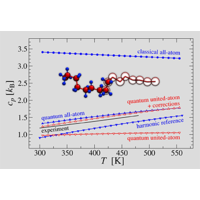
The field of atomistic simulations of polymers is in a mature stage, yet accurate predictions of their specific heat are very rare. The main difficulty stems from the quantum-mechanical nature of intramolecular vibrations. They call for either full, tedious quantum-mechanical treatments, or, for proper corrections of classical simulations. Here, the authors adopt an existing method, which defines a specific heat for a harmonic reference, to estimate the specific heat difference between classical and quantum-mechanical systems and use this as a correction factor. Thereby, they predominantly correct the stiff, high-frequency harmonic modes, while leaving the specific-heat contributions of the slow (anharmonic) modes intact. The results compare well to experimental data.

Magnetoionic control of perpendicular exchange bias

J. Zehner, D. Wolf, M. U. Hasan, M. Huang, D. Bono, K. Nielsch, K. Leistner, and G. S. D. Beach

Phys. Rev. Materials 5, L061401 (2021) - Published 21 June, 2021

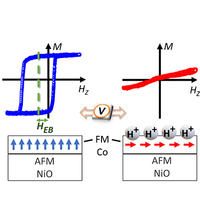
Voltage control of magnetism via ionic motion (magnetoionic control) is currently a thriving approach for low-power magnetic nanodevices. Recently, fast switching and high reversibility have been achieved for proton (H+)-based magnetoionic control in all-solid devices. In this work, the authors extend such (H+)-based magnetoionic control to a perpendicular exchange bias (EB) systems by functionalizing the ferromagnetic Co layer with an underlying antiferromagnetic NiO layer. They reveal the importance of an interfacial Pd layer for the existence of perpendicular EB in this system. Importantly, they demonstrate reversible (H+)-based magnetoionic control of remanence and coercivity in such a perpendicular EB system and thoroughly discuss the underlying mechanism.

Sign In to Your Journals Account

Filter

Section

Filter

Article Lookup

Enter a citation