Highlights

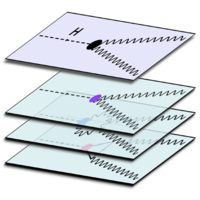
Five-Loop Running of the QCD Coupling Constant

P. A. Baikov, K. G. Chetyrkin, and J. H. Kühn

Phys. Rev. Lett. 118, 082002 (2017) - Published 24 February, 2017

For the first time, theorists calculate the complete five-loop term in the beta function for quark-gluon coupling in quantum chromodynamics.

Observation of the Annihilation Decay Mode B0→K+K−

R. Aaij et al. (LHCb Collaboration)

Phys. Rev. Lett. 118, 081801 (2017) - Published 21 February, 2017

The LHCb Collaboration reports the rarest (8 in 100 million events) fully hadronic B0 meson decay ever observed.

Unifying Inflation with the Axion, Dark Matter, Baryogenesis, and the Seesaw Mechanism

Guillermo Ballesteros, Javier Redondo, Andreas Ringwald, and Carlos Tamarit

Phys. Rev. Lett. 118, 071802 (2017) - Published 15 February, 2017

A minimal extension to the standard model of particle physics involves six new particles.

Measurement of the b-Quark Production Cross Section in 7 and 13 TeV pp Collisions

R. Aaij et al. (LHCb Collaboration)

Phys. Rev. Lett. 118, 052002 (2017) - Published 3 February, 2017

The cross-section for bottom quark production at 13 TeV, as measured by the LHCb Collaboration, differs from QCD predictions.

Strange Quark Magnetic Moment of the Nucleon at the Physical Point

Raza Sabbir Sufian, Yi-Bo Yang, Andrei Alexandru, Terrence Draper, Jian Liang, and Keh-Fei Liu (χQCD Collaboration)

Phys. Rev. Lett. 118, 042001 (2017) - Published 27 January, 2017

The strange quark contribution to magnetic moment and charge radius is extracted from lattice simulations. These are the first such simulations to be carried out using the physical pion mass.

Redefining the Axion Window

Luca Di Luzio, Federico Mescia, and Enrico Nardi

Phys. Rev. Lett. 118, 031801 (2017) - Published 20 January, 2017

The region of parameter space corresponding to realistic models in which axions may exist is considerably larger than assumed.

Observation of J/ψϕ Structures Consistent with Exotic States from Amplitude Analysis of B+→J/ψϕK+ Decays

R. Aaij et al. (LHCb Collaboration)

Phys. Rev. Lett. 118, 022003 (2017) - Published 11 January, 2017

The LHCb collaboration has identified four new structures in B+ decays that are likely to be tetraquark states. These tetraquark systems contain neither of the light u and d quarks.

Solving the Hierarchy Problem at Reheating with a Large Number of Degrees of Freedom

Nima Arkani-Hamed, Timothy Cohen, Raffaele Tito D’Agnolo, Anson Hook, Hyung Do Kim, and David Pinner

Phys. Rev. Lett. 117, 251801 (2016) - Published 15 December, 2016

A new approach to solve the hierarchy problem—that the electroweak and Planck scales differ by 17 orders of magnitude—invokes a large number of copies of the Standard Model.

Golden Probe of Electroweak Symmetry Breaking

Yi Chen, Joe Lykken, Maria Spiropulu, Daniel Stolarski, and Roberto Vega-Morales

Phys. Rev. Lett. 117, 241801 (2016) - Published 9 December, 2016

Four-lepton decays of the Higgs boson could be used to probe a key parameter of electroweak symmetry breaking.

How Bright is the Proton? A Precise Determination of the Photon Parton Distribution Function

Aneesh Manohar, Paolo Nason, Gavin P. Salam, and Giulia Zanderighi

Phys. Rev. Lett. 117, 242002 (2016) - Published 9 December, 2016

The distribution of photons inside the proton can be determined in a model-independent way from electron-proton scattering data.

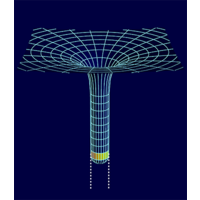
Smooth Horizonless Geometries Deep Inside the Black-Hole Regime

Iosif Bena, Stefano Giusto, Emil J. Martinec, Rodolfo Russo, Masaki Shigemori, David Turton, and Nicholas P. Warner

Phys. Rev. Lett. 117, 201601 (2016) - Published 8 November, 2016

A novel class of horizonless supersymmetric black holes in five dimensions and their dual field theory descriptions are constructed, offering a specific realization of how the information content in a black hole can be consistent with quantum mechanics.

Testing Hadronic Interactions at Ultrahigh Energies with Air Showers Measured by the Pierre Auger Observatory

A. Aab et al. (Pierre Auger Collaboration)

Phys. Rev. Lett. 117, 192001 (2016) - Published 31 October, 2016

The Pierre Auger Observatory has detected more muons from cosmic-ray showers than predicted by the most up-to-date particle-physics models.

Creation of Magnetic Monopoles in Classical Scattering

Tanmay Vachaspati

Phys. Rev. Lett. 117, 181601 (2016) - Published 27 October, 2016

Magnetic monopoles—theorized particles with only one magnetic pole—might possibly be created by wave-wave collisions.

Limits on Active to Sterile Neutrino Oscillations from Disappearance Searches in the MINOS, Daya Bay, and Bugey-3 Experiments

P. Adamson et al. (Daya Bay Collaboration, MINOS Collaboration)

Phys. Rev. Lett. 117, 151801 (2016) - Published 7 October, 2016

An analysis of data from the MINOS, Daya Bay, and Bugey-3 experiments places stringent limits on the mass and mixing of a hypothetical sterile neutrino.

Search for Structure in the Bs0π± Invariant Mass Spectrum

R. Aaij et al.

Phys. Rev. Lett. 117, 152003 (2016) - Published 5 October, 2016

Data from LHCb does not confirm the exotic four-quark hadron recently evidenced by the D0 collaboration.

Dense Axion Stars

Eric Braaten, Abhishek Mohapatra, and Hong Zhang

Phys. Rev. Lett. 117, 121801 (2016) - Published 16 September, 2016

Axions, if they make up the dark mater, could form dense stars balanced by gravity and the mean-field pressure of the axion Bose-Einstein condensate.

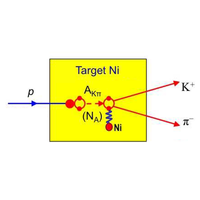
Observation of π−K+ and π+K− Atoms

B. Adeva et al. (DIRAC Collaboration)

Phys. Rev. Lett. 117, 112001 (2016) - Published 8 September, 2016

The DIRAC collaboration at CERN reports the first statistically significant observation of an atom formed from a π meson and a K meson.

Chaos in AdS2 Holography

Kristan Jensen

Phys. Rev. Lett. 117, 111601 (2016) - Published 7 September, 2016

A theoretical analysis points at a possible connection between near-conformal two-dimensional gravity and a fermionic quantum mechanical system with applications to condensed matter physics.

Universal Charge Diffusion and the Butterfly Effect in Holographic Theories

Mike Blake

Phys. Rev. Lett. 117, 091601 (2016) - Published 23 August, 2016

A universal regime describing charge transport in holographic theories with particle-hole symmetry is theoretically predicted, suggesting a link between strongly coupled quantum field theories and quantum chaos.

Lieb-Robinson Bound and the Butterfly Effect in Quantum Field Theories

Daniel A. Roberts and Brian Swingle

Phys. Rev. Lett. 117, 091602 (2016) - Published 23 August, 2016

A universal regime describing charge transport in holographic theories with particle-hole symmetry is theoretically predicted, suggesting a link between strongly coupled quantum field theories and quantum chaos.

Sign In to Your Journals Account

Filter

Section

Filter

Article Lookup

Enter a citation