Highlights

Cosmological Higgs-Axion Interplay for a Naturally Small Electroweak Scale

J. R. Espinosa, C. Grojean, G. Panico, A. Pomarol, O. Pujolàs, and G. Servant

Phys. Rev. Lett. 115, 251803 (2015) - Published 16 December, 2015

Weak coupling of the Higgs boson to two axionlike states could lead to a naturally small electroweak scale, which could be detected via their astrophysical and cosmological effects.

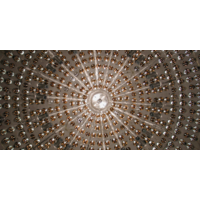
Test of Electric Charge Conservation with Borexino

M. Agostini et al. (Borexino Collaboration)

Phys. Rev. Lett. 115, 231802 (2015) - Published 3 December, 2015

Scientists have placed new limits on how often electrons decay into neutrinos and photons, a reaction that—if it occurred—would violate the law of charge conservation.

Cosmological Relaxation of the Electroweak Scale

Peter W. Graham, David E. Kaplan, and Surjeet Rajendran

Phys. Rev. Lett. 115, 221801 (2015) - Published 23 November, 2015

A theoretical proposal ties the puzzling light mass of the Higgs particle to a hypothetical new particle that plays an important role during the big bang.

Standard Model Prediction for Direct CP Violation in K→ππ Decay

Z. Bai, T. Blum, P. A. Boyle, N. H. Christ, J. Frison, N. Garron, T. Izubuchi, C. Jung, C. Kelly, C. Lehner, R. D. Mawhinney, C. T. Sachrajda, A. Soni, and D. Zhang (RBC and UKQCD Collaborations)

Phys. Rev. Lett. 115, 212001 (2015) - Published 17 November, 2015

First complete lattice QCD calculation of direct CP violation in a kaon decaying to pions is two standard deviations below the experimental value.

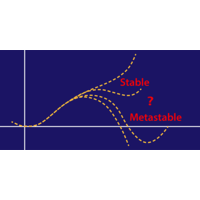
Stability of the Electroweak Vacuum: Gauge Independence and Advanced Precision

A. V. Bednyakov, B. A. Kniehl, A. F. Pikelner, and O. L. Veretin

Phys. Rev. Lett. 115, 201802 (2015) - Published 9 November, 2015

The probability that the Universe exists in a stable state may be greater than previously thought.

Detecting Stealth Dark Matter Directly through Electromagnetic Polarizability

T. Appelquist, E. Berkowitz, R. C. Brower, M. I. Buchoff, G. T. Fleming, X.-Y. Jin, J. Kiskis, G. D. Kribs, E. T. Neil, J. C. Osborn, C. Rebbi, E. Rinaldi, D. Schaich, C. Schroeder, S. Syritsyn, P. Vranas, E. Weinberg, and O. Witzel (Lattice Strong Dynamics (LSD) Collaboration)

Phys. Rev. Lett. 115, 171803 (2015) - Published 23 October, 2015

Lattice gauge theory computations provide bounds on detecting composite dark matter in direct detection experiments.

Semivisible Jets: Dark Matter Undercover at the LHC

Timothy Cohen, Mariangela Lisanti, and Hou Keong Lou

Phys. Rev. Lett. 115, 171804 (2015) - Published 23 October, 2015

Models of dark matter that include dark-sector particles with strong coupling could have evaded LHC searches due to jets of strongly interacting particles that mask their “missing energy” signatures.

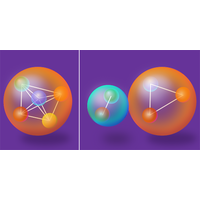
Identifying Exotic Hidden-Charm Pentaquarks

Rui Chen, Xiang Liu, Xue-Qian Li, and Shi-Lin Zhu

Phys. Rev. Lett. 115, 132002 (2015) - Published 25 September, 2015

The pentaquarks discovered by the LHCb Collaboration could be molecular bound states of a charmed baryon and a meson. Observing the predicted isospin partners would allow for this interpretation to be verified.

Discovery of τ Neutrino Appearance in the CNGS Neutrino Beam with the OPERA Experiment

N. Agafonova et al. (OPERA Collaboration)

Phys. Rev. Lett. 115, 121802 (2015) - Published 17 September, 2015

OPERA experiment crosses “5 sigma” threshold for detection of muon neutrinos turning into tau neutrinos.

Entanglement Entropy in Two-Dimensional String Theory

Sean A. Hartnoll and Edward A. Mazenc

Phys. Rev. Lett. 115, 121602 (2015) - Published 16 September, 2015

The entropy of entanglement of a simple two dimensional model of quantum gravity is calculated by reducing the computation to an analysis of free fermions in one spatial dimension.

New Measurement of Antineutrino Oscillation with the Full Detector Configuration at Daya Bay

F. P. An et al. (Daya Bay Collaboration)

Phys. Rev. Lett. 115, 111802 (2015) - Published 11 September, 2015

Antineutrino oscillation data from the fully constructed Day Bay Reactor Neutrino experiment improves the precision of the smallest of the three neutrino mixing angles by a factor of two.

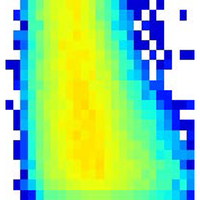
Observation of Zc(3900)0 in e+e−→π0π0J/ψ

M. Ablikim et al. (BESIII Collaboration)

Phys. Rev. Lett. 115, 112003 (2015) - Published 11 September, 2015

The neutral partner of the four-quark state Zc(3900)+- is observed in electron-positron collisions by the BESIII Collaboration.

Measurement of the Ratio of Branching Fractions B(B¯0→D*+τ−ν¯τ)/B(B¯0→D*+μ−ν¯μ)

R. Aaij et al. (LHCb Collaboration)

Phys. Rev. Lett. 115, 111803 (2015) - Published 9 September, 2015

The decay of B mesons into τ leptons is 2.1 standard deviations greater than the Standard Model prediction, according to measurements by the LHCb Collaboration. This agrees with a previous measurement of the BABAR Collaboration.

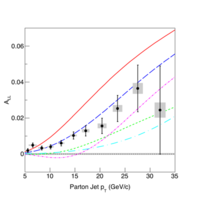
Precision Measurement of the Longitudinal Double-Spin Asymmetry for Inclusive Jet Production in Polarized Proton Collisions at s=200  GeV

L. Adamczyk et al. (STAR Collaboration)

Phys. Rev. Lett. 115, 092002 (2015) - Published 26 August, 2015

Measurements from STAR collaboration experiments at RHIC reveal that gluons and quarks may contribute equally to the spin angular momentum of a proton.

Observation of a New Narrow Axial-Vector Meson a1(1420)

C. Adolph et al. (COMPASS Collaboration)

Phys. Rev. Lett. 115, 082001 (2015) - Published 19 August, 2015

A new axial-vector meson is observed during the diffractive reaction of pions on a hydrogen target.

Observation of J/ψp Resonances Consistent with Pentaquark States in Λb0→J/ψK−p Decays

R. Aaij et al. (LHCb Collaboration)

Phys. Rev. Lett. 115, 072001 (2015) - Published 12 August, 2015

A new type of particle containing five quarks has been observed by the LHCb experiment.

Resolving the Tevatron Top Quark Forward-Backward Asymmetry Puzzle: Fully Differential Next-to-Next-to-Leading-Order Calculation

Michal Czakon, Paul Fiedler, and Alexander Mitov

Phys. Rev. Lett. 115, 052001 (2015) - Published 28 July, 2015

Fully differential two loop calculations in the Standard Model explain the excess of top quarks in the direction of the proton beam in pp¯ collisions at the Tevatron collider.

Evidence of Wγγ Production in pp Collisions at s=8  TeV and Limits on Anomalous Quartic Gauge Couplings with the ATLAS Detector

G. Aad et al. (ATLAS Collaboration)

Phys. Rev. Lett. 115, 031802 (2015) - Published 16 July, 2015

The first measurement of triple gauge boson production (W boson and two photons) at the LHC provides new limits on interactions beyond the standard model.

Search for Ultralight Scalar Dark Matter with Atomic Spectroscopy

Ken Van Tilburg, Nathan Leefer, Lykourgos Bougas, and Dmitry Budker

Phys. Rev. Lett. 115, 011802 (2015) - Published 30 June, 2015

Scientists have now enlisted atomic spectroscopy in the hunt for dark matter.

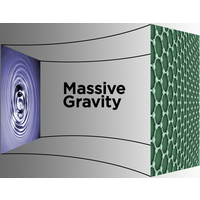
Electron-Phonon Interactions, Metal-Insulator Transitions, and Holographic Massive Gravity

Matteo Baggioli and Oriol Pujolàs

Phys. Rev. Lett. 114, 251602 (2015) - Published 23 June, 2015
A quantum gravity holographic model can describe strongly correlated systems, in particular polaron quasiparticles, predicting a metal-insulator transition.

Sign In to Your Journals Account

Filter

Section

Filter

Article Lookup

Enter a citation