Highlights

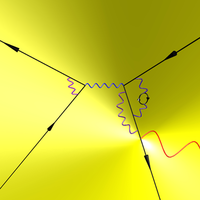
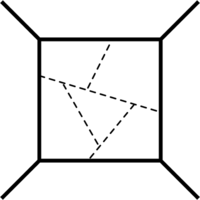
Scattering of Massless Particles in Arbitrary Dimensions

Freddy Cachazo, Song He, and Ellis Ye Yuan

Phys. Rev. Lett. 113, 171601 (2014) - Published 20 October, 2014

A new formula for the scattering of massless particles may simplify predictions and analyses of LHC experiments and shed new light on quantum gravity theories.

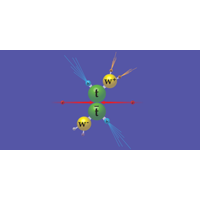
Solvable Relativistic Hydrogenlike System in Supersymmetric Yang-Mills Theory

Simon Caron-Huot and Johannes M. Henn

Phys. Rev. Lett. 113, 161601 (2014) - Published 16 October, 2014

A relativistic quantum field theory extension to the classical Kepler problem provides a new method to compute the bound states of massive W bosons in planar N=4 super Yang-Mills.

Observation of Overlapping Spin-1 and Spin-3 D¯0K− Resonances at Mass 2.86  GeV/c2

R. Aaij et al. (LHCb Collaboration)

Phys. Rev. Lett. 113, 162001 (2014) - Published 14 October, 2014

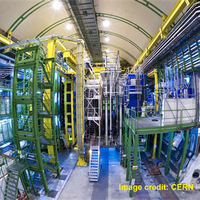
The LHCb collaboration has observed the first spin-3 resonance containing a heavy quark produced in the decay of the bottom-hadron Bs0.

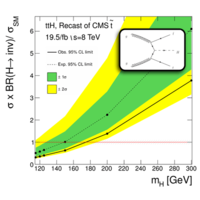
Bounds on Invisible Higgs Boson Decays Extracted from LHC tt¯H Production Data

Ning Zhou, Zepyoor Khechadoorian, Daniel Whiteson, and Tim M. P. Tait

Phys. Rev. Lett. 113, 151801 (2014) - Published 10 October, 2014

A reanalysis of LHC data from a supersymmetry search provides new constraints on the Higgs branching ratio to invisible particles, which are possibly related to dark matter.

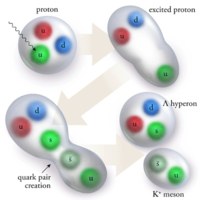
Strangeness Suppression of qq¯ Creation Observed in Exclusive Reactions

M. D. Mestayer et al. (CLAS Collaboration)

Phys. Rev. Lett. 113, 152004 (2014) - Published 10 October, 2014

Strange quark–anti-quark pairs are less likely to be produced in hadronic collisions than their light quark counterparts, providing insight into color confinement in QCD.

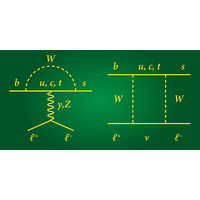
Test of Lepton Universality Using B+→K+ℓ+ℓ− Decays

R. Aaij et al. (LHCb Collaboration)

Phys. Rev. Lett. 113, 151601 (2014) - Published 6 October, 2014

The finding that electrons and muons aren’t produced equally in certain particle decays may hint at a crack in the standard model.

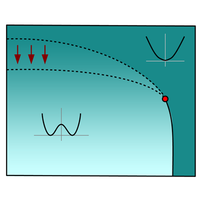
Lattice QCD Phase Diagram In and Away from the Strong Coupling Limit

Ph. de Forcrand, J. Langelage, O. Philipsen, and W. Unger

Phys. Rev. Lett. 113, 152002 (2014) - Published 6 October, 2014

A strong coupling expansion for lattice gauge theory at finite density is able to reduce the sign problem - a numerical difficulty in sampling highly oscillatory wavefunctions in Monte Carlo simulations.

Evidence for Electroweak Production of W±W±jj in pp Collisions at s=8  TeV with the ATLAS Detector

G. Aad et al. (ATLAS Collaboration)

Phys. Rev. Lett. 113, 141803 (2014) - Published 3 October, 2014

The ATLAS experiment at the LHC has found evidence for the scattering of two massive vector bosons, a previously unseen process predicted by the Standard Model.

Sphaleron Rate in the Minimal Standard Model

Michela D’Onofrio, Kari Rummukainen, and Anders Tranberg

Phys. Rev. Lett. 113, 141602 (2014) - Published 1 October, 2014

The most accurate calculation of the sphaleron rate — responsible for baryon number changing processes — has been made using large scale lattice simulations and the mass of the recently discovered Higgs boson.

Search for a Light Sterile Neutrino at Daya Bay

F. P. An et al. (Daya Bay Collaboration)

Phys. Rev. Lett. 113, 141802 (2014) - Published 1 October, 2014

The Daya Bay Reactor Neutrino Experiment has placed stringent limits on a hypothetical fourth neutrino.

Low’s Subleading Soft Theorem as a Symmetry of QED

Vyacheslav Lysov, Sabrina Pasterski, and Andrew Strominger

Phys. Rev. Lett. 113, 111601 (2014) - Published 11 September, 2014

An old identity from Francis Low in the 1950s regarding soft photon production in QED has been shown to be due to a new hidden symmetry of the S-matrix.

Matrix Product States for Gauge Field Theories

Boye Buyens, Jutho Haegeman, Karel Van Acoleyen, Henri Verschelde, and Frank Verstraete

Phys. Rev. Lett. 113, 091601 (2014) - Published 25 August, 2014

The authors demonstrate that matrix product states, a construction used in condensed matter physics to describe the quantum state of many particles, can be used for real-time simulations of a gauge theory.

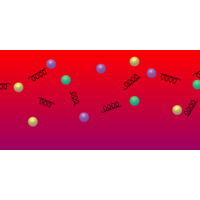
QCD Phase Transition with Chiral Quarks and Physical Quark Masses

Tanmoy Bhattacharya, Michael I. Buchoff, Norman H. Christ, H.-T. Ding, Rajan Gupta, Chulwoo Jung, F. Karsch, Zhongjie Lin, R. D. Mawhinney, Greg McGlynn, Swagato Mukherjee, David Murphy, P. Petreczky, Dwight Renfrew, Chris Schroeder, R. A. Soltz, P. M. Vranas, and Hantao Yin (HotQCD Collaboration)

Phys. Rev. Lett. 113, 082001 (2014) - Published 18 August, 2014

More realistic versions of lattice QCD may lead to a better understanding of how quarks formed hadrons in the early Universe.

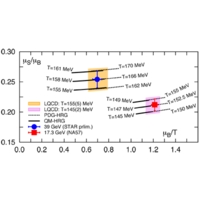
Additional Strange Hadrons from QCD Thermodynamics and Strangeness Freezeout in Heavy Ion Collisions

A. Bazavov, H.-T. Ding, P. Hegde, O. Kaczmarek, F. Karsch, E. Laermann, Y. Maezawa, Swagato Mukherjee, H. Ohno, P. Petreczky, C. Schmidt, S. Sharma, W. Soeldner, and M. Wagner

Phys. Rev. Lett. 113, 072001 (2014) - Published 11 August, 2014

Unobserved hadrons - specifically those made of strange quarks - provide insight into lattice QCD calculations near the Quark Gluon Plasma phase transition.

Precision Measurement of the Top Quark Mass in Lepton+Jets Final States

V. M. Abazov et al. (D0 Collaboration)

Phys. Rev. Lett. 113, 032002 (2014) - Published 17 July, 2014

A new analysis of data from the Tevatron delivers the most precise value of the top quark mass based on a single measurement.

Tensor Interpretation of BICEP2 Results Severely Constrains Axion Dark Matter

David J. E. Marsh, Daniel Grin, Renée Hlozek, and Pedro G. Ferreira

Phys. Rev. Lett. 113, 011801 (2014) - Published 2 July, 2014

If the excess B-mode polarization measured by BICEP2 comes from inflationary gravitational waves then there are severe constraints on the mass and abundance of axionlike particles making up cold dark matter.

Axion Cold Dark Matter in View of BICEP2 Results

Paolo Gondolo and Luca Visinelli

Phys. Rev. Lett. 113, 011802 (2014) - Published 2 July, 2014

If the excess B-mode polarization measured by BICEP2 comes from inflationary gravitational waves then there are severe constraints on the mass and abundance of axionlike particles making up cold dark matter.

Evidence for Polarization of Gluons in the Proton

Daniel de Florian, Rodolfo Sassot, Marco Stratmann, and Werner Vogelsang

Phys. Rev. Lett. 113, 012001 (2014) - Published 2 July, 2014

A new analysis of high-energy data shows that gluons may provide some of the proton’s missing spin.

Observation of the Associated Production of a Single Top Quark and a W Boson in pp Collisions at s=8  TeV

S. Chatrchyan et al. (CMS Collaboration)

Phys. Rev. Lett. 112, 231802 (2014) - Published 9 June, 2014

Separate collider experiments observe the top quark without its usual antiparticle partner in unique processes that could give insight into new physics, such as additional sets of quarks.

Observation of s-Channel Production of Single Top Quarks at the Tevatron

T. Aaltonen et al. (CDF Collaboration†, D0 Collaboration‡)

Phys. Rev. Lett. 112, 231803 (2014) - Published 9 June, 2014
Separate collider experiments observe the top quark without its usual antiparticle partner in unique processes that could give insight into new physics, such as additional sets of quarks.

Sign In to Your Journals Account

Filter

Section

Filter

Article Lookup

Enter a citation