Highlights

Locality of Gravitational Systems from Entanglement of Conformal Field Theories

Jennifer Lin, Matilde Marcolli, Hirosi Ooguri, and Bogdan Stoica

Phys. Rev. Lett. 114, 221601 (2015) - Published 2 June, 2015

AdS/CFT correspondence has uncovered a relationship between the quantum entanglement of non-gravitating systems and the equations of general relativity in the presence of matter sources.

Updated Next-to-Next-to-Leading-Order QCD Predictions for the Weak Radiative B-Meson Decays

M. Misiak, H. M. Asatrian, R. Boughezal, M. Czakon, T. Ewerth, A. Ferroglia, P. Fiedler, P. Gambino, C. Greub, U. Haisch, T. Huber, M. Kamiński, G. Ossola, M. Poradziński, A. Rehman, T. Schutzmeier, M. Steinhauser, and J. Virto

Phys. Rev. Lett. 114, 221801 (2015) - Published 2 June, 2015

Precise standard-model theoretical predictions of the decay of a bottom-quark meson into a strange-quark and a photon allow better bounds on models of new physics, notably those with hypothetical charged Higgs bosons.

Higgs Boson Gluon-Fusion Production in QCD at Three Loops

Charalampos Anastasiou, Claude Duhr, Falko Dulat, Franz Herzog, and Bernhard Mistlberger

Phys. Rev. Lett. 114, 212001 (2015) - Published 27 May, 2015

First three-loop calculation of a cross section in perturbative QCD will help with the search for deviations in Higgs boson properties from Standard Model predictions.

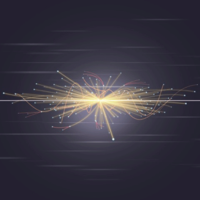
Combined Measurement of the Higgs Boson Mass in pp Collisions at s=7 and 8 TeV with the ATLAS and CMS Experiments

G. Aad et al. (ATLAS Collaboration, CMS Collaboration)

Phys. Rev. Lett. 114, 191803 (2015) - Published 14 May, 2015

A new value for the Higgs boson mass will allow stronger tests of the standard model and of theories about the Universe’s stability.

Entanglement Entropy of Dispersive Media from Thermodynamic Entropy in One Higher Dimension

M. F. Maghrebi and M. T. H. Reid

Phys. Rev. Lett. 114, 151602 (2015) - Published 16 April, 2015

Entanglement entropy – an inherently quantum mechanical property – is related to classical thermodynamic entropy in one higher dimension.

Tevatron Constraints on Models of the Higgs Boson with Exotic Spin and Parity Using Decays to Bottom-Antibottom Quark Pairs

T. Aaltonen et al. (CDF Collaboration†, D0 Collaboration‡)

Phys. Rev. Lett. 114, 151802 (2015) - Published 15 April, 2015

An analysis of data from the now-shuttered Tevatron excludes certain Higgs bosons with exotic properties.

Lattice QCD Evidence that the Λ(1405) Resonance is an Antikaon-Nucleon Molecule

Jonathan M. M. Hall, Waseem Kamleh, Derek B. Leinweber, Benjamin J. Menadue, Benjamin J. Owen, Anthony W. Thomas, and Ross D. Young

Phys. Rev. Lett. 114, 132002 (2015) - Published 1 April, 2015

The Lambda baryon, in its excited state, behaves like a molecule, according to new lattice chromodynamics simulations of the particle’s magnetic structure.

Chiral Symmetry Breaking in QCD with Two Light Flavors

Georg P. Engel, Leonardo Giusti, Stefano Lottini, and Rainer Sommer

Phys. Rev. Lett. 114, 112001 (2015) - Published 16 March, 2015

State of the art lattice simulations have helped elucidate the mechanism behind the spontaneous breaking of chiral symmetry in lattice QCD.

Search for Higgs Boson Pair Production in the γγbb¯ Final State Using pp Collision Data at s=8  TeV from the ATLAS Detector

G. Aad et al. (ATLAS Collaboration)

Phys. Rev. Lett. 114, 081802 (2015) - Published 26 February, 2015

A search for new physics in production of a pair of Higgs bosons finds a modest excess of events, 2.4 standard deviations above the background-only hypothesis.

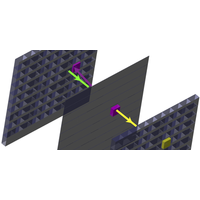
Directional Antineutrino Detection

Benjamin R. Safdi and Burkhant Suerfu

Phys. Rev. Lett. 114, 071802 (2015) - Published 20 February, 2015

A proposed detector for low-energy antineutrinos would reveal the particles’ trajectories, potentially allowing more detailed studies of Earth’s radioactivity and of nuclear reactors.

Neutral Naturalness from Orbifold Higgs Models

Nathaniel Craig, Simon Knapen, and Pietro Longhi

Phys. Rev. Lett. 114, 061803 (2015) - Published 13 February, 2015

A new class of models, rooted in ideas of extra dimensions of space, is proposed that protect the Higgs mass from large loop corrections.

Universality Far from Equilibrium: From Superfluid Bose Gases to Heavy-Ion Collisions

J. Berges, K. Boguslavski, S. Schlichting, and R. Venugopalan

Phys. Rev. Lett. 114, 061601 (2015) - Published 10 February, 2015

A new universality class for many-body systems far from equilibrium is conjectured, providing a link between disparate physical systems ranging from hot plasmas to cold gases.

Observation of Two New Ξb− Baryon Resonances

R. Aaij et al. (LHCb Collaboration)

Phys. Rev. Lett. 114, 062004 (2015) - Published 10 February, 2015

Researchers report the detection of two new subatomic particles made of three quarks from each of the possible quark families.

Quantum Critical Transport and the Hall Angle in Holographic Models

Mike Blake and Aristomenis Donos

Phys. Rev. Lett. 114, 021601 (2015) - Published 12 January, 2015

The techniques of gauge/gravity duality provide a holographic model explaining the anomalous scaling of resistivity in strange metals.

Search for Millicharged Particles Using Optically Levitated Microspheres

David C. Moore, Alexander D. Rider, and Giorgio Gratta

Phys. Rev. Lett. 113, 251801 (2014) - Published 16 December, 2014

Tiny dielectric spheres in an optical trap are used to search for hypothetical particles with a small fractional charge.

SU(2)×U(1) Gauge Invariance and the Shape of New Physics in Rare B Decays

R. Alonso, B. Grinstein, and J. Martin Camalich

Phys. Rev. Lett. 113, 241802 (2014) - Published 9 December, 2014

An effective field theory for physics beyond the electroweak scale, where symmetries of the Standard Model are assumed to apply, provides model-independent constraints on new physics from the branching ratios of B decays.

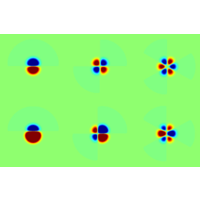
Charge-Swapping Q Balls

Edmund J. Copeland, Paul M. Saffin, and Shuang-Yong Zhou

Phys. Rev. Lett. 113, 231603 (2014) - Published 2 December, 2014

In nonlinear field theories with Q-ball (non-topological soliton) solutions, towers of composite Q-ball solutions exist, where positive and negative charges within a Q-ball can swap positions with each other.

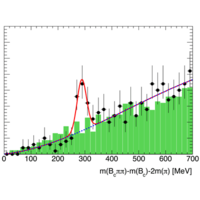
Observation of an Excited Bc± Meson State with the ATLAS Detector

G. Aad et al. (ATLAS Collaboration)

Phys. Rev. Lett. 113, 212004 (2014) - Published 21 November, 2014

The ATLAS Collaboration has observed a new excited state of the Bc± meson at 6842 MeV by reconstructing its decay. The mass and decay are consistent with QCD predictions for this excited state.

Search for a Dark Photon in e+e− Collisions at BaBar

J. P. Lees et al. (BaBar Collaboration)

Phys. Rev. Lett. 113, 201801 (2014) - Published 10 November, 2014

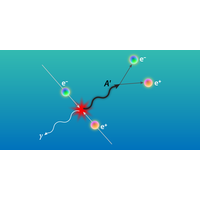
A search for a photonlike particle that could be related to dark matter has come up empty, putting new constraints on models that imagine a dark form of electromagnetism.

Strong Constraints on Sub-GeV Dark Sectors from SLAC Beam Dump E137

Brian Batell, Rouven Essig, and Ze’ev Surujon

Phys. Rev. Lett. 113, 171802 (2014) - Published 21 October, 2014

Using 30 year old electron beam-dump data, stringent new constraints are placed on the parameter space of dark photons - recently proposed hypothetical force carriers between dark matter particles.

Sign In to Your Journals Account

Filter

Section

Filter

Article Lookup

Enter a citation