Highlights

First Evidence for cos2β>0 and Resolution of the Cabibbo-Kobayashi-Maskawa Quark-Mixing Unitarity Triangle Ambiguity

I. Adachi et al. (BABAR Collaboration, Belle Collaboration)

Phys. Rev. Lett. 121, 261801 (2018) - Published 26 December, 2018

Two bottom-quark-factory experiments combine their data to largely resolve an ambiguity in a key CP-violation mixing angle.

First Observation of P-odd γ Asymmetry in Polarized Neutron Capture on Hydrogen

D. Blyth et al. (NPDGamma Collaboration)

Phys. Rev. Lett. 121, 242002 (2018) - Published 13 December, 2018

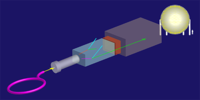
Measurement of a parity-odd asymmetry in the photons emitted from the capture of polarized neutrons on protons provides a first measurement of a weak-interaction term in the nucleon-nucleon potential.

Skyrmions and Clustering in Light Nuclei

Carlos Naya and Paul Sutcliffe

Phys. Rev. Lett. 121, 232002 (2018) - Published 6 December, 2018

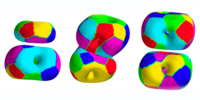
Theorists extend a nearly six-decades-old model for the atomic nucleus and use it to predict shape effects that the traditional model misses.

Significant Excess of Electronlike Events in the MiniBooNE Short-Baseline Neutrino Experiment

A. A. Aguilar-Arevalo et al. (MiniBooNE Collaboration)

Phys. Rev. Lett. 121, 221801 (2018) - Published 26 November, 2018

Confirming previous controversial results, the MiniBooNE experiment detects a signal that is incompatible with neutrino oscillations involving just the three known flavors of neutrinos.

Combination of the Searches for Pair-Produced Vectorlike Partners of the Third-Generation Quarks at s=13  TeV with the ATLAS Detector

M. Aaboud et al. (ATLAS Collaboration)

Phys. Rev. Lett. 121, 211801 (2018) - Published 20 November, 2018

Seven analyses are combined to put the strongest constraints yet on third-generation vectorlike quarks, which arise in models where the Higgs boson is a pseudo-Nambu–Goldstone boson.

Proton Mass Decomposition from the QCD Energy Momentum Tensor

Yi-Bo Yang, Jian Liang, Yu-Jiang Bi, Ying Chen, Terrence Draper, Keh-Fei Liu, and Zhaofeng Liu

Phys. Rev. Lett. 121, 212001 (2018) - Published 19 November, 2018

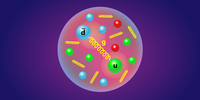
A calculation determines four distinct contributions to the proton mass, more than 90% of which arises entirely from the dynamics of quarks and gluons.

Search for CP Violation in Neutrino and Antineutrino Oscillations by the T2K Experiment with 2.2×10²¹ Protons on Target

K. Abe et al. (T2K Collaboration)

Phys. Rev. Lett. 121, 171802 (2018) - Published 24 October, 2018

More data and improved analysis methods lead to better confidence that neutrinos and antineutrinos behave slightly differently.

First Monte Carlo Global QCD Analysis of Pion Parton Distributions

P. C. Barry, N. Sato, W. Melnitchouk, and Chueng-Ryong Ji (Jefferson Lab Angular Momentum (JAM) Collaboration)

Phys. Rev. Lett. 121, 152001 (2018) - Published 10 October, 2018

Teaser: A combined analysis of collider data finds that the gluon contribution to the pion is three times larger than earlier estimates.

Observation of Higgs Boson Decay to Bottom Quarks

A. M. Sirunyan et al. (CMS Collaboration)

Phys. Rev. Lett. 121, 121801 (2018) - Published 17 September, 2018

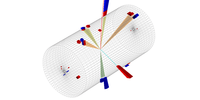
Two CERN experiments have observed the most probable decay channel of the Higgs boson—a milestone in the pursuit to confirm whether this remarkable particle behaves as physicists expect.

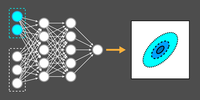
Constraining Effective Field Theories with Machine Learning

Johann Brehmer, Kyle Cranmer, Gilles Louppe, and Juan Pavez

Phys. Rev. Lett. 121, 111801 (2018) - Published 12 September, 2018

A proposed machine-learning approach could speed up the analysis that underlies searches for new particles in high-energy collisions.

Renormalization Group in Field Theories with Quantum Quenched Disorder

Vladimir Narovlansky and Ofer Aharony

Phys. Rev. Lett. 121, 071601 (2018) - Published 15 August, 2018

Renormalization group analysis is applied to uncover several general features of quantum field theories with disorder, including the existence of a new critical exponent.

Observation of an Excited Ω− Baryon

J. Yelton et al. (Belle Collaboration)

Phys. Rev. Lett. 121, 052003 (2018) - Published 2 August, 2018

The observation of an excited Ω− baryon fills a gap in the line-up of triply-strange baryons.

Measurement of the Lifetime of the Doubly Charmed Baryon Ξcc++

R. Aaij et al. (LHCb Collaboration)

Phys. Rev. Lett. 121, 052002 (2018) - Published 31 July, 2018

The LHCb collaboration has measured the lifetime of the Ξcc++ doubly charmed baryon, establishing the weakly decaying nature of this state.

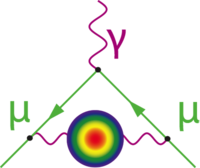
Hadronic Vacuum Polarization Contribution to the Anomalous Magnetic Moments of Leptons from First Principles

Sz. Borsanyi, Z. Fodor, C. Hoelbling, T. Kawanai, S. Krieg, L. Lellouch, R. Malak, K. Miura, K. K. Szabo, C. Torrero, and B. C. Toth (Budapest-Marseille-Wuppertal Collaboration)

Phys. Rev. Lett. 121, 022002 (2018) - Published 12 July, 2018

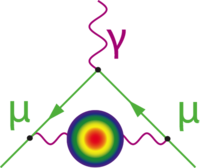
Lattice gauge theory simulations suggest that the disagreement between theoretical and experimental values for the anomalous magnetic moment of the muon might be less than previously thought.

Calculation of the Hadronic Vacuum Polarization Contribution to the Muon Anomalous Magnetic Moment

T. Blum, P. A. Boyle, V. Gülpers, T. Izubuchi, L. Jin, C. Jung, A. Jüttner, C. Lehner, A. Portelli, and J. T. Tsang (RBC and UKQCD Collaborations)

Phys. Rev. Lett. 121, 022003 (2018) - Published 12 July, 2018

Lattice gauge theory simulations suggest that the disagreement between theoretical and experimental values for the anomalous magnetic moment of the muon might be less than previously thought.

Observation of a00(980)−f0(980) Mixing

M. Ablikim et al. (BESIII Collaboration)

Phys. Rev. Lett. 121, 022001 (2018) - Published 11 July, 2018

Observed mixing between two light scalar mesons may help constrain their internal structure.

Jet Topics: Disentangling Quarks and Gluons at Colliders

Eric M. Metodiev and Jesse Thaler

Phys. Rev. Lett. 120, 241602 (2018) - Published 12 June, 2018

Inspired by a text-mining technique, scientists have developed a more direct way to distinguish quark jets from gluon jets in high-energy particle collisions.

Search for a Hypothetical 16.7 MeV Gauge Boson and Dark Photons in the NA64 Experiment at CERN

D. Banerjee et al. (NA64 Collaboration)

Phys. Rev. Lett. 120, 231802 (2018) - Published 8 June, 2018

Data from a search for a hypothetical light boson that couples to electrons rules out about half the parameter space for explanations for an anomaly observed in excited 8Be decays.

Observation of tt¯H Production

A. M. Sirunyan et al. (CMS Collaboration)

Phys. Rev. Lett. 120, 231801 (2018) - Published 4 June, 2018

A proton collision experiment at CERN provides a new handle on the Higgs boson’s interaction with the heaviest of the quarks.

Is Self-Interacting Dark Matter Undergoing Dark Fusion?

Samuel D. McDermott

Phys. Rev. Lett. 120, 221806 (2018) - Published 1 June, 2018

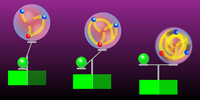
The possibility of self-interacting dark matter undergoing fusion may resolve some of the small-scale structure problems seen in the cold collisionless dark matter paradigm.

Sign In to Your Journals Account

Filter

Section

Filter

Article Lookup

Enter a citation