Highlights

Measurement of CP-Averaged Observables in the B0→K*0μ+μ− Decay

R. Aaij et al. (LHCb Collaboration)

Phys. Rev. Lett. 125, 011802 (2020) - Published 2 July, 2020

The LHCb Collaboration increases the statistical significance of a result relating to the decay rate of B0 mesons that diverges from standard model predictions.

Observation of New Ξc0 Baryons Decaying to Λc+K−

R. Aaij et al. (LHCb Collaboration)

Phys. Rev. Lett. 124, 222001 (2020) - Published 4 June, 2020

The LHCb experiment has discovered at least two new excited states of the Ξc baryon, a finding that could improve understanding of how quarks bind together.

Doing Spin Physics with Unpolarized Particles

Igor P. Ivanov, Nikolai Korchagin, Alexandr Pimikov, and Pengming Zhang

Phys. Rev. Lett. 124, 192001 (2020) - Published 13 May, 2020

Theorists show that collisions between particles with orbital angular momentum could offer a new way to study intrinsic spin properties.

Measurement of R(D) and R(D*) with a Semileptonic Tagging Method

G. Caria et al. (Belle Collaboration)

Phys. Rev. Lett. 124, 161803 (2020) - Published 24 April, 2020

The most precise measurements to date for the ratio of semitauonic to semileptonic B meson decays is in good agreement with Standard Model predictions, in contrast to a number of previous results which showed more than a 3σ discrepancy.

Search for an Invisibly Decaying Z′ Boson at Belle II in e+e−→μ+μ−(e±μ∓) Plus Missing Energy Final States

I. Adachi et al. (Belle II Collaboration)

Phys. Rev. Lett. 124, 141801 (2020) - Published 6 April, 2020

The Belle II experiment finds no Z′ boson in its first results, but it does constrain how strongly the particle might interact with standard model particles.

Hadronic Light-by-Light Scattering Contribution to the Muon Anomalous Magnetic Moment from Lattice QCD

Thomas Blum, Norman Christ, Masashi Hayakawa, Taku Izubuchi, Luchang Jin, Chulwoo Jung, and Christoph Lehner

Phys. Rev. Lett. 124, 132002 (2020) - Published 1 April, 2020

Supercomputer simulations rule out a known quantum effect as the cause of the muon’s unexpectedly strong magnetic moment.

Axiogenesis

Raymond T. Co and Keisuke Harigaya

Phys. Rev. Lett. 124, 111602 (2020) - Published 19 March, 2020

A new theory proposes that a rotation of the axion field early in the Universe’s life could have generated matter-antimatter asymmetry.

Measurement of the Permanent Electric Dipole Moment of the Neutron

C. Abel et al.

Phys. Rev. Lett. 124, 081803 (2020) - Published 28 February, 2020

A new attempt to detect the neutron’s electric dipole moment tightens the constraints on theories of symmetry breaking in the early Universe.

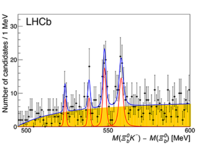
First Observation of Excited Ωb− States

R. Aaij et al. (LHCb Collaboration)

Phys. Rev. Lett. 124, 082002 (2020) - Published 25 February, 2020

Excited Ωb− baryons are seen as narrow peaks in the Ξb0K− mass spectra for the first time.

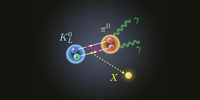
New Physics Implications of Recent Search for KL→π0νν¯ at KOTO

Teppei Kitahara, Takemichi Okui, Gilad Perez, Yotam Soreq, and Kohsaku Tobioka

Phys. Rev. Lett. 124, 071801 (2020) - Published 19 February, 2020

Previously unpredicted particles or a new type of particle interaction could explain the unexpected rare kaon decay events reported by the KOTO experiment in Japan.

Testing the Seesaw Mechanism and Leptogenesis with Gravitational Waves

Jeff A. Dror, Takashi Hiramatsu, Kazunori Kohri, Hitoshi Murayama, and Graham White

Phys. Rev. Lett. 124, 041804 (2020) - Published 28 January, 2020

Upcoming gravitational-wave observatories could find evidence of a new type of neutrino, supporting a popular theory for why matter dominates over antimatter.

Observation of Several Sources of CP Violation in B+→π+π+π− Decays

R. Aaij et al. (LHCb Collaboration)

Phys. Rev. Lett. 124, 031801 (2020) - Published 21 January, 2020

Measurements show large matter-versus-antimatter differences in three-pion decays of B mesons, yielding new insights into the strong interaction dynamics that control these decays.

Light Dark Matter Search with Ionization Signals in XENON1T

E. Aprile et al. (XENON Collaboration)

Phys. Rev. Lett. 123, 251801 (2019) - Published 17 December, 2019

By reanalyzing experimental data from 2017 and 2018, the XENON Collaboration rules out several varieties of low-mass dark matter, including a range of axion-like particles and dark photons.

Improved Upper Limit on the Neutrino Mass from a Direct Kinematic Method by KATRIN

M. Aker et al. (KATRIN Collaboration)

Phys. Rev. Lett. 123, 221802 (2019) - Published 25 November, 2019

The Karlsruhe Tritium Neutrino Experiment (KATRIN) shows that the mass of the neutrino is no larger than about 1 eV—cutting in half the existing limit derived from similar experiments.

Observation of the Leptonic Decay D+→τ+ντ

M. Ablikim et al. (BESIII Collaboration)

Phys. Rev. Lett. 123, 211802 (2019) - Published 22 November, 2019

The first observation of the two-body decay of a charm meson into a tau and its neutrino allow for a new probe of lepton flavor universality.

Superheavy Thermal Dark Matter

Hyungjin Kim and Eric Kuflik

Phys. Rev. Lett. 123, 191801 (2019) - Published 8 November, 2019

A new thermal freezeout mechanism for dark matter produces the correct relic abundance for elementary dark matter having mass up to 1014 GeV, well above a prior unitary bound.

Arrow of Causality and Quantum Gravity

John F. Donoghue and Gabriel Menezes

Phys. Rev. Lett. 123, 171601 (2019) - Published 24 October, 2019

Causality, rather than the arrow of time, may be a more natural discriminant between the past and the future in quantum theories. 

Search for Neutrinoless Double-β Decay with the Complete EXO-200 Dataset

G. Anton et al. (EXO-200 Collaboration)

Phys. Rev. Lett. 123, 161802 (2019) - Published 18 October, 2019

A new lower limit on the neutrinoless double-β decay of 136Xe has been set by the full EXO-200 dataset.

Anomaly of the Electromagnetic Duality of Maxwell Theory

Chang-Tse Hsieh, Yuji Tachikawa, and Kazuya Yonekura

Phys. Rev. Lett. 123, 161601 (2019) - Published 14 October, 2019

The well known electric-magnetic duality of classical electromagnetism is violated upon quantization of the theory in the presence of general background fields.

Tunable Axion Plasma Haloscopes

Matthew Lawson, Alexander J. Millar, Matteo Pancaldi, Edoardo Vitagliano, and Frank Wilczek

Phys. Rev. Lett. 123, 141802 (2019) - Published 1 October, 2019

A proposed device could detect the hypothesized dark matter particle in a mass regime not probed by other devices.

Sign In to Your Journals Account

Filter

Section

Filter

Article Lookup

Enter a citation