Highlights

Measurement of the Positive Muon Anomalous Magnetic Moment to 0.46 ppm

B. Abi et al. (Muon g−2 Collaboration)

Phys. Rev. Lett. 126, 141801 (2021) - Published 7 April, 2021

Measurements of the muon magnetic moment strengthen a previously reported tension with theoretical predictions, ushering in a new era of precision tests of the standard model.

Study of the KL→π0νν¯ Decay at the J-PARC KOTO Experiment

J. K. Ahn et al. (KOTO Collaboration)

Phys. Rev. Lett. 126, 121801 (2021) - Published 24 March, 2021

The KOTO collaboration has now carefully analyzed widely discussed preliminary data containing four signal events for a rare kaon decay—an excess suggesting physics beyond the Standard Model—and found that Standard Model background events are large enough to explain the signal.

Observation of a Near-Threshold Structure in the K+ Recoil-Mass Spectra in e+e−→K+(Ds−D*0+Ds*−D0)

M. Ablikim et al. (BESIII Collaboration)

Phys. Rev. Lett. 126, 102001 (2021) - Published 11 March, 2021

The detection of a new particle containing both charm and strange quarks could offer new insights into how hadrons form.

Measurement of CP Violation in the Decay B+→K+π0

R. Aaij et al. (LHCb Collaboration)

Phys. Rev. Lett. 126, 091802 (2021) - Published 2 March, 2021

A measurement of the CP-violating asymmetry in a charged B meson Kπ decay disagrees with that of a neutral B meson Kπ decay, though they should be equal by isospin symmetry.

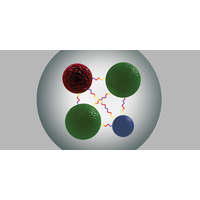
Energy-Dependent π+π+π+ Scattering Amplitude from QCD

Maxwell T. Hansen, Raul A. Briceño, Robert G. Edwards, Christopher E. Thomas, and David J. Wilson (for the Hadron Spectrum Collaboration)

Phys. Rev. Lett. 126, 012001 (2021) - Published 5 January, 2021

A three-hadron scattering amplitude is computed using lattice QCD for the first time.

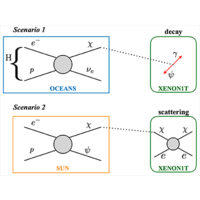
Hydrogen Portal to Exotic Radioactivity

David McKeen, Maxim Pospelov, and Nirmal Raj

Phys. Rev. Lett. 125, 231803 (2020) - Published 1 December, 2020

Exotic hypothetical decays of hydrogen to dark matter could be responsible for the XENON1T excess.

Measuring Changes in the Atmospheric Neutrino Rate over Gigayear Timescales

Johnathon R. Jordan, Sebastian Baum, Patrick Stengel, Alfredo Ferrari, Maria Cristina Morone, Paola Sala, and Joshua Spitz

Phys. Rev. Lett. 125, 231802 (2020) - Published 30 November, 2020

A proposed technique to study our Galaxy’s cosmic-ray history involves observing the damage created by neutrinos within deeply buried rocks.

Automatic Fine-Tuning in the Two-Flavor Schwinger Model

Howard Georgi

Phys. Rev. Lett. 125, 181601 (2020) - Published 26 October, 2020

A theoretical model illustrates that phenomena that might appear to be the result of ad hoc fine tuning at low energies may have a natural explanation in terms of physical principles that apply only at higher energy scales.

SENSEI: Direct-Detection Results on sub-GeV Dark Matter from a New Skipper CCD

Liron Barak, Itay M. Bloch, Mariano Cababie, Gustavo Cancelo, Luke Chaplinsky, Fernando Chierchie, Michael Crisler, Alex Drlica-Wagner, Rouven Essig, Juan Estrada, Erez Etzion, Guillermo Fernandez Moroni, Daniel Gift, Sravan Munagavalasa, Aviv Orly, Dario Rodrigues, Aman Singal, Miguel Sofo Haro, Leandro Stefanazzi, Javier Tiffenberg, Sho Uemura, Tomer Volansky, and Tien-Tien Yu (SENSEI Collaboration)

Phys. Rev. Lett. 125, 171802 (2020) - Published 20 October, 2020

A new sensor provides world-leading sensitivity for distinguishing lightweight dark matter from background noise.

XENON1T Excess from Anomaly-Free Axionlike Dark Matter and Its Implications for Stellar Cooling Anomaly

Fuminobu Takahashi, Masaki Yamada, and Wen Yin

Phys. Rev. Lett. 125, 161801 (2020) - Published 12 October, 2020

A tantalizing signal reported by the XENON1T dark matter experiment has sparked theorists to investigate explanations involving new physics.

Neutrino Self-Interactions and XENON1T Electron Recoil Excess

Andreas Bally, Sudip Jana, and Andreas Trautner

Phys. Rev. Lett. 125, 161802 (2020) - Published 12 October, 2020

A tantalizing signal reported by the XENON1T dark matter experiment has sparked theorists to investigate explanations involving new physics.

Explaining the XENON1T Excess with Luminous Dark Matter

Nicole F. Bell, James B. Dent, Bhaskar Dutta, Sumit Ghosh, Jason Kumar, and Jayden L. Newstead

Phys. Rev. Lett. 125, 161803 (2020) - Published 12 October, 2020

A tantalizing signal reported by the XENON1T dark matter experiment has sparked theorists to investigate explanations involving new physics.

Boosted Dark Matter Interpretation of the XENON1T Excess

Bartosz Fornal, Pearl Sandick, Jing Shu, Meng Su, and Yue Zhao

Phys. Rev. Lett. 125, 161804 (2020) - Published 12 October, 2020

A tantalizing signal reported by the XENON1T dark matter experiment has sparked theorists to investigate explanations involving new physics.

Electric But Not Eclectic: Thermal Relic Dark Matter for the XENON1T Excess

Joseph Bramante and Ningqiang Song

Phys. Rev. Lett. 125, 161805 (2020) - Published 12 October, 2020

A tantalizing signal reported by the XENON1T dark matter experiment has sparked theorists to investigate explanations involving new physics.

Observation of the Production of Three Massive Gauge Bosons at s=13  TeV

A. M. Sirunyan et al. (CMS Collaboration)

Phys. Rev. Lett. 125, 151802 (2020) - Published 5 October, 2020

The CMS Collaboration confirms that certain particle-smashing events produce three massive bosons.

eV-Scale Sterile Neutrino Search Using Eight Years of Atmospheric Muon Neutrino Data from the IceCube Neutrino Observatory

M. G. Aartsen et al. (IceCube Collaboration)

Phys. Rev. Lett. 125, 141801 (2020) - Published 30 September, 2020

An analysis of more than 300,000 muon neutrino detections provides no evidence of sterile neutrinos—a finding at odds with other experiments.

Solar Axions Cannot Explain the XENON1T Excess

Luca Di Luzio, Marco Fedele, Maurizio Giannotti, Federico Mescia, and Enrico Nardi

Phys. Rev. Lett. 125, 131804 (2020) - Published 24 September, 2020

Solar-axion explanations for the excess of electron recoil events reported by the XENON1T experiment are in severe tension with astrophysical data.

First Precision Measurement of the Parity Violating Asymmetry in Cold Neutron Capture on He3

M. T. Gericke et al. (nHe3 Collaboration)

Phys. Rev. Lett. 125, 131803 (2020) - Published 23 September, 2020

A new measurement from the n3He Collaboration advances understanding of parity violation in few-nucleon systems.

Improved Constraints on Sterile Neutrino Mixing from Disappearance Searches in the MINOS, MINOS+, Daya Bay, and Bugey-3 Experiments

P. Adamson et al. (Daya Bay Collaboration, MINOS+ Collaboration)

Phys. Rev. Lett. 125, 071801 (2020) - Published 10 August, 2020

Neutrino experiments place the most stringent limits to date on a hypothetical fourth neutrino, but the possibility that such a particle exists remains open.

Search for Heavy Higgs Bosons Decaying into Two Tau Leptons with the ATLAS Detector Using pp Collisions at s=13  TeV

G. Aad et al. (ATLAS Collaboration)

Phys. Rev. Lett. 125, 051801 (2020) - Published 27 July, 2020

A search for heavy neutral Higgs bosons at the LHC agrees with the Standard Model and results in a significant reduction in parameter space for two-Higgs-doublet models.

Sign In to Your Journals Account

Filter

Section

Filter

Article Lookup

Enter a citation