Highlights

Spectroscopy along Flerovium Decay Chains: Discovery of Ds280 and an Excited State in Cn282

A. Såmark-Roth et al.

Phys. Rev. Lett. 126, 032503 (2021) - Published 22 January, 2021

The discovery that copernicium can decay into a new isotope of darmstadtium and the observation of a previously unseen excited state of copernicium provide clues to the location of the “island of stability.”

Ab Initio Limits of Atomic Nuclei

S. R. Stroberg, J. D. Holt, A. Schwenk, and J. Simonis

Phys. Rev. Lett. 126, 022501 (2021) - Published 12 January, 2021

First-principles calculations predict the properties of nearly 700 isotopes between helium and iron, showing which nuclides can exist and which cannot.

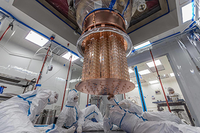
Final Results of GERDA on the Search for Neutrinoless Double-β Decay

M. Agostini et al. (GERDA Collaboration)

Phys. Rev. Lett. 125, 252502 (2020) - Published 17 December, 2020

The GERDA hunt for neutrinoless double-beta decay comes to an end with no evidence that neutrinos are their own antiparticle.

Measurement of the Th229 Isomer Energy with a Magnetic Microcalorimeter

Tomas Sikorsky, Jeschua Geist, Daniel Hengstler, Sebastian Kempf, Loredana Gastaldo, Christian Enss, Christoph Mokry, Jörg Runke, Christoph E. Düllmann, Peter Wobrauschek, Kjeld Beeks, Veronika Rosecker, Johannes H. Sterba, Georgy Kazakov, Thorsten Schumm, and Andreas Fleischmann

Phys. Rev. Lett. 125, 142503 (2020) - Published 28 September, 2020

The high-precision measurement of a nuclear transition of a thorium isotope is a key step towards the development of a nuclear optical clock.

Evidence of Spin-Orbital Angular Momentum Interactions in Relativistic Heavy-Ion Collisions

S. Acharya et al. (The ALICE Collaboration)

Phys. Rev. Lett. 125, 012301 (2020) - Published 30 June, 2020

The measured spin alignment of vector mesons in heavy-ion collisions is consistent with that expected from the spin-orbit coupling of quarks with the large angular momentum of the collision.

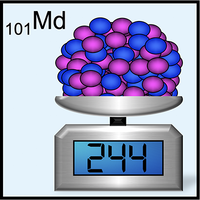
Identification of the New Isotope Md244

J. L. Pore, J. M. Gates, R. Orford, C. M. Campbell, R. M. Clark, H. L. Crawford, N. E. Esker, P. Fallon, J. A. Gooding, J. T. Kwarsick, A. O. Macchiavelli, C. Morse, D. Rudolph, A. Såmark-Roth, C. Santamaria, R. S. Shah, and M. A. Stoyer

Phys. Rev. Lett. 124, 252502 (2020) - Published 23 June, 2020

A new isotope of an element with Z=101, mendelevium has been identified. Because it is very neutron deficient, it is difficult to produce.

Halo Structure of the Neutron-Dripline Nucleus B19

K. J. Cook et al.

Phys. Rev. Lett. 124, 212503 (2020) - Published 27 May, 2020

Coulomb dissociation experiments demonstrate that the heaviest bound isotope of boron, 19B, has a prominent two-neutron halo.

Probing Few-Body Nuclear Dynamics via H3 and He3 (e,e′p)pn Cross-Section Measurements

R. Cruz-Torres et al. (Jefferson Lab Hall A Tritium Collaboration)

Phys. Rev. Lett. 124, 212501 (2020) - Published 26 May, 2020

High-energy electron scattering on Helium-3 and Tritium serve as a crucial benchmark for few-body nuclear theory.

Taming Nuclear Complexity with a Committee of Multilayer Neural Networks

Raphaël-David Lasseri, David Regnier, Jean-Paul Ebran, and Antonin Penon

Phys. Rev. Lett. 124, 162502 (2020) - Published 20 April, 2020

A committee of deep neural networks can predict the ground- and excited-state energies of more than 1800 nuclei with an accuracy akin to state-of-the-art nuclear energy density functionals.

Improved Limit on Neutrinoless Double-Beta Decay in  Te130 with CUORE

D. Q. Adams et al. (CUORE Collaboration)

Phys. Rev. Lett. 124, 122501 (2020) - Published 26 March, 2020

New limits have been set on the neutrinoless double beta decay in 130Te from two years of data from the CUORE experiment.

Longitudinal Wobbling Motion in Au187

N. Sensharma, U. Garg, Q. B. Chen, S. Frauendorf, D. P. Burdette, J. L. Cozzi, K. B. Howard, S. Zhu, M. P. Carpenter, P. Copp, F. G. Kondev, T. Lauritsen, J. Li, D. Seweryniak, J. Wu, A. D. Ayangeakaa, D. J. Hartley, R. V. F. Janssens, A. M. Forney, W. B. Walters, S. S. Ghugre, and R. Palit

Phys. Rev. Lett. 124, 052501 (2020) - Published 5 February, 2020

A rare kind of nuclear spinning motion has been detected in an isotope of gold.

Coexistence of Reflection Asymmetric and Symmetric Shapes in Ba144

S. J. Zhu (朱胜江), E. H. Wang, J. H. Hamilton, A. V. Ramayya, Y. X. Liu (刘艳鑫), N. T. Brewer, Y. X. Luo, J. O. Rasmussen, Z. G. Xiao (肖志刚), Y. Huang (黄彦), G. M. Ter-Akopian, and Ts. Oganessian

Phys. Rev. Lett. 124, 032501 (2020) - Published 24 January, 2020

γ-ray spectroscopy of high-spin states in the neutron-rich 144Ba nucleus finds the first indication of shape coexistence between octupole and well-deformed prolate shapes.

Discovery of an Exceptionally Strong β-Decay Transition of F20 and Implications for the Fate of Intermediate-Mass Stars

O. S. Kirsebom, S. Jones, D. F. Strömberg, G. Martínez-Pinedo, K. Langanke, F. K. Röpke, B. A. Brown, T. Eronen, H. O. U. Fynbo, M. Hukkanen, A. Idini, A. Jokinen, A. Kankainen, J. Kostensalo, I. Moore, H. Möller, S. T. Ohlmann, H. Penttilä, K. Riisager, S. Rinta-Antila, P. C. Srivastava, J. Suhonen, W. H. Trzaska, and J. Äystö

Phys. Rev. Lett. 123, 262701 (2019) - Published 24 December, 2019

The discovery of an exceptionally strong “forbidden” beta decay involving fluorine and neon could change our understanding of the fate of intermediate-mass stars.

Energy of the Th229 Nuclear Clock Isomer Determined by Absolute γ-ray Energy Difference

A. Yamaguchi, H. Muramatsu, T. Hayashi, N. Yuasa, K. Nakamura, M. Takimoto, H. Haba, K. Konashi, M. Watanabe, H. Kikunaga, K. Maehata, N. Y. Yamasaki, and K. Mitsuda

Phys. Rev. Lett. 123, 222501 (2019) - Published 26 November, 2019

A new technique to measure the first isomeric state in 229Th confirms that this isomer is in the laser-accessible vacuum ultraviolet range, and is therefore a candidate for driving a nuclear optical clock.

Underlying Structure of Collective Bands and Self-Organization in Quantum Systems

T. Otsuka, Y. Tsunoda, T. Abe, N. Shimizu, and P. Van Duppen

Phys. Rev. Lett. 123, 222502 (2019) - Published 25 November, 2019

Shell model calculations reveal that collectivity in heavy nuclei could be facilitated by quantum-mechanical self-organization.

Location of the Neutron Dripline at Fluorine and Neon

D. S. Ahn, N. Fukuda, H. Geissel, N. Inabe, N. Iwasa, T. Kubo, K. Kusaka, D. J. Morrissey, D. Murai, T. Nakamura, M. Ohtake, H. Otsu, H. Sato, B. M. Sherrill, Y. Shimizu, H. Suzuki, H. Takeda, O. B. Tarasov, H. Ueno, Y. Yanagisawa, and K. Yoshida

Phys. Rev. Lett. 123, 212501 (2019) - Published 18 November, 2019

Researchers have identified the largest possible isotopes of fluorine and neon, extending the neutron “dripline” for the first time in 20 years.

Multiple Shape Coexistence in Cd110,112

P. E. Garrett et al.

Phys. Rev. Lett. 123, 142502 (2019) - Published 3 October, 2019

Cadmium nuclei take on multiple shapes at low excitation energies, a discovery that overturns a long-accepted tenet of nuclear structure.

Direct Observation of Proton Emission in Be11

Y. Ayyad et al.

Phys. Rev. Lett. 123, 082501 (2019) - Published 22 August, 2019

The elusive beta-delayed proton emission of the neutron-rich halo nucleus 11Be has been observed for the first time.

Interstellar Fe60 in Antarctica

Dominik Koll, Gunther Korschinek, Thomas Faestermann, J. M. Gómez-Guzmán, Sepp Kipfstuhl, Silke Merchel, and Jan M. Welch

Phys. Rev. Lett. 123, 072701 (2019) - Published 12 August, 2019

Iron-60 found in fresh Antarctic snow was forged in nearby supernovae and could help deduce the structure and origin of interstellar dust clouds.

Measurement of the Weak Axial-Vector Coupling Constant in the Decay of Free Neutrons Using a Pulsed Cold Neutron Beam

B. Märkisch, H. Mest, H. Saul, X. Wang, H. Abele, D. Dubbers, M. Klopf, A. Petoukhov, C. Roick, T. Soldner, and D. Werder

Phys. Rev. Lett. 122, 242501 (2019) - Published 21 June, 2019

The most precise measurement of the axial-vector coupling constant has been made using a pulsed neutron beam.

Sign In to Your Journals Account

Filter

Section

Filter

Article Lookup

Enter a citation