Highlights

Laser Spectroscopy of Neutron-Rich Tin Isotopes: A Discontinuity in Charge Radii across the N=82 Shell Closure

C. Gorges et al.

Phys. Rev. Lett. 122, 192502 (2019) - Published 16 May, 2019

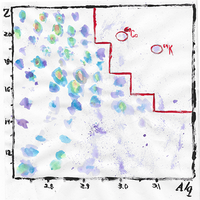
The observation that tin nuclei suddenly increase in size when the number of neutrons they contain reaches a “magic” number helps test models of nucleon interactions.

New Isotope Np220: Probing the Robustness of the N=126 Shell Closure in Neptunium

Z. Y. Zhang (张志远), Z. G. Gan (甘再国), H. B. Yang (杨华彬), L. Ma (马龙), M. H. Huang (黄明辉), C. L. Yang (杨春莉), M. M. Zhang (张明明), Y. L. Tian (田玉林), Y. S. Wang (王永生), M. D. Sun (孙明道), H. Y. Lu (卢洪洋), W. Q. Zhang (张文强), H. B. Zhou (周厚兵), X. Wang (王翔), C. G. Wu (武晨光), L. M. Duan (段利敏), W. X. Huang (黄文学), Z. Liu (刘忠), Z. Z. Ren (任中洲), S. G. Zhou (周善贵), X. H. Zhou (周小红), H. S. Xu (徐瑚珊), Yu. S. Tsyganov, A. A. Voinov, and A. N. Polyakov

Phys. Rev. Lett. 122, 192503 (2019) - Published 16 May, 2019

A newly discovered isotope of neptunium tests the stability of the N=126 shell closure.

Baryon-Number Violation by Two Units and the Deuteron Lifetime

F. Oosterhof, B. Long, J. de Vries, R. G. E. Timmermans, and U. van Kolck

Phys. Rev. Lett. 122, 172501 (2019) - Published 29 April, 2019

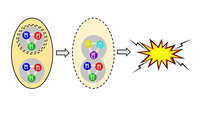
An otherwise stable deuteron decays due to a neutron-to-antineutron transition that violates baryon number by two units, and results in antineutron-proton annihilation.

Matching the Nonequilibrium Initial Stage of Heavy Ion Collisions to Hydrodynamics with QCD Kinetic Theory

Aleksi Kurkela, Aleksas Mazeliauskas, Jean-François Paquet, Sören Schlichting, and Derek Teaney

Phys. Rev. Lett. 122, 122302 (2019) - Published 27 March, 2019

The application of non-equilibrium linear response theory to early pre-equilibrium dynamics of high-energy heavy-ion collisions establishes new constraints for the formation of a hydrodynamic Quark Gluon Plasma in small systems.

First Spectroscopy of the Near Drip-line Nucleus Mg40

H. L. Crawford et al.

Phys. Rev. Lett. 122, 052501 (2019) - Published 7 February, 2019

The low-lying excited states of 40Mg have been studied for the first time following a one-proton removal reaction from 41Al.

First Direct Measurements of Superheavy-Element Mass Numbers

J. M. Gates, G. K. Pang, J. L. Pore, K. E. Gregorich, J. T. Kwarsick, G. Savard, N. E. Esker, M. Kireeff Covo, M. J. Mogannam, J. C. Batchelder, D. L. Bleuel, R. M. Clark, H. L. Crawford, P. Fallon, K. K. Hubbard, A. M. Hurst, I. T. Kolaja, A. O. Macchiavelli, C. Morse, R. Orford, L. Phair, and M. A. Stoyer

Phys. Rev. Lett. 121, 222501 (2018) - Published 28 November, 2018

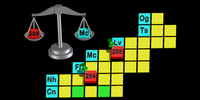
A new measurement technique directly determines the masses of two superheavy isotopes, providing confirmation that previous indirect measurements were correct.

Superallowed α Decay to Doubly Magic Sn100

K. Auranen, D. Seweryniak, M. Albers, A. D. Ayangeakaa, S. Bottoni, M. P. Carpenter, C. J. Chiara, P. Copp, H. M. David, D. T. Doherty, J. Harker, C. R. Hoffman, R. V. F. Janssens, T. L. Khoo, S. A. Kuvin, T. Lauritsen, G. Lotay, A. M. Rogers, J. Sethi, C. Scholey, R. Talwar, W. B. Walters, P. J. Woods, and S. Zhu

Phys. Rev. Lett. 121, 182501 (2018) - Published 30 October, 2018

The detection of unusually fast alpha emission from a heavy isotope could lead to new ways of testing the nuclear shell model.

Eigenvector Continuation with Subspace Learning

Dillon Frame, Rongzheng He, Ilse Ipsen, Daniel Lee, Dean Lee, and Ermal Rrapaj

Phys. Rev. Lett. 121, 032501 (2018) - Published 17 July, 2018

A new computational method tackles many-body quantum calculations that have defied a suite of existing approaches.

Discovery of Ca60 and Implications For the Stability of Ca70

O. B. Tarasov et al.

Phys. Rev. Lett. 121, 022501 (2018) - Published 11 July, 2018

Eight newly discovered neutron-rich nuclei act as key discriminators between different mass models.

Probing Sizes and Shapes of Nobelium Isotopes by Laser Spectroscopy

S. Raeder et al.

Phys. Rev. Lett. 120, 232503 (2018) - Published 8 June, 2018

A laser-based technique provides the most precise measurements to date of nuclear properties for an element above atomic number 100.

First Result on the Neutrinoless Double-β Decay of Se82 with CUPID-0

O. Azzolini et al.

Phys. Rev. Lett. 120, 232502 (2018) - Published 5 June, 2018

The CUPID-0 experiment improves the half-life limit of the 82Se neutrinoless double beta decay by almost an order of magnitude.

Rapid Neutrino Cooling in the Neutron Star MXB 1659-29

Edward F. Brown, Andrew Cumming, Farrukh J. Fattoyev, C. J. Horowitz, Dany Page, and Sanjay Reddy

Phys. Rev. Lett. 120, 182701 (2018) - Published 30 April, 2018

Astrophysicists have found the first direct evidence for the fastest neutrino-emission mechanism by which neutron stars can cool.

Neutron Skins and Neutron Stars in the Multimessenger Era

F. J. Fattoyev, J. Piekarewicz, and C. J. Horowitz

Phys. Rev. Lett. 120, 172702 (2018) - Published 25 April, 2018

Analyses of the gravitational waves from the neutron star merger observed by LIGO and Virgo improve models describing the dense nuclear matter inside a neutron star.

Gravitational-Wave Constraints on the Neutron-Star-Matter Equation of State

Eemeli Annala, Tyler Gorda, Aleksi Kurkela, and Aleksi Vuorinen

Phys. Rev. Lett. 120, 172703 (2018) - Published 25 April, 2018

Analyses of the gravitational waves from the neutron star merger observed by LIGO and Virgo improve models describing the dense nuclear matter inside a neutron star.

Structure of the Lightest Tin Isotopes

T. D. Morris, J. Simonis, S. R. Stroberg, C. Stumpf, G. Hagen, J. D. Holt, G. R. Jansen, T. Papenbrock, R. Roth, and A. Schwenk

Phys. Rev. Lett. 120, 152503 (2018) - Published 12 April, 2018

Ab-inito calculations of 100Sn with N = Z = 50 predict it to be doubly magic.

Strong Neutron Pairing in core+4n Nuclei

A. Revel et al. (R3B Collaboration)

Phys. Rev. Lett. 120, 152504 (2018) - Published 12 April, 2018

The largest neutron-neutron correlation strength is measured in the valence neutrons of 18C.

Measurement of the Splitting Function in pp and Pb-Pb Collisions at sNN=5.02  TeV

A. M. Sirunyan et al. (CMS Collaboration)

Phys. Rev. Lett. 120, 142302 (2018) - Published 3 April, 2018

The structure of jets emerging from high-energy collisions of lead ions may provide a new way to study the quark-gluon plasma created in those same collisions.

Demonstration of a Sensitive Method to Measure Nuclear-Spin-Dependent Parity Violation

Emine Altuntaş, Jeffrey Ammon, Sidney B. Cahn, and David DeMille

Phys. Rev. Lett. 120, 142501 (2018) - Published 2 April, 2018

A method for measuring nuclear spin dependent parity violation that uses diatomic molecules shows an unprecedented sensitivity to parity violation in nuclei with a nonzero spin.

First Results from CUORE: A Search for Lepton Number Violation via 0νββ Decay of Te130

C. Alduino et al. (CUORE Collaboration)

Phys. Rev. Lett. 120, 132501 (2018) - Published 26 March, 2018

Four experiments have demonstrated new levels of sensitivity to neutrinoless double-beta decay, a process whose existence would prove that neutrinos are their own antiparticles.

Search for Neutrinoless Double-β Decay in Ge76 with the Majorana Demonstrator

C. E. Aalseth et al. (Majorana Collaboration)

Phys. Rev. Lett. 120, 132502 (2018) - Published 26 March, 2018

Four experiments have demonstrated new levels of sensitivity to neutrinoless double-beta decay, a process whose existence would prove that neutrinos are their own antiparticles.

Sign In to Your Journals Account

Filter

Section

Filter

Article Lookup

Enter a citation