Highlights

Improved Limit on Neutrinoless Double-β Decay of Ge76 from GERDA Phase II

M. Agostini et al. (GERDA Collaboration)

Phys. Rev. Lett. 120, 132503 (2018) - Published 26 March, 2018

Four experiments have demonstrated new levels of sensitivity to neutrinoless double-beta decay, a process whose existence would prove that neutrinos are their own antiparticles.

Demonstration of Single-Barium-Ion Sensitivity for Neutrinoless Double-Beta Decay Using Single-Molecule Fluorescence Imaging

A. D. McDonald et al. (NEXT Collaboration)

Phys. Rev. Lett. 120, 132504 (2018) - Published 26 March, 2018

A device that can detect individual barium ions could be the heart of an experiment that takes the next step toward probing the nature of the neutrino.

Decay Rate of the Nuclear Isomer Th229(3/2+,7.8  eV) in a Dielectric Sphere, Thin Film, and Metal Cavity

E. V. Tkalya

Phys. Rev. Lett. 120, 122501 (2018) - Published 21 March, 2018

The rate of a nuclear transition of thorium-229 can be controlled by placing the atom in a cavity or in a thin film—an effect that could lead to ultraprecise nuclear clocks.

Search for Neutrinoless Double-Beta Decay with the Upgraded EXO-200 Detector

J. B. Albert et al. (EXO-200 Collaboration)

Phys. Rev. Lett. 120, 072701 (2018) - Published 15 February, 2018

Four experiments have demonstrated new levels of sensitivity to neutrinoless double-beta decay, a process whose existence would prove that neutrinos are their own antiparticles.

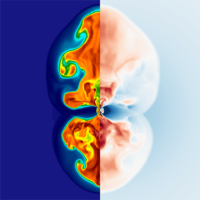
Muon Creation in Supernova Matter Facilitates Neutrino-Driven Explosions

R. Bollig, H.-T. Janka, A. Lohs, G. Martínez-Pinedo, C. J. Horowitz, and T. Melson

Phys. Rev. Lett. 119, 242702 (2017) - Published 15 December, 2017

Higher neutrino emission is found from core-collapse supernova when muons are included in numerical simulations.

Persistence of the Z=28 Shell Gap Around Ni78: First Spectroscopy of Cu79

L. Olivier et al.

Phys. Rev. Lett. 119, 192501 (2017) - Published 6 November, 2017

Two independent experiments on the isotope copper-79 confirm that its nuclear neighbor nickel-78 is indeed a doubly magic nucleus.

Binding Energy of Cu79: Probing the Structure of the Doubly Magic Ni78 from Only One Proton Away

A. Welker, N. A. S. Althubiti, D. Atanasov, K. Blaum, T. E. Cocolios, F. Herfurth, S. Kreim, D. Lunney, V. Manea, M. Mougeot, D. Neidherr, F. Nowacki, A. Poves, M. Rosenbusch, L. Schweikhard, F. Wienholtz, R. N. Wolf, and K. Zuber

Phys. Rev. Lett. 119, 192502 (2017) - Published 6 November, 2017

Two independent experiments on the isotope copper-79 confirm that its nuclear neighbor nickel-78 is indeed a doubly magic nucleus.

High-Precision Probe of the Fully Sequential Decay Width of the Hoyle State in C12

D. Dell’Aquila et al.

Phys. Rev. Lett. 119, 132501 (2017) - Published 25 September, 2017

Two experiments provide the most precise picture to date of how an excited state of carbon decays into three helium nuclei.

New Measurement of the Direct 3α Decay from the C12 Hoyle State

R. Smith, Tz. Kokalova, C. Wheldon, J. E. Bishop, M. Freer, N. Curtis, and D. J. Parker

Phys. Rev. Lett. 119, 132502 (2017) - Published 25 September, 2017

Two experiments provide the most precise picture to date of how an excited state of carbon decays into three helium nuclei.

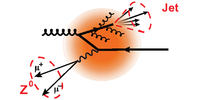
Study of Jet Quenching with Z+jet Correlations in Pb-Pb and pp Collisions at sNN=5.02  TeV

A. M. Sirunyan et al. (CMS Collaboration)

Phys. Rev. Lett. 119, 082301 (2017) - Published 23 August, 2017

Properties of the quark-gluon plasma can be inferred from measurements of jets and Z bosons simultaneously produced in the ion collisions that create the plasma.

Dijet imbalance measurements in Au+Au and pp collisions at sNN=200  GeV at STAR

L. Adamczyk et al. (STAR Collaboration)

Phys. Rev. Lett. 119, 062301 (2017) - Published 10 August, 2017

Analysis of the energy imbalance of dijet pairs in Au-Au collisions at RHIC shows how jets lose energy as they propagate through a quark-gluon plasma.

Nuclear Force Imprints Revealed on the Elastic Scattering of Protons with C10

A. Kumar et al.

Phys. Rev. Lett. 118, 262502 (2017) - Published 28 June, 2017

The scattering of protons from a carbon isotope can be used to test models of the strong force.

Nuclear Physics Around the Unitarity Limit

Sebastian König, Harald W. Grießhammer, H.-W. Hammer, and U. van Kolck

Phys. Rev. Lett. 118, 202501 (2017) - Published 15 May, 2017

Many features of three- and four-nucleon nuclei are well explained by a perturbative expansion around the unitarity limit. It is conjectured that this approach could work for heavier nuclei as well.

Multifaceted Quadruplet of Low-Lying Spin-Zero States in Ni66: Emergence of Shape Isomerism in Light Nuclei

S. Leoni et al.

Phys. Rev. Lett. 118, 162502 (2017) - Published 20 April, 2017

Shape isomers are measured in 66Ni, the lightest nuclei to date in which this behavior has been observed.

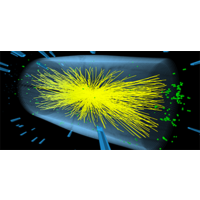
Observation of Charge-Dependent Azimuthal Correlations in p−Pb Collisions and Its Implication for the Search for the Chiral Magnetic Effect

V. Khachatryan et al. (CMS Collaboration)

Phys. Rev. Lett. 118, 122301 (2017) - Published 24 March, 2017

The CMS collaboration observes correlations between same and oppositely charged particles in proton-lead and lead-lead collisions. This challenges the chiral magnetic effect interpretation for charge-dependent azimuthal correlations, and indicates a common underlying mechanism for these correlations.

Characterizing Neutron-Proton Equilibration in Nuclear Reactions with Subzeptosecond Resolution

A. Jedele, A. B. McIntosh, K. Hagel, M. Huang, L. Heilborn, Z. Kohley, L. W. May, E. McCleskey, M. Youngs, A. Zarrella, and S. J. Yennello

Phys. Rev. Lett. 118, 062501 (2017) - Published 10 February, 2017

The equilibration of nuclei containing a large imbalance of protons and neutrons can occur in 3×10-22 seconds, according to experiments—important information for models of element-creation in supernovae.

Lifetime Measurement of the Th229 Nuclear Isomer

Benedict Seiferle, Lars von der Wense, and Peter G. Thirolf

Phys. Rev. Lett. 118, 042501 (2017) - Published 26 January, 2017

The half-life of 229Th nuclear isomer has been measured to be 7±1μs.

Are There Signatures of Harmonic Oscillator Shells Far from Stability? First Spectroscopy of Zr110

N. Paul et al.

Phys. Rev. Lett. 118, 032501 (2017) - Published 18 January, 2017

Spectroscopy measurements of two nominally magic-number isotopes that lie near the neutron dripline show that neither isotope exhibits the states expected for a magic nucleus, challenging existing nuclear shell models.

Universal Off-Equilibrium Scaling of Critical Cumulants in the QCD Phase Diagram

Swagato Mukherjee, Raju Venugopalan, and Yi Yin

Phys. Rev. Lett. 117, 222301 (2016) - Published 23 November, 2016

Observables sensitive to critical dynamics in heavy-ion collisions should be expressible as universal scaling functions according to new theoretical calculations.

Correlated Event-by-Event Fluctuations of Flow Harmonics in Pb-Pb Collisions at sNN=2.76  TeV

J. Adam et al. (ALICE Collaboration)

Phys. Rev. Lett. 117, 182301 (2016) - Published 28 October, 2016

A new measurement of correlations between event-by-event fluctuations of two different flow harmonics better constrains the medium properties of the quark-gluon plasma.

Sign In to Your Journals Account

Filter

Section

Filter

Article Lookup

Enter a citation