Highlights

Observation of tt¯ Production in Pb+Pb Collisions at sNN=5.02  TeV with the ATLAS Detector

G. Aad et al. (ATLAS Collaboration)

Phys. Rev. Lett. 134, 142301 (2025) - Published 7 April, 2025

Top quarks and antiquarks have been detected in heavy-ion collisions at the Large Hadron Collider, showing that all six quark flavors were present in the Universe’s first moments.

Discovery of the Origin of the Enormous Zr88 Neutron-Capture Cross Section and Quantifying Its Impact on Applications

Athanasios Stamatopoulos, Paul E. Koehler, Brad DiGiovine, Veronika Mocko, Artem Matyskin, Christiaan Vermeulen, Aaron Couture, Andrew Cooper, Jonathan Morrell, and Ellen O’Brien

Phys. Rev. Lett. 134, 112702 (2025) - Published 18 March, 2025

Measuring how efficiently an isotope captures neutrons of various energies both confirms and refutes some surprising recent results.

First Measurement of a Weak r-Process Reaction on a Radioactive Nucleus

M. Williams et al.

Phys. Rev. Lett. 134, 112701 (2025) - Published 17 March, 2025

The first measurement of a weak r-process reaction on a radioactive nucleus was made possible by novel solid helium targets.

Improved Limit on Neutrinoless Double Beta Decay of Mo100 from AMoRE-I

A. Agrawal et al. (AMoRE Collaboration)

Phys. Rev. Lett. 134, 082501 (2025) - Published 27 February, 2025

Observations of molybdenum nuclei have revealed no signs of a speculative nuclear decay called neutrinoless double-beta decay, setting a strong constraint on this process.

Stepping into the Sea of Instability: The New Sub-μs Superheavy Nucleus Rf252

J. Khuyagbaatar, P. Mosat, J. Ballof, R. A. Cantemir, Ch. E. Düllmann, K. Hermainski, F. P. Heßberger, E. Jäger, B. Kindler, J. Krier, N. Kurz, S. Löchner, B. Lommel, B. Schausten, Y. Wei, P. Wieczorek, and A. Yakushev

Phys. Rev. Lett. 134, 022501 (2025) - Published 14 January, 2025

The discovery of an isotope, rutherfordium-252, whose ground state forestalls fission for just 60 nanoseconds, could help theorists understand the cosmic synthesis of superheavy elements.

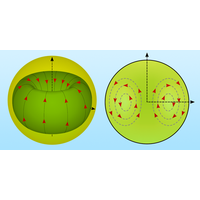
Candidate Toroidal Electric Dipole Mode in the Spherical Nucleus Ni58

P. von Neumann-Cosel, V. O. Nesterenko, I. Brandherm, P. I. Vishnevskiy, P.-G. Reinhard, J. Kvasil, H. Matsubara, A. Repko, A. Richter, M. Scheck, and A. Tamii

Phys. Rev. Lett. 133, 232502 (2024) - Published 4 December, 2024

Nuclear scattering data suggest the possible observation of a predicted but never-observed nuclear vibration.

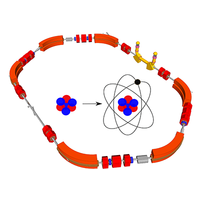
Bound-State Beta Decay of Tl20581+ Ions and the LOREX Project

R. S. Sidhu et al. (E121 Collaboration and LOREX Collaboration)

Phys. Rev. Lett. 133, 232701 (2024) - Published 2 December, 2024

A measurement of the half-life of the bound-state beta decay of fully ionized thallium-205 ions results in a lower solar neutrino capture cross section than previously anticipated.

Toward the Discovery of New Elements: Production of Livermorium (Z=116) with Ti50

J. M. Gates et al.

Phys. Rev. Lett. 133, 172502 (2024) - Published 21 October, 2024

Scientists have synthesized an isotope of the superheavy element livermorium using a novel fusion reaction. The result paves the way for the discovery of new chemical elements.

Highly Nonlinear Light-Nucleus Interaction

Hanxu Zhang, Tao Li, and Xu Wang

Phys. Rev. Lett. 133, 152503 (2024) - Published 11 October, 2024

Hydrogenlike thorium-229 ions interacting with intense lasers could unlock a highly nonlinear and nonperturbative regime of light-nucleus interaction.

Observation of Enhanced Long-Range Elliptic Anisotropies Inside High-Multiplicity Jets in pp Collisions at s=13  TeV

A. Hayrapetyan et al. (CMS Collaboration)

Phys. Rev. Lett. 133, 142301 (2024) - Published 30 September, 2024

Any two particles within jets emitted from pp collisons that have more than 80 charged particle species are found to be more correlated than expected, suggesting an onset of collective behavior in small collision systems.

First Detailed Study of the Quantum Decoherence of Entangled Gamma Photons

Julien Bordes, James R. Brown, Daniel P. Watts, Mikhail Bashkanov, Kieran Gibson, Ruth Newton, and Nicholas Zachariou

Phys. Rev. Lett. 133, 132502 (2024) - Published 25 September, 2024

The quantum entanglement of photons used in positron emission tomography (PET) scans has been shown to be surprisingly robust, opening prospects for developing quantum-enhanced PET schemes.

Magicity versus Superfluidity around O28 viewed from the Study of F30

J. Kahlbow et al. (SAMURAI21-NeuLAND Collaboration)

Phys. Rev. Lett. 133, 082501 (2024) - Published 23 August, 2024

The first identification of the unbound nucleus 30F observed at the Samurai spectrometer in RIKEN has consequences for the superfluidity of 28O and the two-neutron halo nature of 29,31F.

Modification of χc1(3872) and ψ(2S) Production in pPb Collisions at sNN=8.16  TeV

R. Aaij et al. (LHCb Collaboration)

Phys. Rev. Lett. 132, 242301 (2024) - Published 13 June, 2024

A new measurement using pPb collision suggests that exotic hadrons behave differently in a nuclear medium compared to ordinary hadrons.

Excited-State Half-Lives in Cd130 and the Isospin Dependence of Effective Charges

A. Jungclaus et al.

Phys. Rev. Lett. 132, 222501 (2024) - Published 29 May, 2024

Experiments comparing neutron-rich cadmium with previous data on a neutron-poor version prove that a key parameter in nuclear calculations depends on the neutron-to-proton ratio.

First Study of the Ba139(n,γ)Ba140 Reaction to Constrain the Conditions for the Astrophysical i Process

A. Spyrou et al.

Phys. Rev. Lett. 132, 202701 (2024) - Published 17 May, 2024

Measurements related to the production of lanthanum in stars where elements are thought to form via the “i process” indicate that less of the element is produced than models predict.

Production of p Nuclei from r-Process Seeds: The νr Process

Zewei Xiong, Gabriel Martínez-Pinedo, Oliver Just, and Andre Sieverding

Phys. Rev. Lett. 132, 192701 (2024) - Published 9 May, 2024

Adding neutrinos to an existing nucleosynthesis recipe can account for the puzzling existence of neutron-deficient heavy nuclei.

Laser Excitation of the Th-229 Nucleus

J. Tiedau, M. V. Okhapkin, K. Zhang, J. Thielking, G. Zitzer, E. Peik, F. Schaden, T. Pronebner, I. Morawetz, L. Toscani De Col, F. Schneider, A. Leitner, M. Pressler, G. A. Kazakov, K. Beeks, T. Sikorsky, and T. Schumm

Phys. Rev. Lett. 132, 182501 (2024) - Published 29 April, 2024

Researchers use a laser to excite and precisely measure a long-sought exotic nuclear state, paving the way for precise timekeeping and ultrasensitive quantum sensing.

First Measurement of the |t| Dependence of Incoherent J/ψ Photonuclear Production

S. Acharya et al. (ALICE Collaboration)

Phys. Rev. Lett. 132, 162302 (2024) - Published 19 April, 2024

The first experimental measurement of the incoherent photonuclear production of J/ψ in ultraperipheral heavy-ion collisions is better explained by the presence of subnuclear quantum fluctuations of the gluon field.

Measurement of the Ce140(n,γ) Cross Section at n_TOF and Its Astrophysical Implications for the Chemical Evolution of the Universe

S. Amaducci et al. (n_TOF Collaboration)

Phys. Rev. Lett. 132, 122701 (2024) - Published 21 March, 2024

A widening gap between the cerium-140 abundance predicted by theories and that measured in observations of certain stars indicates a potential need for updated models of element formation.

Mass, Spectroscopy, and Two-Neutron Decay of Be16

B. Monteagudo et al.

Phys. Rev. Lett. 132, 082501 (2024) - Published 23 February, 2024

Identification of both the ground and first excited states of 16Be allows for a precise determination of its mass.

Sign In to Your Journals Account

Filter

Section

Filter

Article Lookup

Enter a citation