Highlights

Observation of New Isotopes in the Fragmentation of Pt198 at FRIB

O. B. Tarasov, A. Gade, K. Fukushima, M. Hausmann, E. Kwan, M. Portillo, M. Smith, D. S. Ahn, D. Bazin, R. Chyzh, S. Giraud, K. Haak, T. Kubo, D. J. Morrissey, P. N. Ostroumov, I. Richardson, B. M. Sherrill, A. Stolz, S. Watters, D. Weisshaar, and T. Zhang

Phys. Rev. Lett. 132, 072501 (2024) - Published 15 February, 2024

Less than a year after its opening, the Facility for Rare Isotope Beams produced five never-before-seen isotopes for observation, a success that researchers say highlights the discovery potential of the facility.

Discovery of New Isotopes Os160 and W156: Revealing Enhanced Stability of the N=82 Shell Closure on the Neutron-Deficient Side

H. B. Yang (杨华彬) et al.

Phys. Rev. Lett. 132, 072502 (2024) - Published 15 February, 2024

Adding what seems like too many protons to a nucleus can increase one measure of its stability.

Observation of the Exotic 02+ Cluster State in He8

Z. H. Yang et al.

Phys. Rev. Lett. 131, 242501 (2023) - Published 13 December, 2023

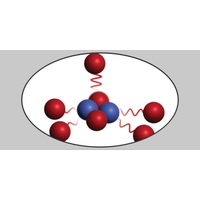
Scattering experiments show that the four extra neutrons in helium-8 can pair up and form a nuclear analog of a Bose-Einstein condensate.

Description of the Proton-Decaying 02+ Resonance of the α Particle

N. Michel, W. Nazarewicz, and M. Płoszajczak

Phys. Rev. Lett. 131, 242502 (2023) - Published 13 December, 2023

Theoretical descriptions of the first excited state of helium-4 are now consistent with experimental data.

Nuclear Charge Radius of Al26m and Its Implication for Vud in the Quark Mixing Matrix

P. Plattner et al.

Phys. Rev. Lett. 131, 222502 (2023) - Published 27 November, 2023

A measurement of the charge radius of an aluminum nucleus probes the assumption that there are only three families of quarks.

Validation of the Be10 Ground-State Molecular Structure Using Be10(p,pα)He6 Triple Differential Reaction Cross-Section Measurements

P. J. Li et al.

Phys. Rev. Lett. 131, 212501 (2023) - Published 21 November, 2023

The protons and neutrons in a nucleus can form clusters analogous to atoms in a molecule, even in the nuclear ground state.

QCD Equation of State of Dense Nuclear Matter from a Bayesian Analysis of Heavy-Ion Collision Data

Manjunath Omana Kuttan, Jan Steinheimer, Kai Zhou, and Horst Stoecker

Phys. Rev. Lett. 131, 202303 (2023) - Published 16 November, 2023

A Bayesian analysis of heavy-ion collisions at intermediate collision energies puts strong constraints on the equation of state at large chemical potential and zero temperature.

Deformation versus Sphericity in the Ground States of the Lightest Gold Isotopes

J. G. Cubiss et al.

Phys. Rev. Lett. 131, 202501 (2023) - Published 14 November, 2023

Charge radii of neutron-deficient gold isotopes measured with resonance-ionization laser spectroscopy display a unique pattern that has not been observed elsewhere in the nuclear chart.

Strong Evidence for N9 and the Limits of Existence of Atomic Nuclei

R. J. Charity, J. Wylie, S. M. Wang, T. B. Webb, K. W. Brown, G. Cerizza, Z. Chajecki, J. M. Elson, J. Estee, D. E. M. Hoff, S. A. Kuvin, W. G. Lynch, J. Manfredi, N. Michel, D. G. McNeel, P. Morfouace, W. Nazarewicz, C. D. Pruitt, C. Santamaria, S. Sweany, J. Smith, L. G. Sobotka, M. B. Tsang, and A. H. Wuosmaa

Phys. Rev. Lett. 131, 172501 (2023) - Published 27 October, 2023

A highly unstable nucleus that decays by emitting five protons has been observed, offering an extreme case for testing nuclear models.

Are Gluon Showers inside a Quark-Gluon Plasma Strongly Coupled? A Theorist’s Test

Peter Arnold, Omar Elgedawy, and Shahin Iqbal

Phys. Rev. Lett. 131, 162302 (2023) - Published 19 October, 2023

A theoretical study demonstrates that in-medium showers of high-energy gluons can be approximately treated as a sequence of individual splitting processes.

Final Results of GERDA on the Two-Neutrino Double-β Decay Half-Life of Ge76

M. Agostini et al. (GERDA Collaboration)

Phys. Rev. Lett. 131, 142501 (2023) - Published 3 October, 2023

The GERDA collaboration has made the most precise determination of the two-neutrino double-β decay half-life of 76Ge.

Tritium Beta Spectrum Measurement and Neutrino Mass Limit from Cyclotron Radiation Emission Spectroscopy

A. Ashtari Esfahani et al. (Project 8 Collaboration)

Phys. Rev. Lett. 131, 102502 (2023) - Published 6 September, 2023

The first frequency-based limit on the neutrino’s mass sets the stage for next-generation experiments.

Measurement of the Lifetime and Λ Separation Energy of HΛ3

S. Acharya et al. (ALICE Collaboration)

Phys. Rev. Lett. 131, 102302 (2023) - Published 5 September, 2023

Researchers have pinned down the binding energy and lifetime of the so-called hypertriton, a particle that could help explain the structure of neutron stars.

First Observation of Electron Scattering from Online-Produced Radioactive Target

K. Tsukada, Y. Abe, A. Enokizono, T. Goke, M. Hara, Y. Honda, T. Hori, S. Ichikawa, Y. Ito, K. Kurita, C. Legris, Y. Maehara, T. Ohnishi, R. Ogawara, T. Suda, T. Tamae, M. Wakasugi, M. Watanabe, and H. Wauke

Phys. Rev. Lett. 131, 092502 (2023) - Published 30 August, 2023

The first electron-scattering experiment off unstable radioisotopes marks a milestone for understanding the shape of exotic atomic nuclei.

Rare K40 Decay with Implications for Fundamental Physics and Geochronology

M. Stukel et al. (KDK Collaboration)

Phys. Rev. Lett. 131, 052503 (2023) - Published 31 July, 2023

Researchers revisit a neglected decay mode with implications for fundamental physics and for dating some of the oldest rocks on Earth and in the Solar System.

Microsecond Isomer at the N=20 Island of Shape Inversion Observed at FRIB

T. J. Gray et al.

Phys. Rev. Lett. 130, 242501 (2023) - Published 13 June, 2023

Researchers may have found an unstable sodium nucleus that has an excited state with a spherical wave function—an elusive prospect for the study of nuclear shapes.

Measurement of the α-Particle Monopole Transition Form Factor Challenges Theory: A Low-Energy Puzzle for Nuclear Forces?

S. Kegel et al.

Phys. Rev. Lett. 130, 152502 (2023) - Published 10 April, 2023

A new electron-scattering experiment challenges our understanding of the first excited state of the helium nucleus.

Discovery of New Isotope U241 and Systematic High-Precision Atomic Mass Measurements of Neutron-Rich Pa-Pu Nuclei Produced via Multinucleon Transfer Reactions

T. Niwase, Y. X. Watanabe, Y. Hirayama, M. Mukai, P. Schury, A. N. Andreyev, T. Hashimoto, S. Iimura, H. Ishiyama, Y. Ito, S. C. Jeong, D. Kaji, S. Kimura, H. Miyatake, K. Morimoto, J.-Y. Moon, M. Oyaizu, M. Rosenbusch, A. Taniguchi, and M. Wada

Phys. Rev. Lett. 130, 132502 (2023) - Published 31 March, 2023

Scientists have precisely measured the masses of 19 neutron-rich nuclei, discovering a new isotope of uranium in the process.

Direct Measurement of Hexacontatetrapole, E6 γ Decay from Fe53m

T. Palazzo, A. J. Mitchell, G. J. Lane, A. E. Stuchbery, B. A. Brown, M. W. Reed, A. Akber, B. J. Coombes, J. T. H. Dowie, T. K. Eriksen, M. S. M. Gerathy, T. Kibédi, T. Tornyi, and M. O. de Vries

Phys. Rev. Lett. 130, 122503 (2023) - Published 24 March, 2023

Observations deliver evidence of an exotic “sixth-order” electromagnetic transition in the gamma-ray emission of an iron isotope, a finding that could provide new ways to test nuclear models.

Final Result of the Majorana Demonstrator’s Search for Neutrinoless Double-β Decay in Ge76

I. J. Arnquist et al. (Majorana Collaboration)

Phys. Rev. Lett. 130, 062501 (2023) - Published 10 February, 2023

The final results from the Majorana Demonstrator’s search for neutrinoless double-beta decay in 76Ge set an upper limit on the half-life of this decay to be T1/2>8.3×1025 years.

Sign In to Your Journals Account

Filter

Section

Filter

Article Lookup

Enter a citation