Highlights

Improved Measurement of Solar Neutrinos from the Carbon-Nitrogen-Oxygen Cycle by Borexino and Its Implications for the Standard Solar Model

S. Appel et al. (Borexino Collaboration)

Phys. Rev. Lett. 129, 252701 (2022) - Published 12 December, 2022

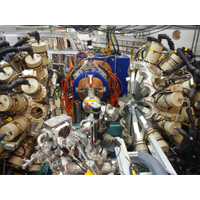
A study of neutrinos from the Sun has measured the signal from the so-called CNO cycle, offering a direct measure of the elemental abundances in the Sun’s core.

Observation of a Strongly Isospin-Mixed Doublet in Si26 via β-Delayed Two-Proton Decay of P26

J. J. Liu (刘嘉健) et al. (RIBLL Collaboration)

Phys. Rev. Lett. 129, 242502 (2022) - Published 8 December, 2022

The isospin mixing between two daughter states from the beta-delayed proton decay of 26P is three times larger than any previously observed mixing.

Crossing N=28 Toward the Neutron Drip Line: First Measurement of Half-Lives at FRIB

H. L. Crawford et al.

Phys. Rev. Lett. 129, 212501 (2022) - Published 14 November, 2022

Researchers have discovered the heaviest-known bound isotope of sodium and characterized other neutron-rich isotopes, offering important benchmarks for refining nuclear models.

Discovery of Na39

D. S. Ahn et al.

Phys. Rev. Lett. 129, 212502 (2022) - Published 14 November, 2022

Researchers have discovered the heaviest-known bound isotope of sodium and characterized other neutron-rich isotopes, offering important benchmarks for refining nuclear models.

Precision Determination of the Neutral Weak Form Factor of Ca48

D. Adhikari et al. (CREX Collaboration)

Phys. Rev. Lett. 129, 042501 (2022) - Published 20 July, 2022

A precision measurement of the neutral weak form factor of 48Ca provides a determination of its neutron skin thickness and constrains the symmetry energy of nuclear matter.

Experimental Demonstration of the Thin-Film Liquid-Metal Jet as a Charge Stripper

T. Kanemura, M. LaVere, R. Madendorp, F. Marti, T. Maruta, Y. Momozaki, P. N. Ostroumov, A. S. Plastun, J. Wei, and Q. Zhao

Phys. Rev. Lett. 128, 212301 (2022) - Published 24 May, 2022

A liquid-metal jet can strip electrons from a high-intensity, accelerator-based ion beam, increasing the beam’s charge and enhancing accelerator performance.

Universal Properties of Weakly Bound Two-Neutron Halo Nuclei

Masaru Hongo and Dam Thanh Son

Phys. Rev. Lett. 128, 212501 (2022) - Published 24 May, 2022

An effective field theory of a two-neutron halo nucleus uncovers unexpected universal behavior.

New Measurements of the Beam-Normal Single Spin Asymmetry in Elastic Electron Scattering over a Range of Spin-0 Nuclei

D. Adhikari et al. (PREX and CREX Collaborations)

Phys. Rev. Lett. 128, 142501 (2022) - Published 8 April, 2022

New measurements of the beam-normal single spin asymmetry in two calcium isotopes show clear differentiation between nuclei with Z<20 and recent results on lead nuclei.

Nanosecond-Scale Proton Emission from Strongly Oblate-Deformed Lu149

K. Auranen et al.

Phys. Rev. Lett. 128, 112501 (2022) - Published 16 March, 2022

An isotope of Lutetium, synthesized for the first time, is found to be the most oblate deformed proton emitter.

First Observation of the Four-Proton Unbound Nucleus Mg18

Y. Jin et al.

Phys. Rev. Lett. 127, 262502 (2021) - Published 22 December, 2021

Experimental detection of the unstable nucleus magnesium-18 hints at a weakening of the so-called magic number for the closed shell of eight neutrons.

Solving the Puzzles of the Decay of the Heaviest Known Proton-Emitting Nucleus Bi185

D. T. Doherty et al.

Phys. Rev. Lett. 127, 202501 (2021) - Published 12 November, 2021

Two complementary experiments confirm the inversion of high- and low-spin states in 185Bi, results that act as a key benchmark for the theory of proton emitters.

Experimental Evidence for an Attractive p−ϕ Interaction

S. Acharya et al. (ALICE Collaboration)

Phys. Rev. Lett. 127, 172301 (2021) - Published 20 October, 2021

Evidence for an attractive interaction between a proton and a ϕ meson is inferred from two-particle correlations.

Improved Neutron Lifetime Measurement with UCNτ

F. M. Gonzalez et al. (UCNτ Collaboration)

Phys. Rev. Lett. 127, 162501 (2021) - Published 13 October, 2021

An improved version of a “bottle” experiment lets researchers lower the uncertainty on this important parameter—but a tantalizing discrepancy remains.

Direct Measurement of the Astrophysical F19(p,αγ)O16 Reaction in the Deepest Operational Underground Laboratory

L. Y. Zhang et al.

Phys. Rev. Lett. 127, 152702 (2021) - Published 7 October, 2021

The first results from the Jinping Underground Nuclear Astrophysics particle accelerator refine a key reaction rate for the destruction of fluorine in stars.

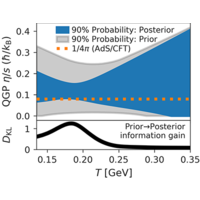
Phenomenological Constraints on the Transport Properties of QCD Matter with Data-Driven Model Averaging

D. Everett et al. (JETSCAPE Collaboration)

Phys. Rev. Lett. 126, 242301 (2021) - Published 17 June, 2021

New constraints on bulk and shear viscosities of a quark-gluon plasma are obtained from a Bayesian analysis of heavy-ion collision data.

Accurate Determination of the Neutron Skin Thickness of Pb208 through Parity-Violation in Electron Scattering

D. Adhikari et al. (PREX Collaboration)

Phys. Rev. Lett. 126, 172502 (2021) - Published 27 April, 2021

Researchers make the most precise measurement yet of the neutron distribution in a heavy nucleus, with implications for the structure of neutron stars.

Implications of PREX-2 on the Equation of State of Neutron-Rich Matter

Brendan T. Reed, F. J. Fattoyev, C. J. Horowitz, and J. Piekarewicz

Phys. Rev. Lett. 126, 172503 (2021) - Published 27 April, 2021

An analysis including the recent measurement of the neutron skin thickness of 208Pb by the PREX-2 experiment provides limits on both the radius and deformability of a 1.4 solar mass neutron star.

New α-Emitting Isotope U214 and Abnormal Enhancement of α-Particle Clustering in Lightest Uranium Isotopes

Z. Y. Zhang (张志远) et al.

Phys. Rev. Lett. 126, 152502 (2021) - Published 14 April, 2021

Researchers have observed the lightest uranium isotope to date, offering insight into models of nuclear structure.

Shape Changes in the Mirror Nuclei Kr70 and Se70

K. Wimmer et al.

Phys. Rev. Lett. 126, 072501 (2021) - Published 18 February, 2021

Two “mirror” nuclei, in which the numbers of neutrons and protons are interchanged, have markedly different shapes—a finding that defies current nuclear theories.

Observation of Coulomb-Assisted Nuclear Bound State of Ξ−–N14 System

S. H. Hayakawa et al. (J-PARC E07 Collaboration)

Phys. Rev. Lett. 126, 062501 (2021) - Published 11 February, 2021

Particle physicists have detected a short-lived nucleus containing two strange quarks, whose properties could provide new insights into the behavior of other nuclear particles.

Sign In to Your Journals Account

Filter

Section

Filter

Article Lookup

Enter a citation