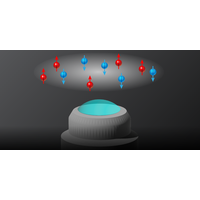
Highlights

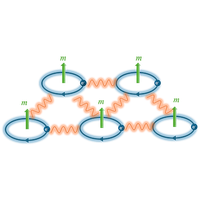
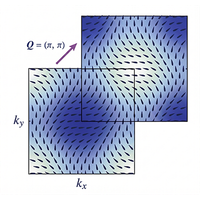
Identifying Instabilities with Quantum Geometry in Flat-Band Systems

Jia-Xin Zhang, Wen O. Wang, Leon Balents, and Lucile Savary

Phys. Rev. Lett. 136, 176504 (2026) - Published 30 April, 2026

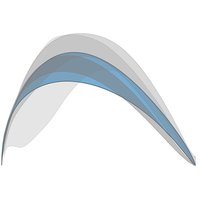
Despite the absence of a well-defined Fermi surface in flat-band systems, a nesting structure related to a geometric quantity constructed from the order parameter and the projection operator onto flat-band states replaces Fermi-surface nesting and determines the most favorable ordering across an arbitrary number of flat bands.

Extraction of the Collins-Soper Kernel from a Joint Analysis of Experimental and Lattice Data

Artur Avkhadiev, Valerio Bertone, Chiara Bissolotti, Matteo Cerutti, Yang Fu, Simone Rodini, Phiala Shanahan, Michael Wagman, and Yong Zhao

Phys. Rev. Lett. 136, 171902 (2026) - Published 29 April, 2026

Lattice QCD data when included along with the analysis of experimental data provides more accurate determinations of transverse-momentum dependent parton distribution related quantities.

Gradient Flow for Parton Distribution Functions: First Application to the Pion

Anthony Francis, Patrick Fritzsch, Robert V. Harlander, Rohith Karur, Jangho Kim, Jonas T. Kohnen, Giovanni Pederiva, Dimitra A. Pefkou, Antonio Rago, Andrea Shindler, André Walker-Loud, and Savvas Zafeiropoulos

Phys. Rev. Lett. 136, 171903 (2026) - Published 29 April, 2026

A gradient-flow-based lattice QCD method overcomes the long standing hinderance in computing higher Mellin moments of parton distribution functions due to power-divergent operator mixings.

Topological Robustness of Anyon Tunneling at ν=1/3

Adithya Suresh, Ramon Guerrero-Suarez, Tanmay Maiti, Shuang Liang, Geoffrey Gardner, Claudio Chamon, and Michael Manfra

Phys. Rev. Lett. 136, 176602 (2026) - Published 29 April, 2026

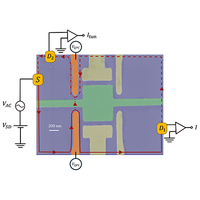
In a chiral Luttinger liquid the scaling exponent for the 1/3 edge mode is insensitive to perturbations within the incompressible fractional quantum Hall effect state and establishes the bulk-boundary correspondence for topologically ordered states.

Environment-Imposed Selection Rules for Nuclear-Spin Conversion of H2 in Molecular Crystals

Nathan McLane, LeAnh Duckett, and Leah G. Dodson

Phys. Rev. Lett. 136, 178002 (2026) - Published 29 April, 2026

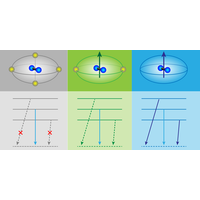
The transitions of hydrogen molecules embedded in a crystal depend on the surroundings—a behavior that could be used to tailor molecular quantum dynamics.

Superconductivity of Incoherent Electrons near the Relativistic Mott Transition in Twisted Dirac Materials

Veronika C. Stangier, Mathias S. Scheurer, Daniel E. Sheehy, and Jörg Schmalian

Phys. Rev. Lett. 136, 176501 (2026) - Published 28 April, 2026

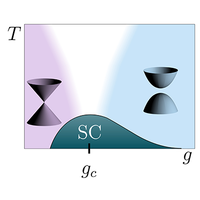
Superconductivity emerges in an unexpected way in twisted two-dimensional materials like graphene, even when there are essentially no mobile charge carriers at zero temperature.

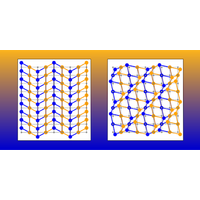
Ferroelectric Fractals: Switching Mechanism of Wurtzite AlN

Drew Behrendt, Atanu Samanta, and Andrew M. Rappe

Phys. Rev. Lett. 136, 176101 (2026) - Published 27 April, 2026

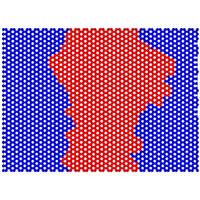
Multiscale modeling shows that ferroelectric switching in wurtzite ferroelectric aluminum nitride proceeds via 1D single columns of atoms propagating from a slow-moving 2D fractal-like domain wall.

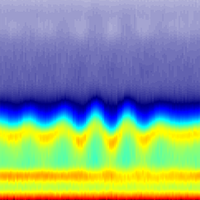
Understanding Mechanisms of Molecular Rare Events from Start to Finish

Rik S. Breebaart, Gianmarco Lazzeri, Roberto Covino, and Peter G. Bolhuis

Phys. Rev. Lett. 136, 168001 (2026) - Published 24 April, 2026

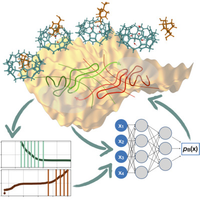
A novel path sampling strategy combined with deep learning computes the full committor function in complex systems with high free energy barriers.

Evidence of Cosmic-Ray Acceleration up to Sub-PeV Energies in the Supernova Remnant IC 443

Zhen Cao et al. (LHAASO Collaboration)

Phys. Rev. Lett. 136, 161002 (2026) - Published 23 April, 2026

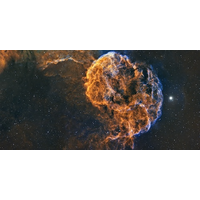
Recently detected gamma rays are best accounted for by relativistic protons accelerated by a millennia-old supernova.

Emergent Chirality and Enantiomeric Selectivity in Layered NbOX2 Crystals

Martin Gutierrez-Amigo, Claudia Felser, Ion Errea, and Maia G. Vergniory

Phys. Rev. Lett. 136, 166605 (2026) - Published 23 April, 2026

Theorists have identified a phase that could facilitate the switching of a crystal between its right-handed and left-handed versions.

Orbital Magnetization of Correlated States in Twisted Bilayer Transition Metal Dichalcogenides

Xiaoyu Liu, Chong Wang, Haoran Chen, Xiao-Wei Zhang, Ting Cao, and Di Xiao

Phys. Rev. Lett. 136, 166606 (2026) - Published 23 April, 2026

The modern theory of orbital magnetization, derived for noninteracting electrons, applied to strongly correlated states remains valid for Hartree–Fock states, so can be used to interpret magnetization in interacting moiré systems.

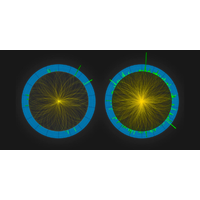
Observation of Suppressed Charged-Particle Production in Ultrarelativistic Oxygen-Oxygen Collisions

A. Hayrapetyan et al. (CMS Collaboration)

Phys. Rev. Lett. 136, 162301 (2026) - Published 22 April, 2026

Researchers at the Large Hadron Collider have observed evidence that indicates that even light nuclei can produce an exotic state of matter called quark–gluon plasma.

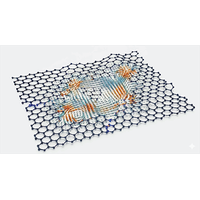
Quantum Transport Spectroscopy of Pseudomagnetic Field in Graphene

Divya Sahani, Sunit Das, Kenji Watanabe, Takashi Taniguchi, Amit Agarwal, and Aveek Bid

Phys. Rev. Lett. 136, 166604 (2026) - Published 22 April, 2026

A quantitative detection of strain-induced pseudomagnetic fields in graphene resolves a challenge in Dirac materials by showing that valley-antisymmetric gauge fields imprint a universal, symmetry-protected beating signature on the Shubnikov-de Haas oscillations in the magnetotransport.

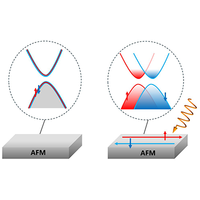
Floquet Spin Splitting and Spin Generation in Antiferromagnets

Bo Li, Ding-Fu Shao, and Alexey A. Kovalev

Phys. Rev. Lett. 136, 166701 (2026) - Published 22 April, 2026

Polarized light lifts spin degeneracy in conventional antiferromagnets without requiring spin-orbit coupling and generates steady-state pure spin current.

Time-domain Measurement of Auger Electron Dynamics in Xenon and Krypton Atoms after Giant Resonance Photoionization

Mahmudul Hasan, Jingsong Gao, Hao Liang, Yiming Yuan, Zach Eisenhutt, Ming-Shian Tsai, Ming-Chang Chen, Hans Jakob Wörner, Artem Rudenko, and Meng Han

Phys. Rev. Lett. 136, 163201 (2026) - Published 20 April, 2026

Attosecond soft-X-ray pump-probe spectroscopy of xenon and krypton atoms reveals two previously unobserved dynamical features in xenon that are inconsistent with lifetimes inferred from energy-domain measurements.

Quantum Signatures of Proper Time in Optical Ion Clocks

Gabriel Sorci, Joshua Foo, Dietrich Leibfried, Christian Sanner, and Igor Pikovski

Phys. Rev. Lett. 136, 163602 (2026) - Published 20 April, 2026

High-precision clocks based on quantum systems will work in a regime where a quantum description of proper time might be necessary.

Compatible Instability: Gauge Constraints of Elasticity Inherited by Electronic Nematic Criticality

W. Joe Meese and Rafael M. Fernandes

Phys. Rev. Lett. 136, 166501 (2026) - Published 20 April, 2026

A 19th-century theory of elasticity inspires a new way to analyze a quantum phase transition that has become central to modern quantum materials research.

Observation of In-Ice Askaryan Radiation from High-Energy Cosmic Rays

N. Alden et al. (ARA Collaboration)

Phys. Rev. Lett. 136, 151003 (2026) - Published 17 April, 2026

A South Pole neutrino experiment has measured radio waves induced by cosmic rays—thus demonstrating that its detection method works.

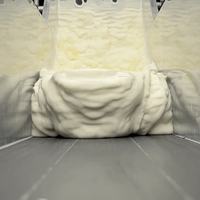
Liquid Dam: A Constant-Speed Regime in Gravity-Driven Shear-Thickening Suspensions

Alexis Bougouin, Henri Lhuissier, Yoël Forterre, and Bloen Metzger

Phys. Rev. Lett. 136, 158202 (2026) - Published 16 April, 2026

Flows of gravity-driven, shear-thickening fluids form a sharp, vertical front that advances at constant velocity independent of released volume, flow height, and slope.

Observing Spatial Charge and Spin Correlations in a Strongly Interacting Fermi Gas

Cyprien Daix, Maxime Dixmerias, Yuan-Yao He, Joris Verstraten, Tim de Jongh, Bruno Peaudecerf, Shiwei Zhang, and Tarik Yefsah

Phys. Rev. Lett. 136, 153402 (2026) - Published 15 April, 2026
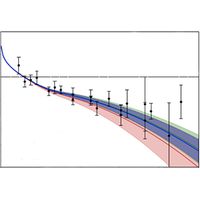
Snapshot measurements of cold-atom gases reveal hidden spin correlations that could force an update of some superconductivity theories.

Sign In to Your Journals Account

Filter

Section

Filter

Article Lookup

Enter a citation