Recent Articles

Experimental and numerical investigations on rotor noise in axial descending flight

Yuhong Li, Xiangtian Li, Han Wu, Peng Zhou, Xin Zhang, and Siyang Zhong

Phys. Rev. Fluids 8, 094803 (2023) - Published 28 September, 2023

We investigate the aerodynamic and aeroacoustic characteristics of a small-scale drone rotor operating in axial descending flight. The integrated aerodynamic forces and the far-field noise are measured by wind tunnel experiments. Then, near-field flow structures and corresponding noise source analysis are presented based on computational aeroacoustics (CAA) simulations. We found the unique acoustic feature of descending flight is the haystacking-like spectral humps, possibly caused by the interaction between the blade leading edge and the rotor wake.

Thermocapillary instability for a shear-imposed falling film

Arnab Choudhury and Arghya Samanta

Phys. Rev. Fluids 8, 094006 (2023) - Published 27 September, 2023

We investigate the thermocapillary instability of a three-dimensional shear-imposed viscous falling film for infinitesimal disturbances of arbitrary wavenumbers. The results show that the H-mode and the thermocapillary S-mode instabilities intensify, but the thermocapillary P-mode instability attenuates if a constant shear stress is applied in the co-flow direction. However, a completely opposite event occurs if it is applied in the counter-flow direction. Interestingly, as the imposed shear stress rises, the onset of instability for the H-mode and the onset of stability for the S-mode merge with each other and produce a single onset for the primary stability.

Impingement of a circular liquid jet on a moving wall

Xiaohe Liu, Neil J. Balmforth, Boris Stoeber, and Sheldon Green

Phys. Rev. Fluids 8, 094101 (2023) - Published 27 September, 2023

Fluid from a circular jet impacting onto a moving wall can spread out into a distinctive, thin, U-shaped lamella over a range of Reynolds numbers and wall-to-jet velocity ratios. The lamella travels a distance in the direction counter to the motion of the wall that is about one third of the width that is eventually reached far downstream. Scaling with either of these lengths collapses the footprint of the lamella on the moving surface onto a universal curve.

Flow past a rotationally oscillating cylinder near a plane wall

Soumarup Bhattacharyya, Raghavendra Naidu S, Kamal Poddar, and Sanjay Kumar

Phys. Rev. Fluids 8, 094102 (2023) - Published 27 September, 2023

The planar boundary affects the flow physics of the wake behind a rotationally oscillating cylinder about its axis and has potential practical engineering applications in areas dealing with fluid mixing and offshore and marine engineering. Wake modes in the transition regime of the flow behind a circular cylinder have been a topic of interest for a long time. In this study, various wake modes in the cross-plane and the spanwise plane are discussed for various gap distances (distance from the planar boundary to the cylinder) and cylinder forcing parameters (oscillation amplitude and frequency) of a rotationally oscillating cylinder.

Mass and momentum transport in the Tilted Rocket Rig experiment

K. Ferguson, K. M. Wang, and B. E. Morgan

Phys. Rev. Fluids 8, 094502 (2023) - Published 27 September, 2023

This work analyzes the characteristics of turbulent transport of mass and momentum in the tilted rocket rig configuration using large eddy simulation. The tilted rocket rig is a configuration that results in inclined Rayleigh-Taylor mixing with a two-dimensional mean flow. Analysis of the spatial distributions and budgets of turbulent quantities is analyzed, and a term frequently neglected in RANS modeling is identified as a dominant contribution in the transverse turbulent mass flux budget.

Drafting of two passive swimmer scale models for open-water races

B. Bolon, C. Pretot, C. Clanet, F. Larrarte, and R. Carmigniani

Phys. Rev. Fluids 8, 094802 (2023) - Published 27 September, 2023

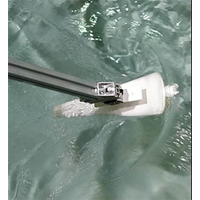
We examined interactions in water channels between swimmer-shaped objects moving at different speeds. Results showed that the ideal place for drafting is at the hip of a neighboring swimmer or just behind a lead swimmer. The former reduces drag by 30% and the latter reduces drag by 40%. Results were confirmed by CFD simulations.

Inverse identification of dynamically important regions in turbulent flows using three-dimensional convolutional neural networks

Eric Jagodinski, Xingquan Zhu, and Siddhartha Verma

Phys. Rev. Fluids 8, 094605 (2023) - Published 26 September, 2023

Extreme events in the near-wall region of turbulent flows play a central role in regulating the energy budget. These events are nonlinear in both space and time, and they are comprised of bursting near-wall streaks and coherent fluid packets being ejected away from/swept towards the wall. We demonstrate that Convolutional Neural Networks, which are capable of autonomously extracting three-dimensional spatial features, can identify such nonlinear coherent structures in a completely data-driven manner, with no a-priori knowledge of the underlying physics.

Assessing non-Oberbeck-Boussinesq effects of convection in cryogenic helium

Michal Macek, Georgy Zinchenko, Věra Musilová, Pavel Urban, and Jörg Schumacher

Phys. Rev. Fluids 8, 094606 (2023) - Published 26 September, 2023

We systematically analyze the breaking of Oberbeck-Boussinesq symmetry in Rayleigh-Bénard convection at high turbulence intensity due to the temperature dependence of material properties. As unique signature of the symmetry breaking, we take the shift of bulk temperatures measured in the center of the convection cell from values expected for symmetrical temperature profiles. We render maps of the shift measured in the phase diagram of the fluid-cold helium gas in this case using nonlinear regression by deep neural networks. This can be considered as a first step in disentangling the longstanding problem of experimentally identifying the ultimate regime of heat transport in turbulent flows.

Editorial: To Review Is to Be

Randall D. Kamien

Phys. Rev. Fluids 8, 090001 (2023) - Published 25 September, 2023

Investigating the origins of fluctuation forces on plates immersed in turbulent flows

Daniel Putt and Rodolfo Ostilla Mónico

Phys. Rev. Fluids 8, 094603 (2023) - Published 25 September, 2023

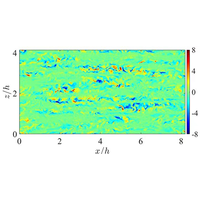
In this paper, we investigate the forces which arise between two plates in turbulent flow. We confirm previous studies which find an attractive force between plates. By simulating several plate sizes, we unravel the causes of the force, linking them primarily to vorticity.

Dynamics of the perceived velocity gradient tensor and its modelling

Ping-Fan Yang, Eberhard Bodenschatz, Guo Wei He, Alain Pumir, and Haitao Xu

Phys. Rev. Fluids 8, 094604 (2023) - Published 25 September, 2023

Describing the coarse-grained velocity gradients over the inertial range scales in turbulence is a challenging but essential part of turbulence modeling. Most models assume, based on dimensional arguments, that the inertial range dynamics involve only the eddy-turnover time associated with the length scale. By analyzing the velocity gradient perceived by four fluid tracers initially forming a regular tetrahedron, however, we find that due to the fast dynamics of the pressure gradient, the perceived velocity gradients at inertial-range scales involve also the Kolmogorov time, the smallest time scale of turbulence. Our finding calls for a re-examination of the dynamics of turbulence models.

Shape transitions of an elastic rod subjected to rotational driving in air

Takuro Kataoka, Taiju Yoneda, and Hirofumi Wada

Phys. Rev. Fluids 8, L092401 (2023) - Published 25 September, 2023

Pick up a green foxtail stem (a plant weed) and slowly rotate it between your fingers. The stem initially bends outward and whirls owing to its rotational inertia. However, as the rotational speed increases, the stem abruptly returns to its straight configuration, rapidly spinning about its axis (twirling). We combine experiment, simulation, and theory to reveal the underlying physical mechanism in this seemingly simple system. We quantify the effects of high-speed flow on the shape dynamics of a slender body by suitably designing a particular geometry of a flexible body in the elastohydrodynamic problem.

Azimuthal rotation induced by the Marangoni force makes small Leidenfrost droplets move in random zigzag directions

Ken Yamamoto (山本 憲)

Phys. Rev. Fluids 8, 093603 (2023) - Published 22 September, 2023

Tiny Leidenfrost droplets exhibit spontaneous motion on a flat, heated plate. Despite their lack of contact with the plate or exposure to external forces, the author discovered that these droplets move in random zigzag patterns. Through thermographic analysis, it was observed that a vertical “hot belt” appears on the droplet’s surface and it spins as if the droplet is a spinning top. This rotational behavior was attributed to internal flows generated within the droplet, originating from buoyancy and the Marangoni force. Finally, the rate of spin was quantitatively characterized in relation to the Marangoni relaxation time and the temperature of the substrate.

Momentum and heat flux events in compressible turbulent channel flows

Cheng Cheng, Wei Shyy, and Lin Fu

Phys. Rev. Fluids 8, 094602 (2023) - Published 22 September, 2023

The present study investigates the momentum and heat fluxes in subsonic/supersonic channel flows. By employing the spectral linear stochastic estimation, the near-wall fluxes are decomposed into large and small-scale components, and the logarithmic-region fluxes are decomposed into active and inactive parts, respectively. The findings of the present study demonstrate that the generation of the extreme events of the heat and momentum transfers in the near-wall region should be ascribed to the near-wall small-scale flow, and both the inactive and active components contribute to the mean fluxes in the logarithmic region.

Bubble breakup reduced to a one-dimensional nonlinear oscillator

Aliénor Rivière, Laurent Duchemin, Christophe Josserand, and Stéphane Perrard

Phys. Rev. Fluids 8, 094004 (2023) - Published 21 September, 2023

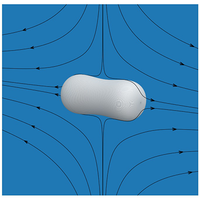
One of the main flow geometries into which bubbles break in turbulence are uniaxial straining flows. In this work we investigate bubble deformations and breakup in these flows, as a function of the Reynolds number, the Weber number (We, ratio of inertia and capillarity) and the initial bubble shape. We demonstrate that, even though linear stability analysis predicts the existence of a stable position for some We smaller than a critical value, bubbles can break due to their initial shape. Finally, we propose a reduced nonlinear model based on oblate-prolate bubble oscillations which quantitatively captures the deformations dynamics and bubble lifetime.

Axisymmetric gas–liquid displacement flow under a confined elastic slab

Gunnar G. Peng, Callum Cuttle, Christopher W. MacMinn, and Draga Pihler-Puzović

Phys. Rev. Fluids 8, 094005 (2023) - Published 21 September, 2023

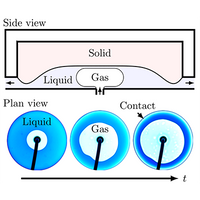
Lubrication flow in a soft Hele-Shaw cell formed by the narrow gap between a rigid boundary and a confined elastic solid can choke itself: The viscous pressure gradient squeezes the soft material which bulges into the flow path near the cell outlet, ultimately interrupting the flow if the flow rate is too large. Here we show that if the lubrication flow is driven by injected gas displacing the viscous liquid, then the critical injection flow rate above which choking occurs is increased by both the proximity to the cell rim of the gas-liquid interface and by the compression of the gas, resulting in a reduced tendency of the cell to choke.

Generation of laminar vortex rings by an impulsive body force

Rabia Sonmez, Robert A. Handler, Ryan Kelly, David B. Goldstein, and Saikishan Suryanarayanan

Phys. Rev. Fluids 8, 094701 (2023) - Published 21 September, 2023

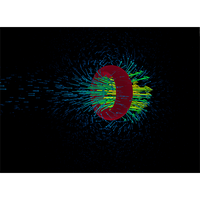
We show that laminar vortex rings can be generated by impulsive body forces having particular spatial and temporal characteristics. Numerical simulations and analytical models show that the strength of these rings can be accurately predicted by considering diffusion alone, despite the nonlinear nature of the generation process. It is found that when the duration of the force is less than a time scale based on the force radius and fluid viscosity, the ring circulation can be predicted accurately using an inviscid model.

Water entry of a flexible wedge: How flexural rigidity influences spray root and pressure wave propagation

Christine Gilbert, John Gilbert, and M. Javad Javaherian

Phys. Rev. Fluids 8, 090502 (2023) - Published 20 September, 2023

Wedge water entry serves as a key model to understand phenomena like high-speed craft slamming, seaplane landings, and diving aquatic birds. In this paper, wedge water entry experiments and simulations are used to examine how hydrodynamic loads, structural deflection, water contact lines, and rigid body motions are influenced by changes in the flexural rigidity of the wedge’s bottom panels. Preliminary findings indicate that the nondimensionalized spray root position and velocity versus time collapse despite significant variations in the panel’s flexural rigidity values (see figure for velocity curves). The study provides insights for future research and model improvements in water entry dynamics.

Depressurization-induced drop breakup through bubble growth

Christophe Pirat, Cécile Cottin-Bizonne, Choongyeop Lee, Stella M. M. Ramos, and Olivier Pierre-Louis

Phys. Rev. Fluids 8, L091601 (2023) - Published 19 September, 2023

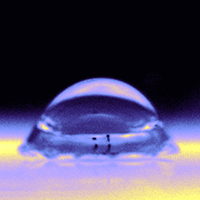
Drop breakup is often associated with boiling or violent impacts onto targets. We report on experiments where the decrease of ambient pressure triggers the growth of a bubble in a drop that sits on a textured hydrophobic surface. We find a transition from top-breakup to triple-line breakup depending on the initial contact angle of the drop, which is captured by a model based on inertial dynamics.

Pore-scale statistics of temperature and thermal energy dissipation rate in turbulent porous convection

Ao Xu, Ben-Rui Xu, and Heng-Dong Xi

Phys. Rev. Fluids 8, 093504 (2023) - Published 18 September, 2023

Through high-resolution pore-scale simulations, we uncover that impermeable solid porous matrices significantly influence the heat and fluid flow within these materials. We discover that as porosity decreases, temperature fluctuations increase; unlike porous materials with matrices being permeable to heat flux, impermeable ones cause less organized flow patterns. Furthermore, intense thermal energy dissipation mainly occurs near the surfaces of the porous material, and exhibits more intermittency compared to traditional convection systems.

Sign In to Your Journals Account

Filter

Recent Issues

Vol. 11, Iss. 10
October 2026
Vol. 11, Iss. 9
September 2026
Vol. 11, Iss. 8
August 2026
Vol. 11, Iss. 7
July 2026
Category
Article Type
Section

Filter

Article Lookup

Enter a citation