Recent Articles

Hydrodynamic collapse of the Leidenfrost vapor layer

Dana Harvey and Justin C. Burton

Phys. Rev. Fluids 8, 094003 (2023) - Published 18 September, 2023

During the Leidenfrost effect, a stable vapor film separates a hot solid from an evaporating liquid. As the solid cools, the vapor layer is metastable, and can undergo a violent collapse accompanied by explosive boiling of the liquid. We provide insight into this failure mechanism using a computational model with hydrodynamics, thermodynamics, and rapid evaporation of the liquid phase. By varying both liquid and solid properties, we find that inertial forces, which are typically ignored in theoretical treatments of the vapor layer, are likely responsible for initiating the instability leading to failure.

Collapse dynamics of two-dimensional dry and immersed granular columns of elongated grains

Nathan Coppin, Michel Henry, Miguel Cabrera, Emilien Azéma, Frédéric Dubois, Vincent Legat, and Jonathan Lambrechts

Phys. Rev. Fluids 8, 094303 (2023) - Published 18 September, 2023

The collapse of a granular column is a benchmark case for the study of granular materials. In this work, the collapse dynamics of two-dimensional columns of elongated grains are numerically investigated in dry and immersed conditions. The focus is set on the orientation of the grains and its influence on the behavior of the column. An energy-based approach suggests the influence of grain shape on mobility is limited to the prefactor of a power-law.

Fragmentation and coalescence dynamics of non-wetting blobs during immiscible two-phase flows in porous media

L. Talon, R. Bouguemari, A. Yiotis, and D. Salin

Phys. Rev. Fluids 8, 093602 (2023) - Published 15 September, 2023

We study experimentally the dynamics of non-wetting blobs flowing simultaneously with a wetting fluid in a quasi-two-dimensional porous medium consisting of random obstacles. The blobs continuously merge forming larger ones (coalescence) and breakup into smaller ones (fragmentation) leading to an overall dynamic equilibrium between the two processes. In this work, we analyze the probability functions for coalescence and breakup as a function of blob sizes and total flow rate.

Reconfiguration and oscillations of a vertical, cantilevered sheet subject to vortex shedding behind a cylinder

J. John Soundar Jerome, Yohann Bachelier, Delphine Doppler, Christoph Lehmann, and Nicolas Rivière

Phys. Rev. Fluids 8, 093801 (2023) - Published 15 September, 2023

Mechanical structures in nature and in applications are often very flexible and also, are exposed to vortex-laden flows. While vortex-induced-vibration is one of the most commonly studied fluid-structure interactions, we explore what can be called vortex-forced-vibrations of a flexible sheet to provide physical insights on the average reconfiguration, vibration amplitude, and frequency response of a thin sheet forced by von Karman vortices.

Transition to fully developed turbulence in quasi-two-dimensional electromagnetic layers

Seunghwan Shin, Filippo Coletti, and Nicholas Conlin

Phys. Rev. Fluids 8, 094601 (2023) - Published 15 September, 2023

In forced two-dimensional flows, the energy input is not only balanced by viscous dissipation within the fluid, but also by friction along the boundaries. In this study, we investigate the classic experimental realization of quasi-2D turbulence in electromagnetically driven layers of conducting fluids and confirm that friction dominates over viscous dissipation in such systems. The emergence of fully developed turbulence is governed by the frictional Reynolds number (Reα) rather than the commonly used viscous Reynolds number (Re), as evidenced by the fact that descriptors from 58 cases of different forcing in five layer configurations collapse onto master curves when plotted against Reα.

Force balances in strong-field magnetoconvection simulations

Imogen G. Cresswell, Evan H. Anders, Benjamin P. Brown, Jeffrey S. Oishi, and Geoffrey M. Vasil

Phys. Rev. Fluids 8, 093503 (2023) - Published 14 September, 2023

We study force balances in two-dimensional Rayleigh-Benard simulations with a large range of imposed background magnetic fields. We find two main regimes, a magnetically constrained regime where the linear Lorentz force dominates, and a magnetically influenced regime where the nonlinear Lorentz force heavily influences dynamics, meaning that classic hydrodynamical flow patterns are not achieved at the highest Rayleigh number studied in this work. Despite the impact of the nonlinear Lorentz force on the dynamics, we find classical hydrodynamic scaling of the Nusselt number and also derive scaling laws for the magnetic field in both of these regimes.

Nonlinear effects of variable bathymetry and free surface on mini-tsunamis generated by a moving ship

Jinyu Yao, Harry B. Bingham, and Xinshu Zhang

Phys. Rev. Fluids 8, 094801 (2023) - Published 14 September, 2023

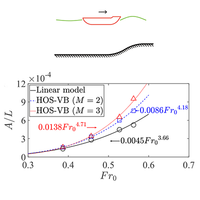
Mini-tsunamis are generated when a ship travels through a depth change and can cause significant coastline erosion. It is found that the amplitude of mini-tsunami and wavelength are increased by the higher order bottom and free-surface nonlinearities, and those effects are more significant for a fast-traveling ship in a narrow channel. Our work can shed light on nonlinear effects in the generation of mini-tsunamis, and advance the development of warning systems for coastal erosion owing to the ship-generated waves.

Similarity relations for laminar pipe flows of Bingham fluids in friction coordinates

Fabio Ramos and Gabriel Sanfins

Phys. Rev. Fluids 8, L091301 (2023) - Published 14 September, 2023

We introduce similarity relations and symmetry groups for the analysis of laminar Bingham fluid flows, presenting a valuable new expression for calculating the friction factor, particularly when pressure gradient data are available. Notably, we highlight the significance of friction coordinates as the most suitable framework for unraveling the complexities of Bingham plastic fluids.

Phase-field modeling of complex interface dynamics in drop-laden turbulence

Alessio Roccon, Francesco Zonta, and Alfredo Soldati

Phys. Rev. Fluids 8, 090501 (2023) - Published 12 September, 2023

Phase-field modeling of drop dynamics and direct numerical simulation of drop-laden turbulent flow are used to examine the complex topological changes of the dispersed phase — breakage and coalescence — and to determine the evolving drop size distribution. Potentials and perspectives for further development of the phase-field method to model mass transfer, heat transfer, and Marangoni effects due to thermocapillarity and surfactants are also discussed.

Small scale quasigeostrophic convective turbulence at large Rayleigh number

Tobias G. Oliver, Adrienne S. Jacobi, Keith Julien, and Michael A. Calkins

Phys. Rev. Fluids 8, 093502 (2023) - Published 12 September, 2023

We investigate the most turbulent simulations to date for rapidly rotating convection in a plane layer geometry. The results show that the flow remains viscously controlled across the investigated parameter space, and that the length scales present within the flow remain comparable to those predicted by linear theory.

Rogue nanowaves: A route to film rupture

James E. Sprittles, Jingbang Liu, Duncan A. Lockerby, and Tobias Grafke

Phys. Rev. Fluids 8, L092001 (2023) - Published 11 September, 2023

The rupture of thin liquid films on solid surfaces is conventionally assumed to be driven by intermolecular forces, in the so-called spinodal regime. Here, a theoretical framework is created for the experimentally observed thermal regime, in which fluctuation-induced nanowaves rupture films. Fluctuating hydrodynamics is able to capture this regime and its predictions are verified by molecular simulations. Rare-event theory is then applied to this field for the first time to reveal a novel picture of how and when rogue nanowaves create rupture.

How the fine structure of the electric double layer and the flow affect morphological instability in electrodeposition

I. Rubinstein and B. Zaltzman

Phys. Rev. Fluids 8, 093701 (2023) - Published 7 September, 2023

Dendrite formation due to morphological instability in cathodic electrodeposition of a metal and related fluid flows are investigated. We show that the electric double layer fine structure and the finite electrode reaction rate regularize the electrodeposition front short-wave singularity and select a range of unstable perturbation modes. The critical wavelength corresponds to the fastest growing mode and scales with the electric double layer width and the reaction-diffusion length. The emerging electroconvective (electroosmotic) flow in the nonequilibrium regime selects the cathodic diffusion layer width as the dominant length scale for morphological instability and emerging dendrites.

Effectiveness of the dispersed-phase continuum model for investigating the airflow in the print gap of inkjet printers

A. F. V. de A. Aquino, S. G. Mallinson, G. D. McBain, G. D. Horrocks, C. M. de Silva, and T. J. Barber

Phys. Rev. Fluids 8, 094302 (2023) - Published 7 September, 2023

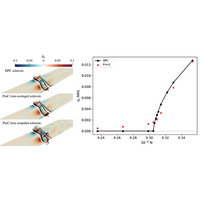
Numerical simulations using the dispersed-phase continuum (DPC) and the particle-in-cell (PinC) models were performed to characterize the onset of instability where the airflow in the print gap of inkjet printers becomes nonuniform in the spanwise direction. The results indicated that the baseflow shifts from a uniform flow field to a standing wave regime at a specific number density, which characterizes a supercritical pitchfork bifurcation. Furthermore, the comparison between both models showed that the DPC technique effectively computed the mean flow field with a reduction of up to 1000x in processing time.

Interplay of viscosity and wettability controls fluid displacement in porous media

Saideep Pavuluri, Ran Holtzman, Luqman Kazeem, Malyah Mohammed, Thomas Daniel Seers, and Harris Sajjad Rabbani

Phys. Rev. Fluids 8, 094002 (2023) - Published 6 September, 2023

The interplay between viscosity ratio and contact angle for viscous-dominated flows in a two-dimensional porous medium is studied with Direct Numerical Simulations. Viscous fingering, intermediate flow, and compact displacement regimes were examined for various viscosity ratios at the sample scale. Even at the pore-scale, various pore filling mechanisms were found. For imbibition and drainage, cooperative filling occurs at large viscosity ratios. At low viscosity ratios, film flow (strong imbibition), and unstable bursts (strong drainage) were seen. Changes in pore filling mechanisms occurring at the same contact angle indicates the viscosity ratio impact on effective wettability variation.

Propagation of air fingers into an elastorigid Y-bifurcation

Haolin Li, Anne Juel, Finn Box, and Draga Pihler-Puzović

Phys. Rev. Fluids 8, 094001 (2023) - Published 5 September, 2023

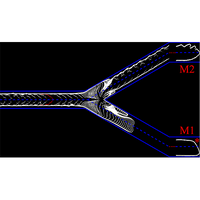
An air finger is injected with constant volumetric flow rate into a bifurcating liquid-filled Hele-Shaw channel topped with an elastic sheet, to study airway reopening. Imposing collapsed channel configurations, we observe finger propagation in straight parts of the channel that are reflected in finger morphologies. The mechanics involved also controls recovery of steady states post-bifurcation, and, in some regimes, can lead to multiple reopening scenarios downstream from the bifurcation for experimentally indistinguishable fingers in the main channel. Our results suggest that steady state propagation is unlikely to be recovered between bifurcations in practical networks.

Experimental estimation of turbulence modulation in droplet-laden two-phase jet

Hao Wu, Zhenyu Zhang, Fujun Zhang, Kun Wu, and William L. Roberts

Phys. Rev. Fluids 8, 094301 (2023) - Published 5 September, 2023

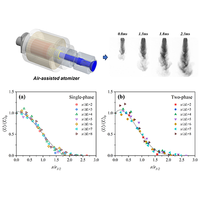
Turbulent flows laden with liquid droplets are known as a member of turbulent dispersed multiphase flows (TDMF) that occurs in many natural, chemical, and industrial processes. In this research, we utilize a phase/Doppler particle analyzer to experimentally evaluate the impact of droplets generated from air-assisted atomization on the turbulent modulation of continuous gas-phase flow. The presence of liquid droplets affects gas-phase turbulence in three distinct manners: increasing fluctuation velocity, expanding the region with steep fluctuation velocity gradients, and causing axial stretching within the shear region.

Predicting extreme events in a data-driven model of turbulent shear flow using an atlas of charts

Andrew J. Fox, C. Ricardo Constante-Amores, and Michael D. Graham

Phys. Rev. Fluids 8, 094401 (2023) - Published 5 September, 2023

Dynamical systems with extreme events are difficult to capture with data-driven modeling, due to the relative scarcity of data within extreme events. A recently developed technique called CANDyMan decomposes the system into separate charts containing extreme and non-extreme states, learning dynamical models in each chart via time-mapping neural networks, then stitching the charts into a global dynamical model. We apply CANDyMan to a low-dimensional model of turbulent shear flow which undergoes extreme intermittent quasi-laminarization events. We show that the multi-chart model better forecasts the dynamical system evolution than either a standard single-chart model or Koopman-based model.

Comment on “Effect of viscous-convective subrange on passive scalar statistics at high Reynolds number”

Dhawal Buaria and Katepalli R. Sreenivasan

Phys. Rev. Fluids 8, 097601 (2023) - Published 5 September, 2023

Diffusive and convective dissolution of carbon dioxide in a vertical cylindrical cell

Daniël P. Faasen, Farzan Sepahi, Dominik Krug, Roberto Verzicco, Pablo Peñas, Detlef Lohse, and Devaraj van der Meer

Phys. Rev. Fluids 8, 093501 (2023) - Published 1 September, 2023

Dissolution and mass transfer of carbon dioxide gas into liquid barriers plays a vital role in many environmental and industrial applications. We study the downward dissolution and propagation dynamics of CO2 into a vertical water barrier confined to a narrow vertical glass cylinder, using both experiments and direct numerical simulations (DNS). Tracking the CO2 front propagation in time leads to discovery of two distinct transport regimes: A purely diffusive and an enhanced diffusive regime. Using DNS, we explain the propagation dynamics of these two transport regimes, namely by disentangling the contributions of diffusion and convection to the propagation of the CO2 front.

Caterpillar like motion of droplet in a shear flow

A. Chahine, J. Sebilleau, R. Mathis, and D. Legendre

Phys. Rev. Fluids 8, 093601 (2023) - Published 1 September, 2023

A special caterpillar like motion is reported for glycerin droplets sliding on a horizontal hydrophobic substrate under the influence of a shear flow. The droplet elongates in the flow direction adopting a rivulet shape with the development of waves resulting in a caterpillar like motion.

Sign In to Your Journals Account

Filter

Recent Issues

Vol. 11, Iss. 10
October 2026
Vol. 11, Iss. 9
September 2026
Vol. 11, Iss. 8
August 2026
Vol. 11, Iss. 7
July 2026
Category
Article Type
Section

Filter

Article Lookup

Enter a citation