Recent Articles

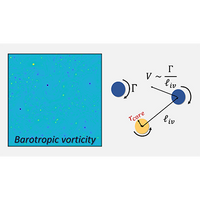
Vortex core radius in baroclinic turbulence: Implications for scaling predictions

Gabriel Hadjerci and Basile Gallet

Phys. Rev. Fluids 8, 094501 (2023) - Published 1 September, 2023

We derive a scaling prediction for the typical core radius of the isolated vortices that span baroclinic turbulence. This refinement of the vortex-gas theory does not impact the scaling behavior of the eddy diffusivity for linear bottom drag. By contrast, it induces a new scaling-law for the eddy diffusivity in the ultra-low-quadratic-drag regime. We validate these predictions numerically.

Effect of hydrodynamic dispersion on spherical reaction front dynamics in porous media

Pratyaksh Karan, Uddipta Ghosh, Fabian Brau, Yves Méheust, and Tanguy Le Borgne

Phys. Rev. Fluids 8, 084502 (2023) - Published 31 August, 2023

Reaction fronts are regions in a flow field where two solutes, brought together by advection and dispersion, mix and react. Often, injection of one solute into a porous reservoir of the other manifests in a spherical reaction front, the dynamics of which is addressed here. In a porous medium, mixing between the two solutes is greatly enhanced because of hydrodynamic dispersion, resulting in a more advanced position of the front, while the rate of reaction also gets augmented significantly during the initial transient regimes. We show that when dispersion is sufficiently strong, these early enhancements are also maintained at larger times, when the front inevitably reaches a stationary state.

Droplet dynamics in Burgers vortices. I. Mass transport

Orr Avni and Yuval Dagan

Phys. Rev. Fluids 8, 083604 (2023) - Published 30 August, 2023

Intricate connections involving vortical flow patterns, droplet relaxation times, drag forces, and transport processes are examined using a Lagrangian particle tracking approach. We focus on mass transport and phase transition in droplets within Burgers vortices, capturing the essence of small-scale structures within turbulent flows. Thermodynamic gradients generate complex dynamics; droplets may stabilize around the vortex, revealing a periodic solution only when a high pressure drop generates a condensation core. This dynamical periodicity may suggest droplet clustering induced by phase change, while the emergence of the condensation region reveals a distinct bifurcation point.

Droplet dynamics in Burgers vortices. II. Heat transfer

Orr Avni and Yuval Dagan

Phys. Rev. Fluids 8, 083605 (2023) - Published 30 August, 2023

This second part of a paper series extends the previous model to account for the role of heat transfer in the equilibrium and transient response of droplet-vortex systems, serving as a case model for a broader range of interactions between droplets and vortical flows. The presented scaling analysis elucidates the coupling between heat and mass transport mechanism and uncovers the timescale characteristic of each within vortical structures. We analyze the extent to which nonlinear transport processes play a significant role in the droplet’s dynamic response. This analysis may serve as an estimation for the thermodynamic conditions in which the incorporation of nonlinear effects is substantial.

Free evolution vortex in a magnetic field

Zhao-Bo Wang, Long Chen, Yan-Wu Cao, Chun-Xu Ke, Juan-Cheng Yang, and Ming-Jiu Ni

Phys. Rev. Fluids 8, 083703 (2023) - Published 30 August, 2023

Numerical verification is presented of Davidson’s theoretical proposal that the angular momentum parallel to the magnetic field of a single vortex is conserved whereas the perpendicular angular momentum decays exponentially during a free-decay evolution. Theoretical scaling laws for the linear process and the nonlinear process of a single MHD vortex decay are given. It is found that the initial linear phase of a single MHD vortex decay characterized by the dominance of the Lorentz force over the inertial force exists locally. However, the whole evolution is closer to the global nonlinear behavior of a single vortex decay, for which the viscous dissipation is almost equal to the Joule dissipation.

Steric effects in induced-charge electro-osmosis for strong electric fields

J. Galen Wang, Daniel R. Ladiges, Ishan Srivastava, Sean P. Carney, Andy J. Nonaka, Alejandro L. Garcia, and John B. Bell

Phys. Rev. Fluids 8, 083702 (2023) - Published 29 August, 2023

We investigate the role of steric effects on induced-charge electro-osmosis, focusing on flow field and charge distribution. Steric effects are crucial mesoscale phenomena, but they are either neglected or overly simplified in previous theoretical and computational studies. Using a hybrid Eulerian-Lagrangian method, our simulations highlight the importance of the steric effects, which lead to intriguing characteristics at strong electric fields that have not been captured by the traditional continuum method, including a suppression of velocity scaling and the overcharging of co-ions to the surface charge.

Molecular-gas-dynamics simulations of turbulent Couette flow over a mean-free-path-scale permeable substrate

Ryan M. McMullen, Michael C. Krygier, John R. Torczynski, and Michael A. Gallis

Phys. Rev. Fluids 8, 083401 (2023) - Published 28 August, 2023

Turbulent boundary layers on reentry vehicles may be modified by roughness, permeability, and noncontinuum effects induced by the fibrous thermal-protection-system (TPS) material coating its surface. To investigate these effects, we perform molecular-gas-dynamics (MGD) simulations of turbulent Couette flow over a substrate inspired by TPS materials. We find that rarefaction within the substrate can significantly increase its permeability, while in the free portion of the channel, we observe surprisingly good agreement between our MGD simulations and the Navier-Stokes equations, even when the local Knudsen number approaches the value typically associated with breakdown of the continuum assumption.

Optimal heat transport in rotating Rayleigh-Bénard convection at large Rayleigh numbers

Robert Hartmann, Guru S. Yerragolam, Roberto Verzicco, Detlef Lohse, and Richard J. A. M. Stevens

Phys. Rev. Fluids 8, 083501 (2023) - Published 28 August, 2023

Moderate rotation is able to enhance the heat transport in (rotating) Rayleigh-Bénard convection. While the heat transport can significantly exceed the nonrotating value for Rayleigh numbers Ra≲5×10⁸, no or only little enhancement remains at larger Ra. Here, we aim to identify the reason for the vanishing heat transport enhancement and its different behavior towards large Ra: How is the loss of enhancement related to the onset of geostrophic turbulence? What role does rotation-induced shearing at the plates play in this context?

Floquet stability and Lagrangian statistics of a nonlinear time-dependent ABC dynamo

Calum S. Skene and Steven M. Tobias

Phys. Rev. Fluids 8, 083701 (2023) - Published 28 August, 2023

Our paper investigates the modification of the Lagrangian statistics of a fluid flow by a magnetic field undergoing dynamo action, for a family of flows generated by spatially periodic oscillating-in-time forcings. A Floquet stability analysis shows that an exact periodic solution to these flows becomes unstable, leading to a turbulent fluid flow regime. By calculating the finite-time-Lyapunov-exponents we can then characterize the amount of stretching and chaos present in these flows. In all cases considered, we show that the amount of chaos in the saturated dynamo flow is reduced from that of the underlying turbulent flow, providing insight into how these dynamos saturate.

Controlled collision of Hele-Shaw drops in extensional flow using a six-port microfluidic device

Aysan Razzaghi and Arun Ramachandran

Phys. Rev. Fluids 8, 084201 (2023) - Published 28 August, 2023

We present a strategy to use hydrodynamic force in a six-port microfluidic channel to steer two drops towards collision in an extensional flow. By implementing an analytical solution in the control loop, the flow rates that are required to steer the drops toward their respective target points can be determined using a single control parameter. This parameter is a dimensionless time scale that can manipulate the drops either by engaging all six ports to create a flow field with two stagnation points, or by deactivating some of the ports and creating a linear extensional flow.

Genesis of thermalization in the three-dimensional, incompressible, Galerkin-truncated Euler equation

Sugan Durai Murugan and Samriddhi Sankar Ray

Phys. Rev. Fluids 8, 084605 (2023) - Published 28 August, 2023

The long-time solutions of the Galerkin-truncated, three-dimensional, incompressible Euler equations relax to an absolute equilibrium state. We uncover the mechanism that triggers thermalization in physical space and conclude with a numerical prescription to suppress the oscillations that precede onset of thermalization in numerical simulations of the Euler equation.

Direct numerical simulations of compressible isothermal turbulence in a periodic box: Reynolds number and resolution-level dependence

Yoshiki Sakurai and Takashi Ishihara

Phys. Rev. Fluids 8, 084606 (2023) - Published 28 August, 2023

Direct numerical simulations (DNS) of compressible isothermal turbulence (CIT) at turbulent Mach number around 0.3 in a periodic box with the number of grid points and the Taylor microscale Reynolds number up to 4096^3 and 853 are conducted using an 8th-order compact finite difference scheme. The DNS results show that the solenoidal component of the energy spectrum and the solenoidal dissipation rate obtained from CIT agree well with those from incompressible turbulence when normalized by solenoidal quantities. Results with high spatial resolution show that the dilatational component of the energy spectrum for CIT exhibits a power law at high wavenumbers due to the appearance of shocklets.

Asymptotic scaling laws for the skin friction of zero pressure gradient boundary layers

Hamidreza Anbarlooei, Fabio Ramos, and Daniel O. A. Cruz

Phys. Rev. Fluids 8, 084607 (2023) - Published 28 August, 2023

This study offers a detailed description of momentum exchange in turbulent boundary layer flows at extreme Reynolds numbers. We introduce a new power-law formula for skin-friction, revealing insights into the boundary layer’s asymptotic thickness. Our findings align with experimental data, suggesting a universal transition in wall-bounded flows at high Reynolds numbers.

Erratum: Drag force on spherical particles trapped at a liquid interface [Phys. Rev. Fluids 7, 124001 (2022)]

Zhi Zhou, Petia M. Vlahovska, and Michael J. Miksis

Phys. Rev. Fluids 8, 089901 (2023) - Published 28 August, 2023

Spatial distribution of coherent structures in a self-similar axisymmetric turbulent wake

Weijun Yin, Shancong Tao, Koji Nagata, Yasumasa Ito, Yasuhiko Sakai, and Yi Zhou

Phys. Rev. Fluids 8, 084603 (2023) - Published 24 August, 2023

The coherent structures in a self-similar axisymmetric turbulent wake are orderly distributed and also regularly organized. There is an intrinsic connection between the self-similar distributions of the one-point statistics and the spatial distribution of the coherent structures. We confirm the well-known assertion that coherent structures are “the sinews and muscles of fluid motions”.

Enhancing the shear-stress-transport turbulence model with symbolic regression: A generalizable and interpretable data-driven approach

Chenyu Wu and Yufei Zhang

Phys. Rev. Fluids 8, 084604 (2023) - Published 24 August, 2023

Data-driven Reynolds averaged Navier-Stokes (RANS) turbulence models for separated flows based on black-box machine learning models have been widely researched in recent years. However, they often lack generalizability and interpretability. In this work, field inversion and symbolic regression (FISR) are used to develop an interpretable and generalizable data-driven RANS turbulence model. The proposed turbulence model shows good accuracy in various test cases that are completely distinct from its training set.

Underlying physics of mixing efficiency for shear-forced, stratified turbulence

Young R. Yi and Jeffrey R. Koseff

Phys. Rev. Fluids 8, 084803 (2023) - Published 23 August, 2023

Large scale ocean simulations employ eddy viscosities and diffusivities to represent the irreversible mixing of momentum and scalars due to unresolved scales of motion. These closures often require a prescription of the ratio of the vertical buoyancy flux to the rate of turbulence production (i.e., mixing efficiency). In this paper, we demonstrate that this ratio is strongly sensitive to the turbulence generation mechanism by considering the Reynolds stress and buoyancy flux budgets as a function of the turbulent Froude number.

Measurements of an axisymmetric hypersonic shear-layer instability on a cone-cylinder-flare in quiet flow

Elizabeth K. Benitez, Matthew P. Borg, Pedro Paredes, Steven P. Schneider, and Joseph S. Jewell

Phys. Rev. Fluids 8, 083903 (2023) - Published 22 August, 2023

Compression corners are commonly present along aircraft, such as at control surfaces, and can cause shock/boundary-layer interactions when the vehicle moves at supersonic or hypersonic speeds. By generating a separation bubble at the corner, a shear layer is present in the flow, which can potentially amplify instabilities, leading to a boundary-layer transition downstream of reattachment. We show, through experiments conducted under low-disturbance Mach-6 flow, the amplification of such a shear-layer instability by comparing measurements from two cone-cylinder-flare geometries with computations of the same.

Reinforcement-learning-based parameter optimization of a splitter plate downstream in cylinder wake with stability analyses

Chengyun Wang, Peng Yu, and Haibo Huang

Phys. Rev. Fluids 8, 083904 (2023) - Published 22 August, 2023

We employ a single-step Deep Reinforcement Learning (DRL) algorithm to optimize the spatial location and length of a downstream splitter plate, aimed at suppressing vortex shedding behind a cylinder. Contrary to common sense, positioning the splitter plate laterally rather than directly in the posterior of the cylinder can make a greater influence on the stability of the entire flow field, even with a shorter length. By integrating DRL techniques, stability analysis via dynamic mode decomposition (DMD), and comparisons with Bayesian optimization (BO), the study highlights the potential of this DRL algorithm for advanced optimization in fluid dynamics.

Drag on a partially immersed sphere at the capillary scale

Robert Hunt, Ze Zhao, Eli Silver, Jinhui Yan, Yuri Bazilevs, and Daniel M. Harris

Phys. Rev. Fluids 8, 084003 (2023) - Published 22 August, 2023

Drag on a sphere in a steady flow is an important and thoroughly studied problem in fluid dynamics, yet relatively little work includes the effects of a free surface. Through experiments and simulations, we characterize the drag on a sphere partially immersed at an air-water interface as a function of submergence depth. The presence of the free surface can induce drag forces several times greater than the equivalent fully submerged case, with pronounced hysteretic effects strongly influenced by the sphere’s wettability. We ascribe the drag increase to an asymmetric pressure loading on the sphere that persists for flows both above and below the minimum capillary-gravity wave speed.

Sign In to Your Journals Account

Filter

Recent Issues

Vol. 11, Iss. 10
October 2026
Vol. 11, Iss. 9
September 2026
Vol. 11, Iss. 8
August 2026
Vol. 11, Iss. 7
July 2026
Category
Article Type
Section

Filter

Article Lookup

Enter a citation